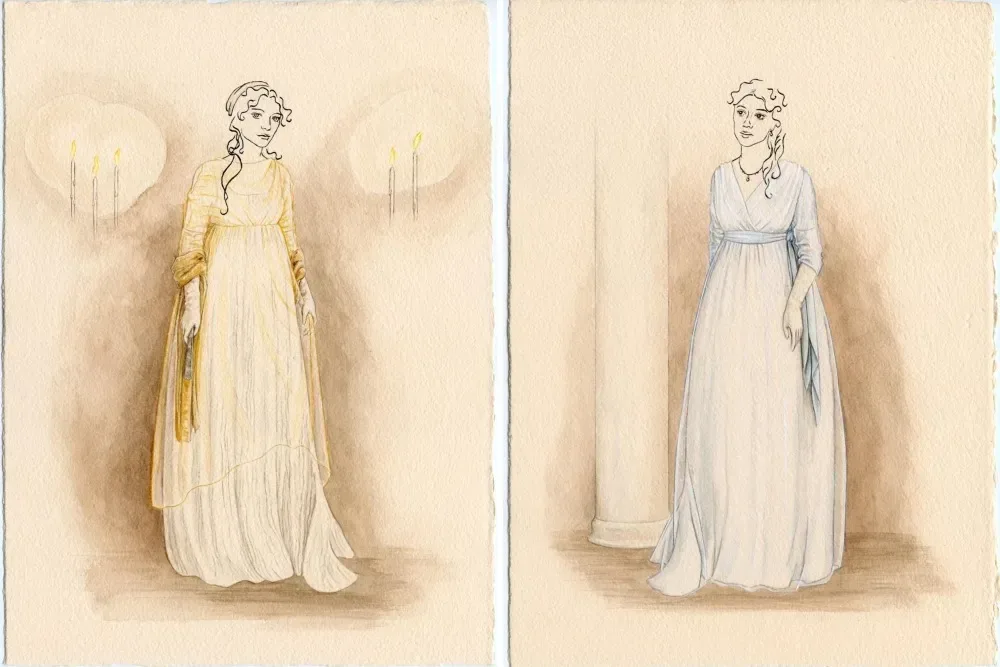
Jane Austen adaptation merchandise often has an awkward choice to make: go literal with a title treatment and a poster image, or make something that can stand on its own once the cinema campaign has passed. Sarah Flint’s new Sense and Sensibility capsule has chosen the latter route. The limited collection, made with Focus Features, uses the forthcoming film’s visual world and the contrast between the Dashwood sisters as its starting point rather than putting a movie logo at the center of every item.
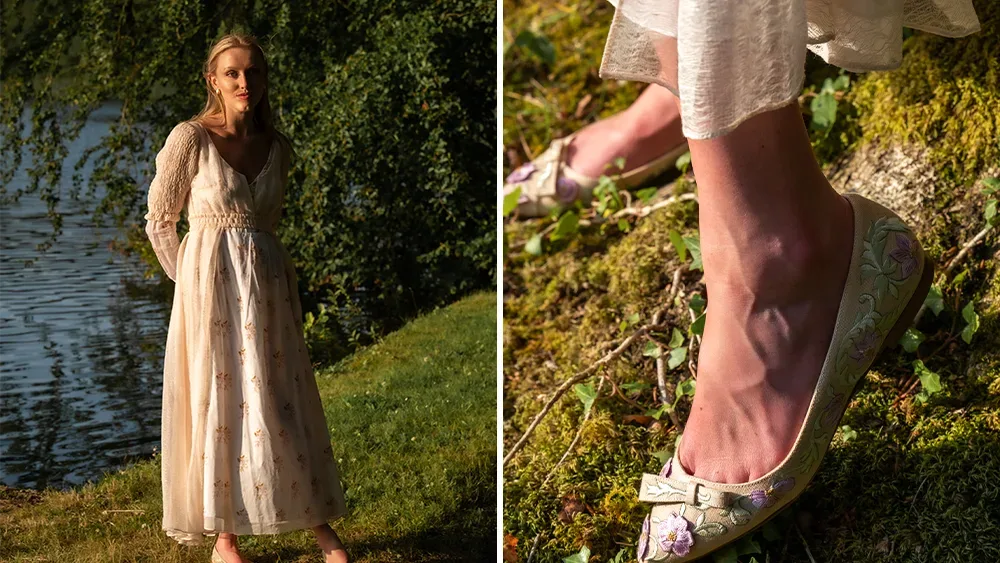
Available September 30 exclusively through Sarah Flint’s website, the capsule comprises two of the designer’s established shoe silhouettes and two scarves. The footwear is where the character concept is most explicit: the restrained Emma shoe is linked to Elinor Dashwood, while the more romantic Natalie silhouette is connected to Marianne. Both are made from linen and hand-embroidered with Japanese anemones.
The timing is deliberate. The collection arrives ahead of the new Sense and Sensibility film’s U.S. theatrical release on October 16, turning the lead-up to a literary adaptation into a more unusual kind of film tie-in: one centered on textile work, floral symbolism and costume-adjacent design rather than conventional promotional apparel.
Two shoes, two Dashwood sensibilities
At the heart of Austen’s story is the difference between the sisters’ temperaments. Elinor is the more reserved and practical of the two, while Marianne is presented as romantic and freer in spirit. The capsule uses that divide as an organizing principle. Rather than claiming that either character would simply wear a modern product, the collaboration assigns each existing Sarah Flint silhouette a personality-based role.
That makes the Emma and Natalie names useful design shorthand within the collection. The Emma is described as the understated option for Elinor; the Natalie carries Marianne’s romantic emphasis. It is a distinction based on character reading, not a claim that the shoes reproduce Georgian footwear.
That distinction matters. A period-inspired capsule is not necessarily a historical reconstruction. Here, the supplied details point to contemporary shoes translated through selected material and decorative cues: linen, embroidery and floral imagery. Those choices evoke the domestic needlework and textile traditions associated with the era without presenting the collection as museum costume.
The anemone is the shared visual anchor. Flint describes it as a classic English garden flower and connects it with “anticipation” in the old language of flowers. Whether shoppers approach the flower as Austen-adjacent symbolism or simply a design motif, it gives both shoe styles a common thread while leaving their personality cues distinct.
“We hand-embroidered it onto linen, the same slow, careful way women of that era would have worked, one stitch at a time, because printing it would have missed the point,” Flint said.
Related coverage includes Sarah Flint’s Sense and Sensibility Capsule Arrives Ahead of New Film.
Why hand embroidery is the collection’s key detail
Hand embroidery is more than a surface decoration in this case. It is the technical choice that makes the capsule’s period reference legible. Embroidery means a motif is built with thread stitches worked into a base fabric; it is different from printing, where an image or color is applied onto the surface. The collection’s Japanese anemones are hand-embroidered onto linen, meaning the floral design is tied directly to the garment-like material chosen for the shoes.
Flint’s explanation frames that labor as central to the concept. A printed flower could have communicated the same image at a distance, but would not carry the same connection to slow, stitch-by-stitch work. The emphasis is therefore not only on what the anemones look like, but on how they are made.
Linen is similarly significant because it supports the capsule’s textile focus. It is not presented as a literal replica of a specific historical shoe, but as a material that lets the embroidery remain the focal detail. The result is a collaboration rooted in craft vocabulary rather than broad Regency shorthand.
For collectors of movie-adjacent fashion, that can be a more durable proposition than an item whose only connection to a film is a printed mark. The film relationship is still specific—the shoes map onto Elinor and Marianne, and the colors and motifs draw from the new movie—but the design language is intentionally less overt.
Scarves extend the film’s visual palette
The footwear is joined by two hand-painted scarves. The Anemones Scarf was painted by Flint, while the Dashwood Scarf was created by her longtime collaborator Katarzyna Strozynska-Goraj. Both pull colors and motifs from the film’s visual world.
The distinction between the scarves and shoes is worth noting. The shoes foreground linen and embroidered anemones, while the scarves foreground hand-painted imagery. Together, they give the capsule two different approaches to the same source material: stitched floral ornament on one hand, painted color and motif on the other.
That also keeps the products from functioning as duplicates. Someone drawn to the Elinor/Marianne character contrast has the two shoe options; someone more interested in the broader visual language of the film has the Anemones and Dashwood scarf designs. No prices, production quantities or further specifications were provided, so prospective buyers should treat “limited” as the collection’s stated designation rather than infer a numbered edition or a particular scarcity level.
A tie-in built around adaptation, not nostalgia alone
This collection is attached to a new interpretation of a story that already has major screen history. Georgia Oakley directs the upcoming film from a screenplay by novelist Diana Reid. Daisy Edgar-Jones plays Elinor and Esmé Creed-Miles plays Marianne. The supporting cast includes Caitríona Balfe as Mrs. Dashwood, Frank Dillane as John Willoughby, George MacKay as Edward Ferrars and Fiona Shaw as Mrs. Jennings.
The film follows the sisters after their father’s death forces the Dashwood family to leave its estate and live with reduced means. Romance, heartbreak and the strict expectations of Georgian society shape the story. Those circumstances help explain why the capsule puts so much weight on temperament and constrained expression: Elinor and Marianne do not merely offer two colorways or two decorative moods; they are the story’s central emotional counterpoints.
Oakley previously directed Blue Jean, which earned her a BAFTA nomination, while Reid is known for novels including Love & Virtue. The project also continues a line of Austen films from Focus Features and Working Title that includes Joe Wright’s 2005 Pride & Prejudice and Autumn de Wilde’s 2020 Emma.
There is also an unavoidable comparison point in Ang Lee’s acclaimed 1995 Sense and Sensibility, starring Emma Thompson as Elinor and Kate Winslet as Marianne. Thompson won the Academy Award for best adapted screenplay for that film. The new adaptation is not being sold as a remake of that particular screen version, but its arrival naturally places it alongside one of the best-known Austen adaptations.
What the collaboration signals
Flint has described the project as a long-held wish to work with this particular Austen book. Her comments emphasize that the point was not to apply a film logo to a shoe, but to decide where Elinor’s sensibility ends and Marianne’s begins—even down to the color of the thread used on each design.
“I didn’t want a shoe with a movie logo slapped on it,” Flint said. “I spent real time on where Elinor ends and Marianne begins, down to which thread color went on which shoe.”
That approach gives the capsule a clear practical implication for buyers: its connection to the movie is strongest in the materials, motif and character interpretation, not in overt branding. For an Austen fan, that may be the appeal. For someone interested solely in a conventional souvenir, it may be a reminder to look closely at the product descriptions and imagery before treating the pieces as direct replicas of something worn on screen.
It is also a concise example of how film-related products can engage with a production’s design language before audiences have seen the completed movie. The scarves draw directly from its colors and motifs, while the shoes use the Dashwood sisters as their conceptual framework. That kind of connection sits at the intersection of screen promotion, fashion design and the broader production ecosystem—a landscape also evolving through initiatives such as new film and TV production-intelligence tools.
Release details
The Sarah Flint x Sense and Sensibility capsule becomes available September 30 exclusively at Sarah Flint’s website. The film reaches U.S. theaters October 16. The confirmed range includes the Emma and Natalie linen shoes with hand-embroidered Japanese anemones, plus the hand-painted Anemones Scarf and Dashwood Scarf.
For now, the strongest read on the collection is simple: it is a fashion capsule using Austen’s two central sisters as design prompts, with handmade floral detail doing most of the storytelling. It does not need to replace the upcoming movie’s costume design or promise a historical recreation. Its interest lies in translating Elinor’s restraint, Marianne’s romanticism and the anemone’s anticipatory symbolism into objects made for a present-day wardrobe.