Molly Tuttle took Artist of the Year at the 25th Americana Music Honors & Awards in Nashville, leading a compact but significant set of competitive winners that also included Brandi Carlile, Tyler Childers, Gillian Welch and David Rawlings, Ken Pomeroy and Mandy Fer.
The September 16 ceremony at the Ryman Auditorium paired its six voted competitive prizes with tributes and lifetime honors for Robert Plant, Dolly Parton and Tom Petty and the Heartbreakers. The result was an awards show built less around a long list of trophies than around performances, collaborations and arguments—sometimes explicit ones—about the value of human-made music.
The 2026 Americana Honors & Awards winners
- Artist of the Year: Molly Tuttle
- Album of the Year: Snipe Hunter, Tyler Childers, with Rick Rubin and Nick Sanborn recognized as producers
- Song of the Year: Brandi Carlile’s “Returning to Myself,” credited to Carlile as singer and sole songwriter
- Duo/Group of the Year: Gillian Welch and David Rawlings
- Emerging Act of the Year: Ken Pomeroy
- Instrumentalist of the Year: Mandy Fer
Welch and Rawlings repeated as Duo/Group of the Year winners. Childers was not present to accept Album of the Year for Snipe Hunter. Carlile’s song award was connected in event materials to her 2025 album Returning to Me, although the song itself is referred to as “Returning to Myself” elsewhere in the event coverage and performance listing. That title discrepancy is worth noting rather than smoothing over: the award recipient and the wider result are clear, but the supplied record contains two versions of the title.
Tuttle’s win follows a deliberate musical shift
Tuttle’s Artist of the Year victory was her first in that category. It arrived after the release of her fifth studio album, So Long Little Miss Sunshine, and touring behind it. The album represented a move toward a more mainstream-facing sound than some of her earlier work—a choice she acknowledged could worry listeners who most closely associate her with traditional bluegrass.
For more context, explore Open-Box ROG Xbox Ally Pricing Is a Useful Handheld PC Deal, Not a Return to Affordable Hardware.
That tension makes the award especially telling. Americana is a broad umbrella rather than one fixed musical template, typically making room for music drawing on roots traditions without requiring strict loyalty to a single one. In practical terms, that means a performer can bring bluegrass technique and repertoire into a recording that reaches beyond conventional bluegrass production or audience expectations. Tuttle’s recognition suggests that stylistic expansion did not put her outside the community’s definition of the form.
Her performance kept one foot firmly in older roots vocabulary. Tuttle played “Rosalie,” a murder ballad she wrote with Ketch Secor, the Old Crow Medicine Show frontman whom she married on August 22. She played clawhammer guitar, a percussive picking approach in which the hand strikes downward across the strings, while Secor joined on fiddle. A murder ballad is a narrative folk-song form centered on a killing and its consequences; it is not a new invention, but its presence on a newer, sonically exploratory record underlines the way Americana often moves between inherited forms and contemporary framing.
The win also carried a sense of return. Tuttle had previously been nominated at these awards in 2018 for Instrumentalist of the Year, shortly after moving to Nashville. This time, the institution recognized her in its most expansive artist category.
Carlile’s song award puts connection at the center
Carlile won Song of the Year for “Returning to Myself.” In accepting, she described the song’s idea as a journey back to oneself that ultimately leads outward again, toward other people. She thanked her wife, Catherine Carlile, and made clear that the award felt meaningful because it represented more than solitary self-discovery.
That emphasis mattered within a ceremony consistently focused on community. Carlile also performed Dolly Parton’s “Coat of Many Colors” with I’m With Her, while I’m With Her performed “Wild and Clear and Blue.” Carlile praised the latter from the stage, identifying it as a personal favorite of the last decade despite competing in the same category.
It is an unusually direct illustration of the culture these honors aim to celebrate. Awards competitions naturally distinguish one winner from other nominees. But Carlile’s remarks recast song recognition as something other than a simple hierarchy, giving public credit to a fellow contender and placing songwriting within a continuing exchange between peers.
Plant’s honor linked roots music across generations
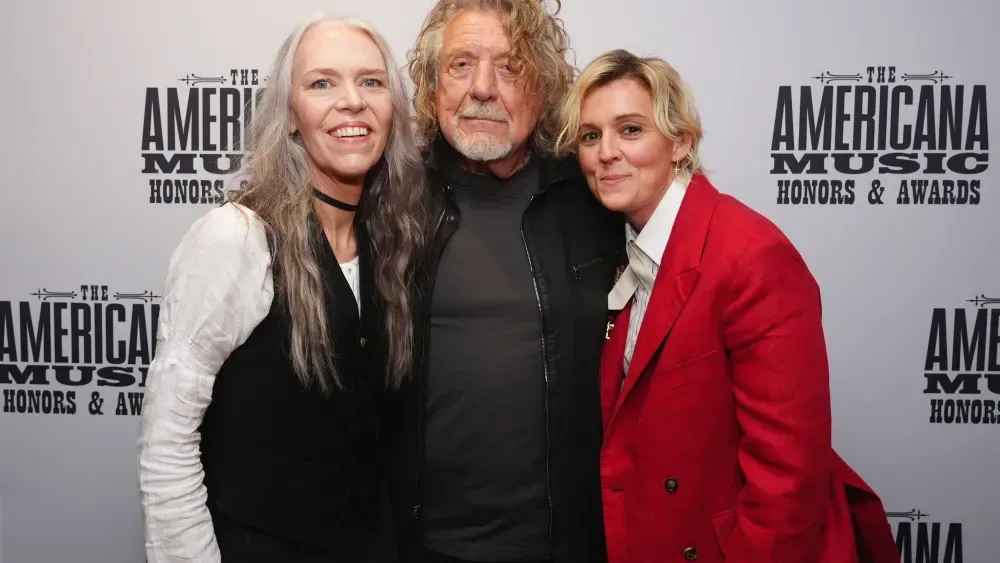
Robert Plant received a Lifetime Achievement honor and made his first appearance at the event in 15 years. He followed his remarks with “Satan Your Kingdom Must Come Down” and “Angel Dance,” including the high-register vocal work long associated with his performing career.
Plant described arriving in Nashville 20 years earlier and being welcomed by Alison Krauss and T Bone Burnett. His account framed that encounter as the start of an important new chapter, one tied to American music traditions he had spent much of his life studying and adopting.
His remarks also named a wide range of artists: Lead Belly, Patty Griffin, John Prine, Steve Earle, Jack White, Buddy Miller, Lucinda Williams, Welch, Mavis Staples, Bonnie Raitt, Charlie Rich, George Jones, Sister Rosetta Tharpe and Parton among them. The list did not attempt to define Americana through a narrow lineage. Instead, it treated songwriting, voices and instrumental craft as connective tissue across folk, blues, country, rock and gospel-adjacent traditions.
That is useful context for a ceremony in which Plant could receive a lifetime honor while Tuttle was rewarded for a record that stretched past the expectations of part of her bluegrass base. The category is not simply a historical museum for roots music. Its internal debate is about how traditions are carried forward and who gets to reshape them.
Mandy Fer turns Instrumentalist honor into a call for visibility
Mandy Fer used her Instrumentalist of the Year acceptance to address the lack of women prominently featured as lead guitarists when she was first learning electric guitar. Fer, who previously performed with Allison Russell and now plays with Sway Wild, said that filling part of that gap became a life’s work.
She cited Sister Rosetta Tharpe and Bonnie Raitt as trailblazers and expressed hope that people of all gender identities would feel encouraged to play lead guitar or pursue work that is not considered typical for their gender.
The distinction between an instrumentalist award and an artist award is meaningful here. The former directs attention to musicianship itself: the contribution made through performance, technique, arrangement and command of an instrument, whether or not the player is positioned as a project’s public-facing lead artist. Fer’s speech expanded that recognition into a question of who audiences are accustomed to seeing credited, centered and celebrated for technical authority onstage.
A night of tributes, new songs and an AI dispute
The program’s performance slate covered original work, legacy catalog and tributes. Chris Stapleton appeared with the Heartbreakers for “American Girl,” “Breakdown” and “You Wreck Me,” honoring Tom Petty and the Heartbreakers. Carlile and I’m With Her honored Parton with “Coat of Many Colors.” Hays Carll and Elizabeth Cook performed “Play a Train Song” in tribute to Todd Snider, and the cast came together for “Dance the Night Away” in tribute to Raul Malo.
Jesse Welles delivered “The Nerd Reich,” a current-events song whose title he said came from a recently released book about the rise of technocracy. The set also included Pomeroy performing “Days Getting Darker,” S.G. Goodman playing “Snapping Turtle,” Margo Price performing “Don’t Let the Bastards Get You Down,” Kathleen Edwards singing “Save Your Soul,” and Buddy Miller and Dan Penn performing “Don’t Look Back.”
Hosts the Milk Carton Kids—Kenneth Pattengale and Joey Ryan—gave the evening’s clearest statement on generative AI and music. Their remarks invoked Gillian Welch’s “Everything Is Free,” specifically its conviction that artists will keep making work even when payment is uncertain. They contrasted that drive with comments attributed to the chief executive of Suno, a generative-AI music app, and voiced support for Jason Isbell and others involved in legal action.
Generative AI music refers to systems that produce audio, songs or musical elements from prompts and learned patterns. The hosts’ objection was not framed as a technical claim that computers cannot output music. It was an argument about authorship, labor and purpose: making music is a human practice people are compelled to undertake, not merely a task to automate because software can perform it quickly.
That distinction has practical consequences for artists and listeners. Debates over AI can involve questions of training data, copyright, compensation and whether audiences can identify the human choices behind a recording. At this ceremony, the point was more intimate. The hosts presented Americana as a network of songwriters, players, crew members, organizers, radio workers, labels and other people whose relationships sustain the work. In that framing, music’s value cannot be reduced to an efficient output.
Why the small awards slate changes the show
Only six competitive categories were awarded, a comparatively lean format that allowed the ceremony to devote substantial time to performance and recognition beyond the voting categories. Rather than treating a song fragment as transition music between a large number of prizes, the event gave artists room to play and gave the tributes a central role.
That structure is also consistent with the night’s winners. Pomeroy’s Emerging Act award placed a newer voice beside established figures such as Carlile, Childers, Welch and Rawlings. Fer’s Instrumentalist win foregrounded a musician whose speech focused on representation. Tuttle’s Artist of the Year prize rewarded an artist balancing a roots foundation with change. Plant’s lifetime honor located that present-tense work within a much longer exchange among American musical traditions and artists who have drawn from them.
The full three-and-a-half-hour ceremony was livestreamed and remained on YouTube at the time of reporting, with an edited public-television version planned for later in the fall.