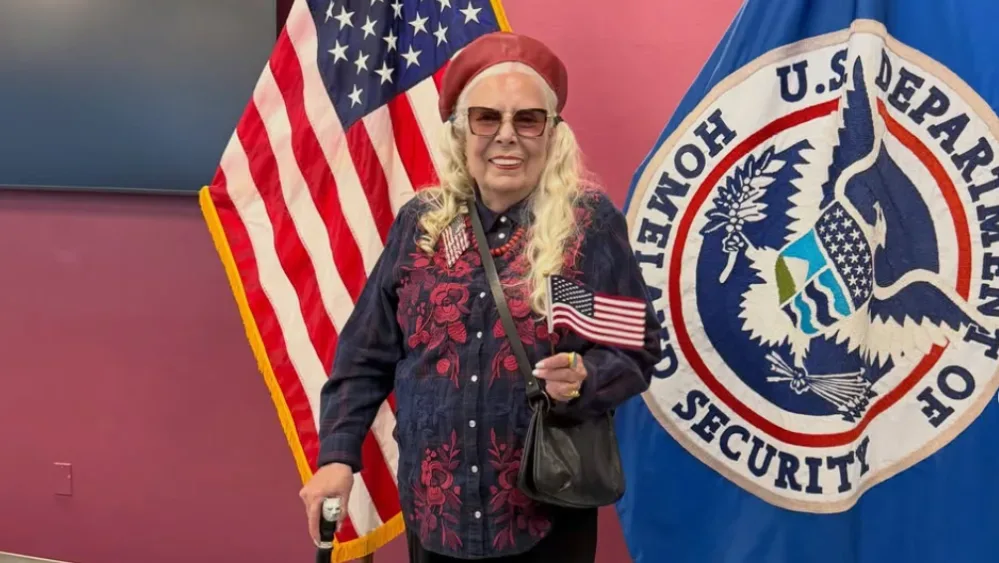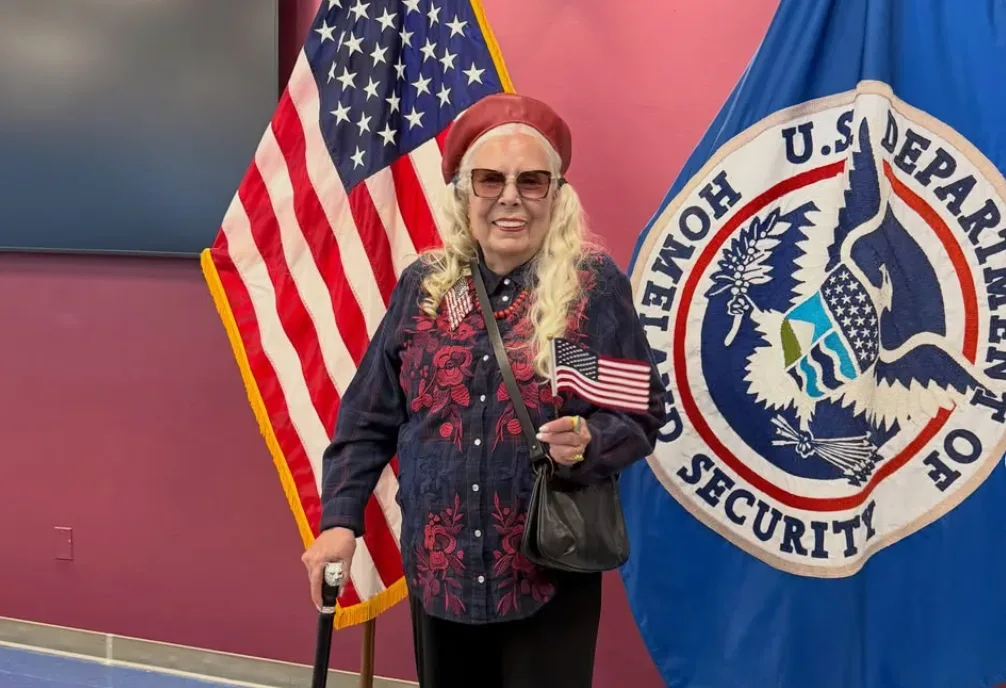
Joni Mitchell has become a U.S. citizen, a personal milestone she introduced with characteristic economy: a photograph holding an American flag, a brief video of her swearing-in, and the caption, “A journey that began 62 years ago.”
The musician’s posts show her smiling in front of United States and Department of Homeland Security flags, followed by applause as she is called up for the citizenship oath. Mitchell has not publicly provided further details about the decision, but the timing gives added resonance to a life spent moving between a Canadian upbringing and an American artistic career.
Her citizenship status had recently entered a larger cultural conversation after she was omitted from a ranking focused on living American songwriters because she remained a Canadian citizen. That technical distinction no longer applies. It also does not erase Mitchell’s Canadian identity or the deep ties she has maintained there; rather, it recognizes the longstanding American half of a cross-border life.
A life shaped by Canada and the United States
Born Roberta Joan Anderson in Fort McLeod, Alberta, in 1943, Mitchell spent part of her youth in Saskatoon after her family moved there when she was 9. She attended Calgary’s Alberta College of Art in 1963. Those roots are fundamental to any account of her, and the new citizenship news should not be mistaken for a renunciation of them.
Mitchell’s move to the United States is generally traced to 1965, when she married Chuck Mitchell and moved with him to Detroit. Both participated in the city’s folk scene. Her first New York appearance followed at the Gaslight in 1966, and she relocated to Chelsea in 1967 after the marriage ended.
By 1968, Mitchell had moved west to Los Angeles’ Laurel Canyon area, a locale closely associated with a generation of singer-songwriters. She purchased a Bel Air home in 1975. Yet even as California became a major center of her working life, Mitchell preserved close links to Canada and established residency in British Columbia around the 1971 release of Blue.
That timeline helps explain why the citizenship development feels meaningful without being simple. Mitchell’s career cannot be neatly placed on one side of a border. Her early life and continuing connections are Canadian; Detroit, New York and California were crucial places in the evolution of her public career. The 62 years cited in her post broadly reaches back to the period when her American journey began.
What the oath changes — and what it does not
Citizenship is a legal status, not an artistic genre label. Its clearest relevance here is civic. At a Hollywood Bowl “Joni Jam” two years ago, Mitchell made her frustration explicit while criticizing Donald Trump: “I wish I could vote…I’m a Canadian. I’m one of those lousy immigrants.”
Related coverage includes Joni Mitchell Becomes a U.S. Citizen After Decades in America.
That earlier remark does not establish a single public explanation for why Mitchell pursued citizenship now, and none should be invented in its absence. Her new post did not offer political commentary beyond the imagery of the ceremony and her short caption. Still, the contrast between having said she wished she could vote and subsequently taking the oath is naturally striking.
It is also worth separating citizenship from nationality as cultural identity. The available information describes a move to dual citizenship after decades in the U.S. Dual citizenship means a person holds citizenship in two countries. In Mitchell’s case, the development adds U.S. citizenship alongside the Canadian identity that has been present since the beginning of her life and work.
For audiences, that distinction matters. It avoids treating this as a story of a musician suddenly becoming “American” in any broader cultural sense. Mitchell has long been part of American musical life while remaining Canadian. The oath formally acknowledges one part of a biography that has never fit a single-nationality shorthand.
A return to performance after a difficult recovery
The milestone arrives during a period in which Mitchell has also re-emerged publicly as a performer. She suffered a brain aneurysm in 2015 and was regarded as retired from public performance for years. Her recovery unfolded gradually, eventually opening the door to a sequence of high-profile communal concerts built around the format known as a “Joni Jam.”
A Joni Jam is not simply a standard solo concert. It is a gathering of musicians performing together around Mitchell and her songs, emphasizing collaboration and a shared songbook. Brandi Carlile organized an all-star Joni Jam at the Newport Folk Festival in 2022, which marked Mitchell’s return to that kind of major public performance.
Further group appearances followed at the Gorge in Washington state in 2023 and at the Hollywood Bowl in 2024. Mitchell has also been associated with private Joni jams involving fellow musicians in the Santa Barbara area. Taken together, those appearances have made the citizenship moment feel less like an isolated headline and more like another chapter in a wider return to public life.
That return has been especially notable because it has not required Mitchell to flatten her history into a comeback narrative. The performances have been collective, relaxed in structure, and centered on the songs and relationships around them. The citizenship posts carry a similarly personal tone: a major legal and civic event, presented with just enough context to signal its importance.
Why Mitchell’s status mattered to public debate
Debates over lists of “American” artists often look trivial until they reveal how much cultural labels leave out. In Mitchell’s case, excluding her from an American-songwriter ranking because she was not legally a U.S. citizen was internally consistent with that list’s stated definition. It also prompted frustration because her influence on American music is so extensive and because so much of her adult life has been spent in the United States.
Her naturalization resolves the narrow eligibility question, but it does not resolve the more interesting one: whether creative work is best understood through passports, residence, upbringing, scenes, collaborators, or the audiences that take songs into their own lives. Mitchell’s biography argues for all of the above. Alberta, Saskatoon, Detroit, New York, British Columbia and Southern California are not competing footnotes; each is part of the route.
That is why the phrase “a journey that began 62 years ago” lands so effectively. It does not frame the oath as the starting line. It frames it as a destination within an exceptionally long personal story — one that begins in Canada, runs through decades of American cultural life, and still contains both.
For more music-industry news involving artists’ next chapters, see our coverage of Quavo’s plans for another album after QRÖMELIFE.