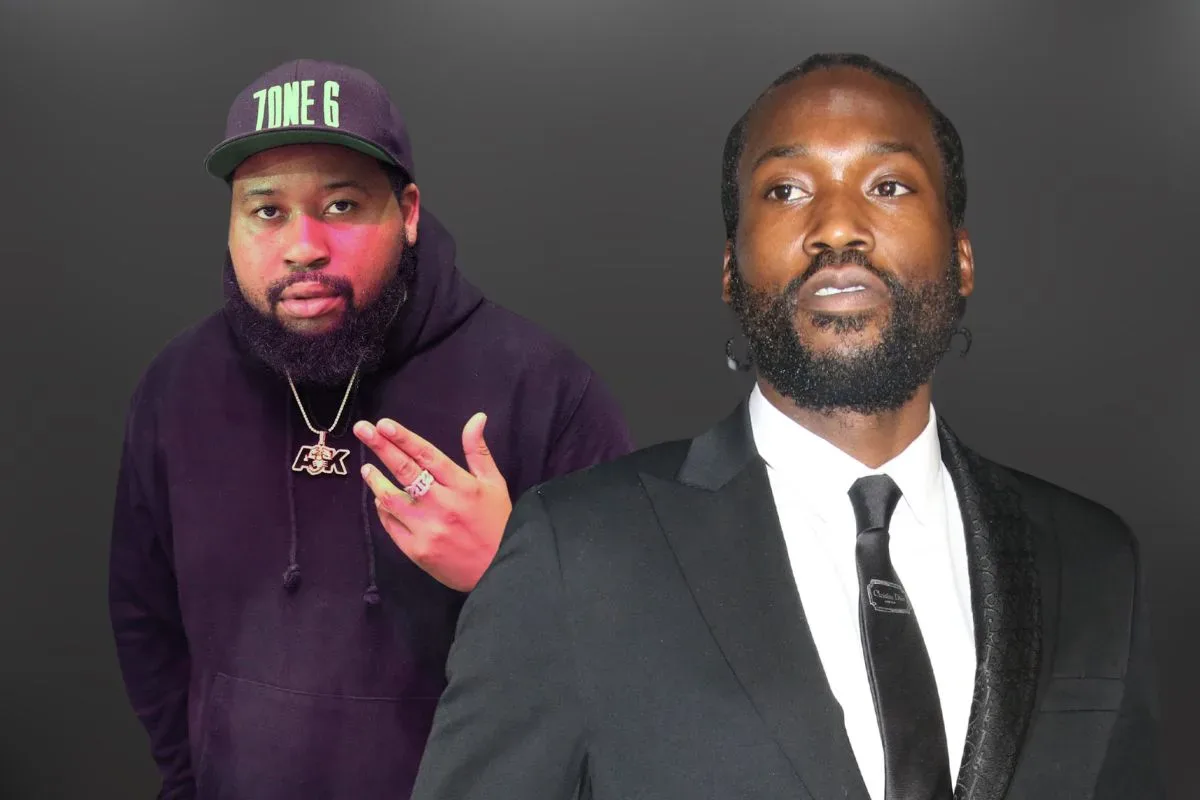
Meek Mill has renewed his public dispute with DJ Akademiks after comments made by the commentator during an online exchange with streamer Sneako, who identifies as Muslim. The immediate issue is not a disagreement over music coverage or an ordinary round of personality-driven online sparring: Meek objected to Akademiks’ language about Islam and to the reach of the platform from which it was delivered.
The clash also pulls several earlier disputes back into view. Meek referenced a 2025 livestream incident involving a 15-year-old, questioned Akademiks’ stated connection to Spanish Town, Jamaica, and reiterated his larger criticism that the broadcaster’s style of coverage can reward conflict. Those are distinct issues, and it is important not to blur an artist’s accusation with an established legal conclusion.
What prompted Meek Mill’s latest criticism
The exchange began after Akademiks mocked Sneako while discussing religion and Palestinians. A clip circulated by Sneako Productions showed Akademiks using a homophobic Jamaican slur and asking Sneako whether Islam was a religion centered on attraction to men.
Meek responded by urging people to remove Akademiks from their online recommendations and criticizing how comfortably he believed the commentator was speaking about a faith community while holding a large audience. In the same response, Meek brought up the earlier livestream involving a teenager and argued that people should reconsider working with or associating with Akademiks.
“Remember when I said take this guy out your algorithm look how he speaking on a religion so comfortable with a large platform,” Meek wrote, before raising his separate allegation regarding the prior livestream.
“Algorithm” is a useful word to unpack here. On video, livestreaming and social platforms, an algorithm is the automated recommendation system that decides which posts may be placed in front of additional viewers. Meek’s point was not simply that he disliked the comments; he was arguing that audience attention, partnerships and engagement can materially extend the impact of a creator’s remarks.
That distinction matters in modern online disputes. A clip can move far beyond its original stream through reposts, reaction content and recommendation feeds. Criticism of a creator therefore often targets both the words said and the larger ecosystem that distributes, monetizes or amplifies those words.
The previous teen-stream controversy needs careful framing
Meek’s post referred to a January 2025 livestream in which Akademiks asked a 15-year-old sexually explicit questions. Akademiks later apologized, calling it a regrettable moment and saying it should be treated as a teachable one.
Meek characterized the incident as “grooming.” That is his allegation, not a proven legal finding. The term has serious social and legal implications, so the available information supports a narrower description: an earlier livestream prompted criticism because an adult asked a minor sexually explicit questions, and Akademiks subsequently apologized for that conduct. Nothing provided establishes a legal determination supporting Meek’s characterization.
This is more than a technical wording choice. Online arguments frequently compress a chain of events—video clip, criticism, apology, counterattack—into a single loaded label. Separating confirmed conduct from contested descriptions allows readers to evaluate what happened without converting social-media rhetoric into a verified adjudication.
A conflict with years of history
The disagreement between Meek and Akademiks did not start with the comments about Sneako. The pair argued on Clubhouse in 2020 over how rap conflicts are covered, with 21 Savage attempting to settle the exchange.
The dispute re-emerged in September following Lil Durk’s acquittal. At that time, Meek accused Akademiks of benefiting from destructive Hip-Hop feuds, urged a boycott, and said he would build a competing Dream Chasers streaming presence. Akademiks answered by posting screenshots that appeared to show attempted calls from Meek and challenged him over comments about coming to his home.
That background helps explain why the latest exchange escalated quickly. Meek’s response was framed as part of an established complaint about Akademiks’ influence and approach, rather than as a one-off reaction to a single clip. Akademiks’ work sits at the intersection of commentary, livestreaming and music-world news, where on-air commentary can itself become the next story and trigger a response cycle involving artists, fans and other creators.
It is also a reminder that public feuds can have multiple tracks at once. One track concerns the immediate subject—in this case, comments about Islam. Another concerns prior conduct and apologies. A third concerns credibility, audience power and whether a commentator’s conflict-focused output causes harm or simply reflects an audience appetite that already exists.
Meek also questions Akademiks’ Jamaican roots
Meek broadened the argument by questioning Akademiks’ claimed birthplace and his ties to Jamaican music. He asked whether Akademiks was from Spanish Town and argued that the commentator does not promote Jamaican artists’ music. Meek said he has family in Spanish Town and demanded clarification about where Akademiks is really from.
Akademiks previously addressed that point during an October 13 broadcast, saying he was born at Spanish Town Hospital in Jamaica. That is the stated birthplace Meek is now challenging; the material available does not independently resolve the question.
The nationality argument appears connected to the language in the Sneako clip and Meek’s belief that Akademiks is not representing Jamaican artists or culture as Meek thinks he should. But birthplace, cultural identity and professional editorial choices are separate claims. Saying a commentator was born in a particular place does not, on its own, establish a required pattern of music coverage. Conversely, dissatisfaction with a person’s coverage does not disprove their stated origin.
Why the religion issue changes the stakes
Celebrity and streaming feuds are often built around provocation, but remarks about religious identity carry a different weight. The comment challenged Islam through derogatory language while addressing a Muslim streamer. Meek’s criticism focused on the fact that a sizable platform could make such speech feel normalized or consequence-free.
There is no indication in the supplied material that Akademiks issued an apology for the remarks about Islam. His documented apology in this account concerns the separate 2025 incident involving the teenage streamer. Keeping those episodes separate is essential, particularly as older controversy is being invoked to challenge present-day behavior.
For audiences, the practical takeaway is to treat viral clips with enough context to identify what is actually at issue. The core confirmed sequence is straightforward: Akademiks made derogatory comments in an exchange involving Sneako and Islam; Meek publicly condemned the remarks and referenced an earlier controversy; and their existing feud supplied the fuel for wider accusations about influence, culture and conduct.
The story also illustrates a persistent problem in livestream-era entertainment media. A host’s words may be delivered in a confrontational, improvised setting, but the clip can then circulate as a durable artifact. That changes the incentives around outrage: a provocative moment may generate attention immediately, while the response from artists and viewers can create another wave of coverage days later.
Meek’s call to change what appears in people’s recommendations is, in that sense, a call for audience accountability rather than only a demand for an individual apology. Whether viewers agree with that approach or not, it points to a reality of creator-driven media: attention is not passive. Watching, sharing and engaging can all help determine which figures and formats receive more visibility.
This dispute is separate from other public arguments involving major music figures, such as Nicki Minaj’s recent public clash with Kathy Hochul, but both demonstrate how rapidly high-profile voices can turn a single online statement into a broader debate about responsibility and influence.
What remains unresolved
The available account does not show a direct response from Akademiks to Meek’s newest criticism of the Islam remarks. It also does not establish independent proof concerning Meek’s challenge to Akademiks’ birthplace, nor does it turn Meek’s grooming allegation into a legal finding.
What is clear is that an already fraught relationship has entered another chapter, this time centered on rhetoric about religion and the responsibility that comes with a large digital audience. The prior arguments over rap-conflict coverage, the earlier livestream apology and the new dispute over Islam are connected by the same central question: what standards should a highly visible commentator meet when the content is designed for an audience that can amplify every moment?