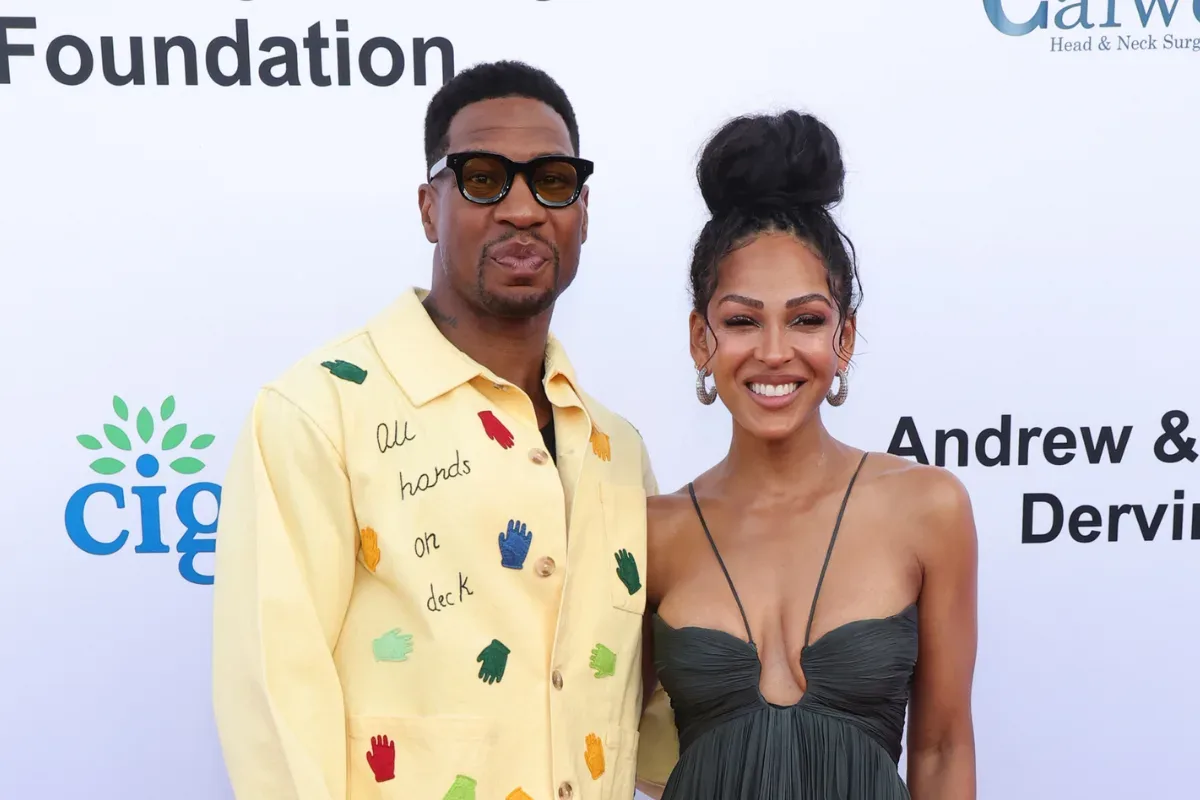
Meagan Good has revisited the career calculation behind her appearance in 50 Cent’s “21 Questions” music video: it was not simply a high-profile part during a major rap moment, but a chance to be seen differently.
In a SiriusXM FLY interview with Eutopia, Good said she had first missed an opportunity to appear in a Busta Rhymes video after failing to return a call. Her mother urged her to check her messages, but the part was already gone. When “21 Questions” arrived, Good recognized a new opening—one that could reach an audience repeatedly and help establish that she had moved into adult roles.
“I was like to me, this is a national commercial,” Good said of the video opportunity.
A music video as a career-positioning tool
Good’s phrase gets at the media environment surrounding a major music-video release. In this context, a “national commercial” does not mean a conventional advertisement for a product. It means a short, highly repeatable piece of visual media capable of putting an actor’s face and performance in front of a wide audience again and again.
Good contrasted that reach with film and television. A viewer must elect to watch a movie or start a show; music-video rotation could create additional encounters without the same initial decision from the audience. That distinction was central to her thinking. Her aim was visibility, but more specifically, visibility that would change the assumptions viewers brought to her work.
Her manager reportedly had reservations because of 50 Cent’s image at the time. Good pushed for the role anyway, judging that the association and the scale of the video’s circulation could support her own transition. The decision was therefore a form of career strategy: choosing a project not only for the character on the page, but for the audience, format and cultural moment around it.
That is an important difference. A supporting appearance can be small in running time while still being large in public impact. Music videos often operate as compressed storytelling, performance and image-making at once. For an actor working to shed a pre-existing label, that concentration can be particularly useful.
Why “21 Questions” had unusual reach
The video arrived in 2003, during 50 Cent’s breakthrough year. “21 Questions,” featuring Nate Dogg, spent four weeks at No. 1 on the Billboard Hot 100. “In Da Club” had already reached the top, and “21 Questions” gave a different dimension to the artist’s presence around Get Rich Or Die Tryin’.
Related coverage includes Meagan Good Saw 50 Cent’s ‘21 Questions’ as a Turning Point.
Rather than leaning only on the street narratives and sharp rival-directed attacks associated with 50 Cent’s early persona, the song is framed as a relationship record. That gave its video a built-in need for a partner character with emotional weight inside the scenario.
Good played 50 Cent’s partner in a narrative that places him behind bars. Tyson Beckford appears as a rival inmate, while visits and phone calls place the relationship at the center of the clip. In practical storytelling terms, Good was not merely present for a cameo: her character helped carry the video’s stakes. The prison setting created separation, and the scenes between the couple supplied the emotional connection around that separation.
For Good’s stated goal, that distinction mattered. A role built into the story offers an audience more than a quick visual impression. It attaches the performer to the video’s point of view and its emotional throughline. That is a stronger basis for image change than appearing only as background decoration.
The challenge of outgrowing a child-actor label
Good has described doubts around this period of her life before. In an earlier interview, she recalled questioning her path at 19 while trying to move from child roles into adult work. She said faith helped her continue acting and use her platform to encourage younger women.
The shift was not only about which projects she accepted. Good also connected it to how she dressed, explaining that as she got older she wanted her presentation to make clear that she was no longer a child. That is a useful reminder that public image is assembled from multiple signals: roles, styling, interviews, collaborators and the spaces where an audience repeatedly encounters someone.
None of those signals guarantees the next role. But Good’s account describes a conscious effort to influence the available narrative rather than passively wait for it to change. Taking “21 Questions” was one move within that broader effort.
The stakes are familiar across screen careers. A performer’s earlier success can create recognition, but it can also narrow how gatekeepers imagine their range. The difficulty is not simply finding adult material; it is persuading casting decision-makers and audiences that an actor belongs in it. Music-video visibility offered Good a way to make that case at scale.
There is another useful angle here for anyone thinking about entertainment careers: high exposure and authorship are not the same thing. “21 Questions” gave Good a prominent opportunity inside someone else’s project. It could reshape perception, but it did not mean she controlled the kinds of stories being developed for women. Her later work suggests she saw that limitation clearly.
From visibility to creating roles
By 2015, Good and Tamara Bass were making work through Krazy Actress Productions, including the web series All That Matters. The move behind the camera marked a different response to the same structural problem.
Good argued that women on screen were too often limited to being love interests or victims, while fuller character types were excluded from lead roles. She and Bass wanted stories with women who had their own perspectives, shortcomings and lives. In other words, the goal was not merely to make female characters more admirable. It was to make them more complete.
That distinction matters because a character with flaws, agency and a point of view has room to drive a story. A love interest can be meaningful, as Good’s “21 Questions” role demonstrates, yet the category becomes restrictive when it is one of the few roles routinely available. Producing offered Good and Bass a way to develop work instead of waiting for a part that met those standards to appear.
It is a progression that makes Good’s recollection of “21 Questions” more revealing. Early in the transition, she identified a powerful existing platform and used it to challenge the audience’s perception of her. Later, she and Bass pursued greater control over the projects themselves. One approach concerns access to attention; the other concerns who gets to shape the narrative once that attention arrives.
For a wider view of how screen work can retain value beyond its initial release, see this look at the continuing residual impact of a film performance. Good’s comments focus on a different kind of value: the long-term career effect a widely circulated appearance can have on how an audience sees an actor.
The practical lesson in Good’s choice
Good’s story is not a universal formula, and it should not be reduced to “take any visible job.” The available evidence points to a more specific calculation. “21 Questions” was attached to an artist having a major year, a song that became a four-week No. 1, and a video where Good had a defined narrative function. Those conditions made it unusually useful for the purpose she had in mind.
Her own explanation also shows why the missed Busta Rhymes call remained disappointing: opportunities in entertainment often depend on timing as much as intention. But the lost chance did not end the broader goal. Good recognized the next opening, overrode skepticism around it and used a music video to make a case for her adult identity on screen.
That makes “21 Questions” more than a remembered early-2000s clip. In Good’s telling, it was an intentional pivot point—one that linked a chart-dominating record, a narrative performance and her determination to define the next stage of her career.