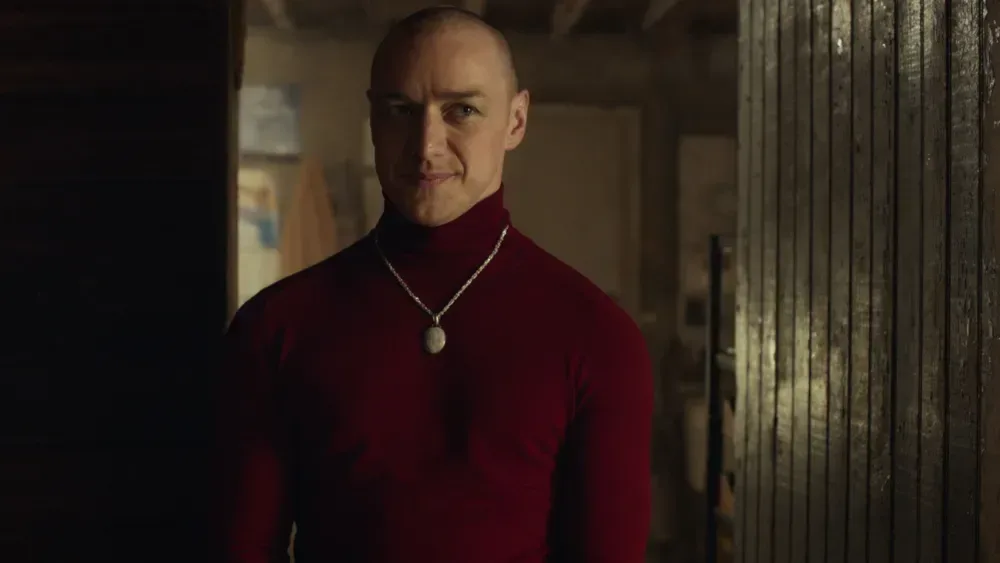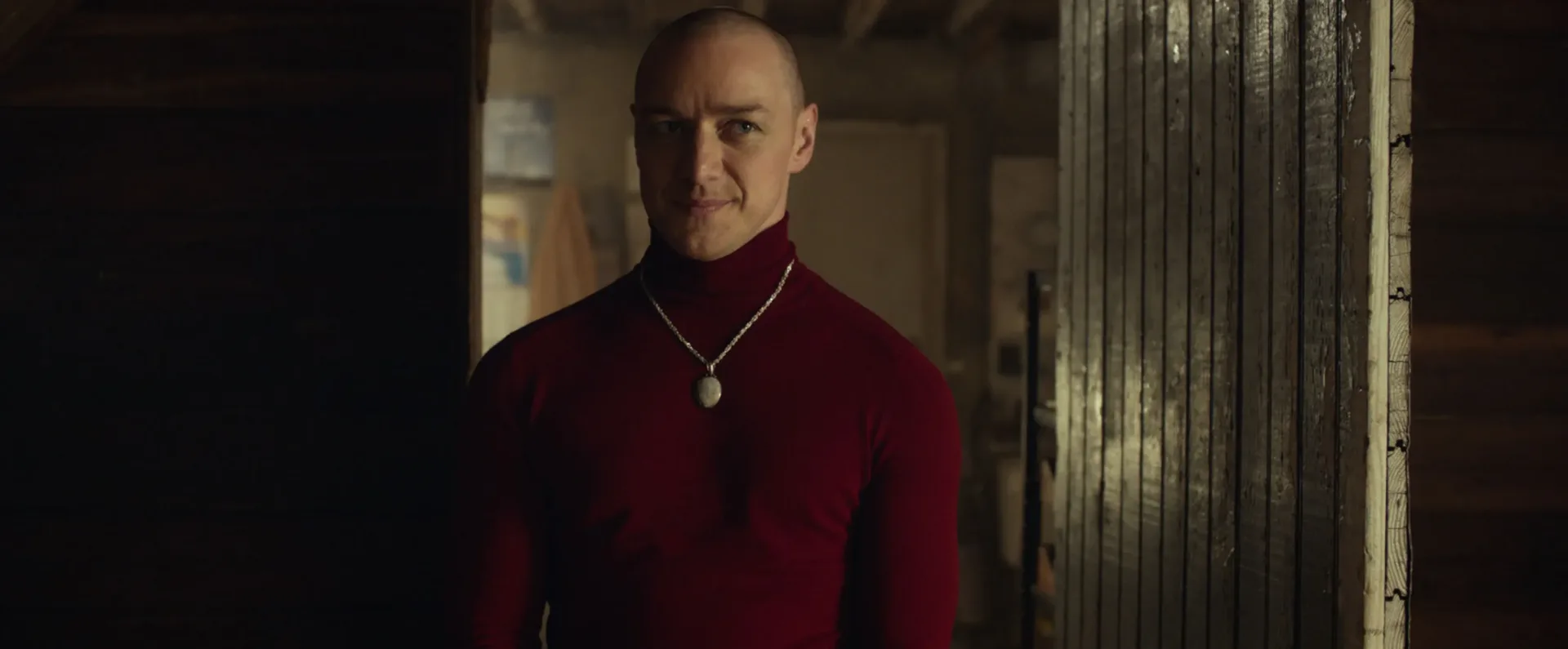
James McAvoy has worked across prestige drama, superhero spectacle and horror, but he says the film that continues to provide him with regular residual payments is M. Night Shyamalan’s Split.
Speaking on the Happy Sad Confused podcast, McAvoy described residual income as inconsistent for most productions. An actor may receive an occasional payment worth a few hundred pounds, he said, while other checks can be so small that handling them feels more trouble than they are worth. For McAvoy, though, Split is the clear exception: “the only one that really consistently pays me.”
The remark puts a practical post-release angle on one of the most commercially successful films of McAvoy’s career. Made on a reported production budget of roughly $6 million, Split ultimately grossed $278.45 million worldwide: $138.29 million domestically and $140.16 million internationally. McAvoy recalled that the film’s first weekend brought in about $40 million, and said the production was effectively profitable at that point after he estimated around $30 million in advertising spending.
What residuals mean in this context
Residuals are payments made to performers after a production’s initial work has been completed, under the terms governing later uses of that work. McAvoy’s comments do not lay out the specific deal attached to Split, nor do they provide a complete accounting of how its payments are calculated. They do illustrate the central point: a screen credit on a successful movie does not automatically mean that every title will generate a dependable stream of later income for an actor.
That distinction matters when discussing a performer with credits including Atonement, X-Men: First Class and Speak No Evil. High profile is not the same thing as a continuing payout. McAvoy’s examples range from checks worth a few hundred pounds to one worth 25 cents. In his telling, Split is the rare title that has kept producing payments consistently rather than intermittently or in negligible amounts.
The vocabulary can easily get blurred in conversations about movie money. A theatrical gross is the revenue a film collects at the box office; it is not a direct measure of what any individual actor receives. A production budget covers the making of a film, while marketing is a separate and potentially substantial expense. Residuals, meanwhile, concern payments to performers for qualifying uses after the original production work. McAvoy was discussing the latter, while also reflecting on why Split became a standout commercial performer.
A modestly priced thriller with a huge gross
Split, released in 2016, placed McAvoy at the center of a contained horror-thriller premise. He plays a man described as having 23 distinct personalities who kidnaps three girls. The story turns on their attempt to escape before the apparent arrival of a frightening 24th personality.
Anya Taylor-Joy, Haley Lu Richardson and Jessica Sula co-starred. The setup gave McAvoy an unusually demanding role: one character with multiple identities, each requiring its own manner, voice, posture and level of threat. But the available numbers also show why the film’s financial result remains notable. Its $278.45 million worldwide gross was many times larger than its approximately $6 million production budget.
Related coverage includes James McAvoy Says ‘Split’ Is the One Film That Still Consistently Pays Residuals.
McAvoy recalled receiving the first residual check by the end of the opening weekend, calling the moment “bonkers.” His figures were stated as recollection rather than a formal studio ledger, but they underline the remarkable speed of the movie’s opening business. He estimated the film made about $40 million in its first weekend, against the roughly $6 million production cost and an estimated $30 million promotional outlay.
It is important not to turn that shorthand into an overly tidy formula. Box-office revenue is not simply pocketed in full by a studio, and a film’s overall financial picture can involve distribution arrangements, exhibitor shares and other expenses not addressed in McAvoy’s comments. Still, his broader point is soundly supported by the scale of the film’s performance: Split cost relatively little to make and earned enormously more than that cost worldwide.
Why preparation mattered to McAvoy
McAvoy also connected the film’s efficient production approach to Shyamalan’s working methods. The actor said the key lesson he took from the director was preparedness. In McAvoy’s view, Shyamalan came to the work focused on getting the most from each shooting day, each shot and the story’s available resources, then communicating that plan to the crew.
That is not merely a compliment about organization. On a modest budget, preparation can be a creative and logistical advantage. A filmmaker who has clearly mapped out what a scene needs can reduce uncertainty during production and concentrate the available time and money on the shots that best serve the story. McAvoy specifically identified an ability to “maximize” days, shots and story as the trait that stood out.
He said he learned from directors both consciously and subconsciously, with Shyamalan’s preparedness becoming one of the clearest takeaways. McAvoy also applied the comment to Glass, Shyamalan’s sequel to Split, describing both productions as made with very modest budgets.
The observation is particularly relevant to Split because the film’s premise does not depend on the kind of large-scale spectacle associated with some of McAvoy’s other work. The tension comes from performance, confinement and the escalating possibility of a new personality emerging. That does not make the role simple; in fact, the multi-personality premise asks a lot of its lead actor. It does mean the film could place emphasis on controlled execution rather than expensive visual scale.
What McAvoy’s comments reveal—and what they do not
McAvoy’s account provides an unusually candid reminder that film success has different meanings depending on whose perspective is being considered. A widely seen movie may be artistically important, culturally visible or commercially successful, but those categories do not guarantee that it will send a performer meaningful residual payments years later.
For Split, the commercial part is unusually clear. The reported $6 million production cost and $278.45 million global gross make it a major return in straightforward box-office terms. McAvoy’s account adds the performer-side detail: this is the title he says continues to pay him reliably.
At the same time, the comments should not be treated as a comprehensive guide to all of McAvoy’s contracts or earnings. He did not disclose payment amounts from Split, the mechanics of its residual structure, or the terms attached to his other films. The useful takeaway is narrower. Even a major actor with a varied filmography can see ongoing checks arrive unevenly, and a tightly budgeted hit can remain financially meaningful long after its opening weekend.
For viewers, the lasting appeal of Split may be bound to its thriller construction and McAvoy’s central performance. For McAvoy, it is also a rare example of a project whose success remains tangible in a recurring, practical way. The film did not simply open big; by his account, it has stayed present in the most literal form possible: the check still arrives.
McAvoy’s reflections also sit neatly beside a broader conversation about how film careers are measured. Credits on acclaimed dramas and franchise movies can define a performer’s public profile. Yet the project that has the most persistent financial afterlife may be a focused genre film made for a fraction of the cost of a blockbuster. For another recent story about a filmmaker discussing the uncertain path between writing a script and making a feature, see Quentin Tarantino’s planned tenth feature.