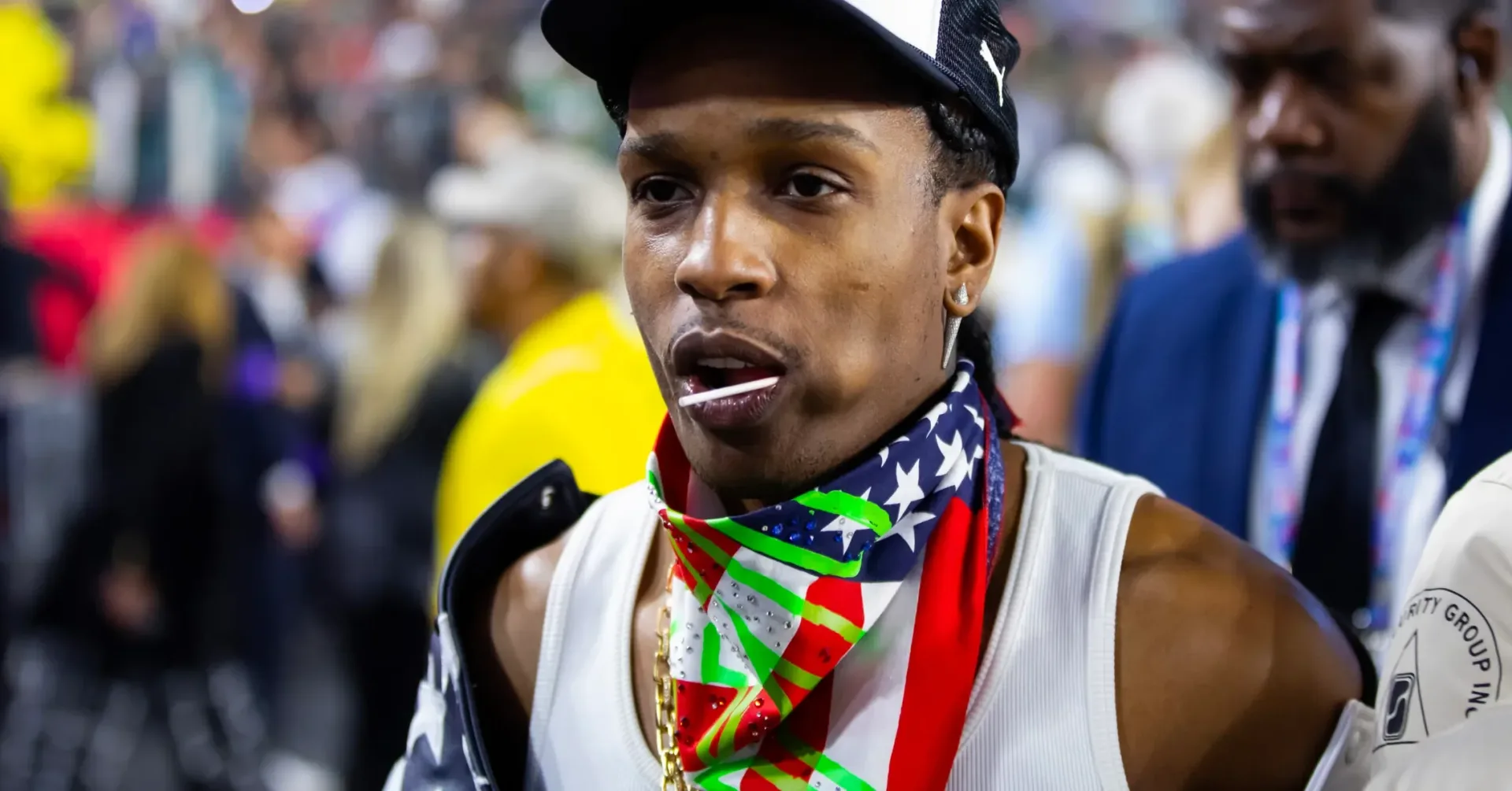
A$AP Rocky’s new visual for “Shroom Clouds” is drawing a familiar kind of internet scrutiny: a fast-moving blend of criticism over artificial intelligence, questions about authorship and an allegation of plagiarism that remains unproven.
The video, released October 19 for the Disc 2 single featuring reggie and Jeremih, has been discussed heavily online after users alleged that material from another video had been used or fed into the production. At present, that is an accusation circulating among users, not an established copyright finding. No verified statement from Rocky’s camp or a response from a specifically identified original creator was available in the supplied information.
That distinction matters. Online visual comparisons can raise reasonable questions, especially when a video openly credits AI contributors, but resemblance alone does not settle how footage was made, whether material was licensed, whether a visual reference was coincidental, or whether a legal infringement occurred. The public conversation has moved much faster than the verifiable record.
The credits put AI at the center of the conversation
“Shroom Clouds” credits Rocky alongside directors Aisulton Seitov and Pietro Biz Biasia. North of Now and Partizan are listed as producers. The credit list also names “AI Artist: Spike and Red” and “AI Artist: Ces.”
Those explicit AI credits are a major reason the discussion has become more complicated than a standard debate about a surreal music-video image. Viewers are not merely guessing that generative tools may have been involved; the supplied credits indicate that AI artists contributed to the work. What those credits do not specify is the scope of that contribution. They do not establish which shots, effects or stages of the production involved AI.
That uncertainty has produced competing readings. Some viewers have taken the credits and perceived visual artifacts as evidence that AI-generated effects play a noticeable role. Others have argued that the clip appears to combine AI-assisted material with a larger production involving practical work and conventional visual effects.
“Practical” production generally means images captured or created physically, such as on-set performances, props, sets, makeup, costumes or in-camera effects. VFX, short for visual effects, refers to imagery created or altered after filming through digital techniques. Generative AI is a separate, though sometimes overlapping, category: it can create or transform image material from prompts, existing inputs or other technical workflows. A polished final video can contain more than one of these methods, and a viewer generally cannot determine the complete production pipeline from a credit line alone.
Why the authorship allegation needs careful language
The central plagiarism claim has spread in an environment where AI use already makes audiences more alert to questions of creative origin. But it is important not to collapse separate issues into one conclusion.
Related coverage includes A$AP Rocky’s ‘Shroom Clouds’ Video Draws AI and Plagiarism Claims.
- AI involvement means credited AI artists worked on the project in some capacity.
- A visual similarity claim means viewers believe they see a connection between works.
- Plagiarism or copyright infringement would require substantially more information than an online allegation to establish.
These categories can overlap, but they are not interchangeable. A work can be criticized for its aesthetic use of AI without being proven to have copied another work. Conversely, a copying dispute could involve material made without generative AI. The current discussion touches both subjects, yet the available facts do not resolve either the alleged source material or the exact technical process behind the disputed imagery.
For audiences, the most useful stance is to keep the allegation labeled as an allegation. That does not dismiss criticism or the desire for clearer explanations. It simply prevents a disputed social-media claim from becoming a stated fact before supporting evidence, direct responses or formal action emerge.
Rocky’s recent comments added fuel to the reaction
The release arrived shortly after Rocky discussed his own preferences around creative work. He said he prefers working “practically” with musicians and producers, while also suggesting that fully prompted AI work is something for the people making it and questioning who gets to decide what is standard.
Those remarks have become part of the reaction because the video’s credits make AI participation visible. For viewers opposed to AI-generated imagery in high-profile art, the apparent tension is easy to see: an artist can express a preference for practical collaboration while releasing work that includes credited AI artists. Other viewers see less contradiction, interpreting the project as a mixed workflow rather than a fully AI-prompted video.
Neither position can be conclusively verified from the available credits. A listed AI artist may have contributed to isolated effects, concept work, generated elements, compositing inputs or more extensive sections. Without a detailed breakdown from the filmmakers, claims about how much of “Shroom Clouds” is generated remain estimates.
The dispute reflects a broader issue for music-video production: credits can disclose participation without giving audiences the granular context they now expect. “AI Artist” is meaningful transparency compared with no disclosure at all, but it does not answer the questions viewers are asking about process, source material and creative control.
What viewers can reasonably take from the available information
The confirmed baseline is relatively narrow. “Shroom Clouds” is part of the Don’t Be Dumb Disc 2 rollout, features reggie and Jeremih, and was released October 19 with Rocky, Seitov and Biz Biasia credited as directors. Its production credits include North of Now and Partizan, while the credits also identify Spike and Red and Ces as AI artists.
It is also clear that some viewers dislike the visible AI-related elements. One Reddit commenter argued that Rocky has a distinct creative vision and strong collaborators, but felt that the use of AI hurt the result. That reaction is subjective, but it explains why the credit line has become as central to the debate as the copying allegation itself. To some critics, even limited AI effects can distract from work they perceive as otherwise carefully assembled.
What remains unclear is equally important: whether the alleged visual source is accurately identified, whether any material was actually copied, whether rights were obtained for any referenced material, and how extensively AI was used. There is no verified response from Rocky’s side in the available information, no verified response from a named creator, and no settled legal outcome.
A prop visible in the video has also attracted speculation. Some fans read it as “30 OCT 2026” and treated that as a possible clue toward a deluxe release date. That is fan interpretation, not a confirmed release plan. It should be treated in the same cautious way as the wider discourse: an interesting reading of a detail, not an announcement.
Transparency is becoming part of the creative reception
Whether or not the plagiarism allegation goes anywhere, the response to “Shroom Clouds” shows how AI disclosure is changing the way audiences assess music visuals. The question is no longer only whether a shot looks convincing or imaginative. Viewers increasingly want to know what they are seeing, who made it and what source material informed it.
That demand can be difficult to satisfy in a short credit roll. Modern videos may involve live-action photography, computer-generated imagery, editorial manipulation, compositing and AI-assisted processes at once. Still, the lack of detail leaves space for assumptions. In a moment when audiences are particularly sensitive to provenance—the documented origin and history of creative material—that space can quickly be filled by mistrust.
The same pressure is visible across entertainment projects experimenting with generative tools, including debates around ambitious AI-led video concepts. AI movie experiments have already made process and presentation central to their reception, rather than treating the technology as a behind-the-scenes footnote.
For Rocky’s video, the immediate takeaway is not that an online allegation has been proven. It has not. The takeaway is that credited AI involvement has made viewers less willing to give ambiguous imagery the benefit of the doubt, particularly when they believe it resembles pre-existing work. A clear response or fuller production explanation could change the conversation. Until then, the claims surrounding “Shroom Clouds” remain unresolved—and should be described that way.