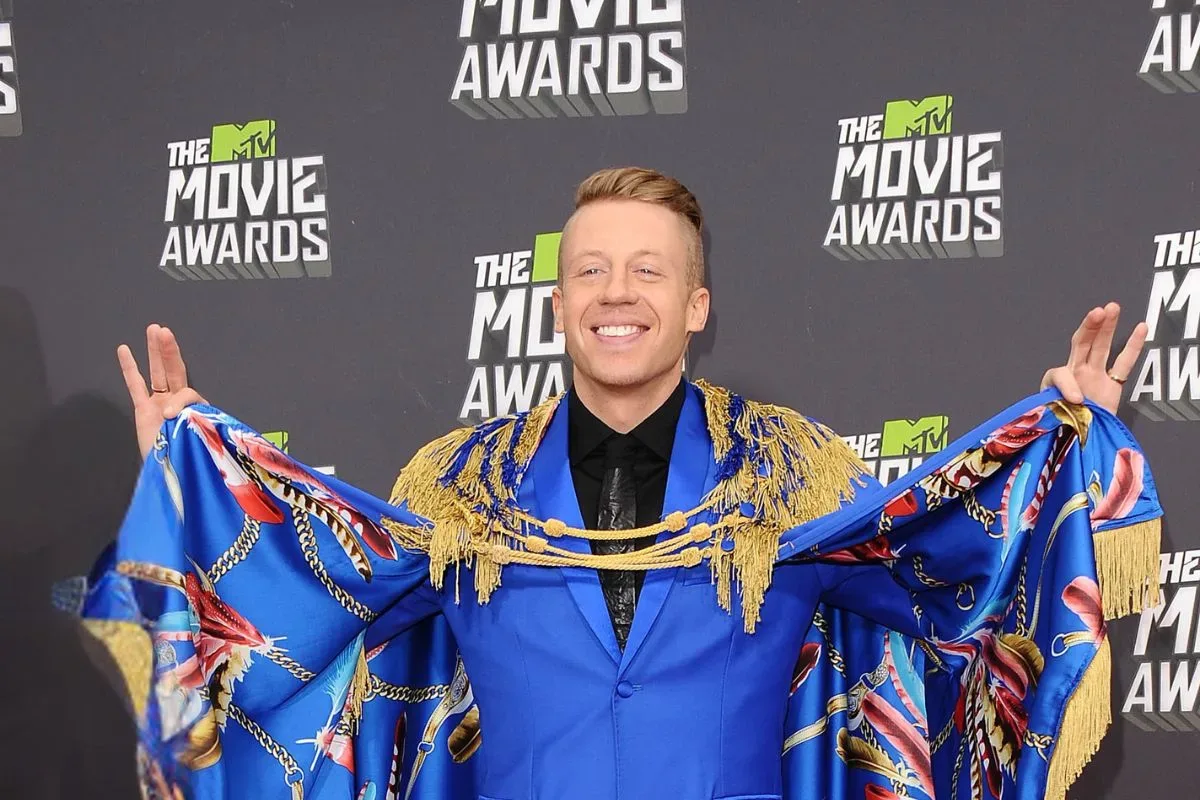
A mural in Gaza City has placed Macklemore at the center of a concert-industry dispute that has rapidly expanded beyond a single tour lineup. Local artists Anne Redwan and Qusai al-Helo painted the rapper on a concrete slab amid the city’s ruins, wrapping him in a Palestinian flag with one fist raised. The work carries the message: “Thank you for using your voice for Palestine.”
The painting responds to Macklemore’s public advocacy for Palestinians and to reports that he was removed from Ed Sheeran’s stadium tour after multiple venues objected to his appearance. It is a striking example of how a performance dispute in the United States can take on a very different meaning elsewhere: the mural is not promotional art for an artist or a tour, but a visible gesture of appreciation for political speech during a humanitarian crisis.
What led to the mural
In early September, Macklemore appeared at MetLife Stadium in New Jersey, where he wore a keffiyeh, screened footage of destruction in Gaza, performed “Hind’s Hall,” and led the audience in chants of “Free Palestine.” A keffiyeh is a traditional patterned scarf strongly associated with Palestinian identity and solidarity in this context.
That appearance drew criticism from pro-Israel organizations and Jewish organizations. Robert Kraft, the owner of Gillette Stadium in Massachusetts, subsequently said Macklemore would not be allowed to perform at that venue for Sheeran’s scheduled September 25 and 26 dates. Kraft alleged that Macklemore had a history of antisemitic rhetoric and imagery. Macklemore has consistently denied those allegations.
Those points need to be kept distinct. Macklemore’s actions at MetLife Stadium are central to the dispute; the allegation of antisemitism is contested. Criticism of Israeli government policy, advocacy for Palestinian rights, and antisemitism are not interchangeable terms, even though public debate around Gaza has often treated them as if they are. The disagreement here is partly about where institutions and audiences draw those boundaries, and whether they believe Macklemore crossed them.
Reports indicated that Kraft had contacted Sheeran and that other stadium owners could withhold their venues if Macklemore remained on the bill. Messina Touring Group, the tour promoter, said multiple venues had refused to host the concert with Macklemore in the lineup, resulting in his removal.
For further context on the response to that decision, the ongoing backlash around the Macklemore tour decision has continued to frame the issue as more than a routine support-act change.
Why venue power is the central issue
Stadium tours are built on agreements among performers, promoters, venue owners, local operators, insurers, security teams and ticket holders. An artist may be the public face of a show, but access to the building is controlled by the entities that own or operate it. That reality matters in this case because the reported objection was not simply a disagreement between two musicians. It was a conflict over whether a venue owner can determine which political expression is permitted on a bill.
Venue control is not the same thing as a legal finding about speech. The supplied information does not establish a legal ruling, contractual language, or a definitive account of every discussion between the tour and the stadiums. It does, however, describe a practical pressure point: when a show depends on large venues, a refusal to host can force a promoter and headliner to choose between retaining a supporting artist and preserving the route itself.
That leaves Sheeran in a difficult commercial and artistic position. Keeping Macklemore, based on the reported ultimatum, could mean losing access to venues. Removing him risks being interpreted as yielding to pressure over political advocacy. Neither reading eliminates the other party’s concerns: venue owners may point to safety, community reaction, or their judgment of an artist’s conduct, while critics of the removal may see a powerful private institution limiting a performer’s political voice.
Solidarity from the rest of the bill
The effects reportedly spread beyond Macklemore’s own slot. Every opening act on the tour dropped out in solidarity with him, leaving Sheeran to perform without support acts. That response matters because it changes the scale of the dispute. A lineup alteration can usually be managed quietly. A full withdrawal by openers makes the controversy part of the event itself, shaping what fans, workers, venue staff and local authorities expect when the tour arrives.
It also shows the practical stakes of solidarity. Supporting acts are ordinarily a key part of a stadium package: they help establish the night’s pacing and provide exposure to a large audience. Choosing to leave therefore has consequences for the artists and for the show, but it can also signal that performers consider the principle at issue more important than the opportunity.
Macklemore said he would donate his entire $1 million in tour earnings to Palestinian aid organizations. Kraft responded by saying that Sheeran had already asked him to match a $2 million donation to humanitarian efforts in the region. The two commitments sit alongside, rather than resolve, the core conflict. Humanitarian giving can direct money toward relief, but it does not answer the separate question of who gets to appear on a stage or how accusations surrounding political expression should be assessed.
Philadelphia becomes the next immediate test
Sheeran’s September 19 show at Lincoln Financial Field in Philadelphia is scheduled as the first stop after the controversy intensified. Police preparations reportedly include a significant presence and members of the Civil Affairs Division in anticipation of possible protests. A Civil Affairs Division typically focuses on managing public demonstrations and interactions between police and communities, rather than functioning as ordinary concert staffing.
The expected deployment does not establish that disorder will occur. It indicates that officials are planning for the possibility of demonstrations around an event already shaped by a highly charged political dispute. For concertgoers, that may mean visible security, altered approaches around the stadium, or disruptions connected to protest activity. The available information also says ticket prices have fallen significantly since the controversy began, though it does not establish a precise cause or quantify the change.
Philadelphia is therefore not simply another stop on a major pop tour. It is the first public measure of how this episode will affect an event once Macklemore is off the bill but the debate around him remains. If the concert proceeds with protests, counter-protests, heightened policing, or public attention to the support-act withdrawals, the dispute will have altered the experience without changing the headline performer.
A work of public memory, not just a response image
The Gaza City mural gives the episode a dimension that neither tour routing nor ticket pricing can capture. Redwan and al-Helo’s work honors an artist for speaking in support of Palestine, using a damaged urban setting to turn that support into public memory. It does not settle the arguments surrounding Macklemore’s language, Kraft’s objections, or the promoter’s decision. Instead, it records how the artists themselves interpret the moment.
That distinction is essential. Street art can be advocacy, commemoration and argument at once. In this case, its message is explicit: Macklemore’s words and performance were heard as solidarity. The mural’s prominence in Gaza City also underscores the unequal distance between a stadium-tour controversy and the people directly living through the destruction referenced during the MetLife show.
As the dates move forward, several issues remain unresolved: whether other venues will take a similar stance, whether more artists will withdraw, how fans respond to the revised show, and whether humanitarian pledges become a sustained part of the conversation. What is already clear is that the conflict has exposed the leverage held by stadium owners and promoters, while the mural ensures that Macklemore’s stance is being remembered far beyond the touring circuit.