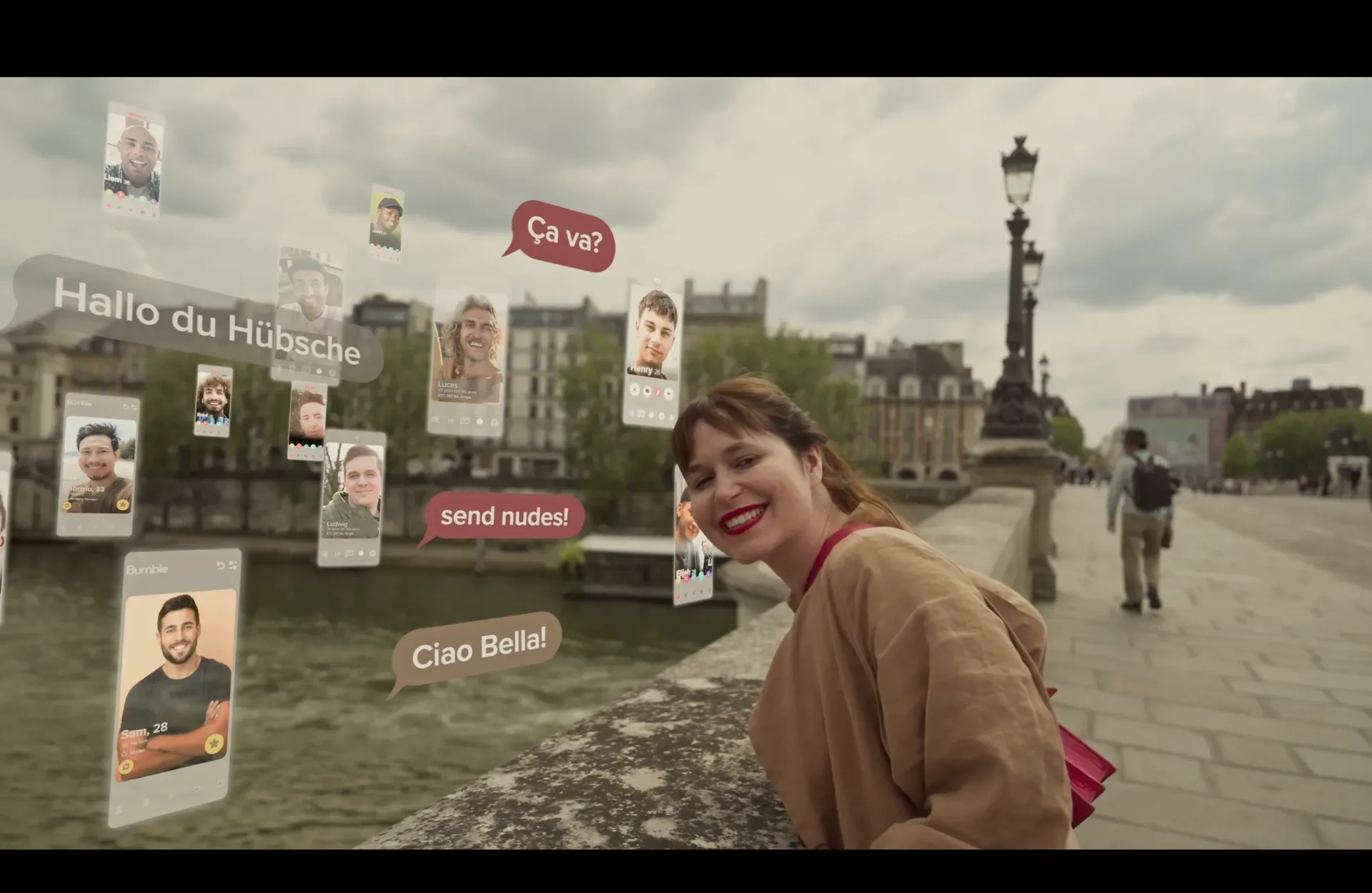
Shalini Kantayya’s documentary Love Apptually is headed for a U.S. theatrical release in February, timed around Valentine’s Day. The release brings a particularly uncomfortable counterpoint to the season’s usual language of romance: rather than treating dating apps as a neutral convenience, the film examines the technologies and commercial incentives that help shape how people pursue connection.
The documentary follows French journalist Judith Duportail, whose initial interest in Tinder develops into a much broader investigation of the systems surrounding app-based dating. After discovering that Tinder had a hidden desirability-rating system, Duportail sought access to the personal information the platform held about her. She ultimately received 800 pages of data.
That figure is a striking way into the film’s central subject. A dating profile can feel like a small, voluntary self-portrait: photographs, a short biography, preferences and a running sequence of choices. But the film’s premise suggests a far larger record is built around that activity. Love Apptually uses Duportail’s experience to ask what happens when intimate decisions are made inside products designed not only to facilitate introductions, but also to sustain engagement and generate profit.
A personal data request becomes a wider investigation
Duportail’s path gives the documentary a concrete entry point into an enormous subject. Her pursuit begins with Tinder and the platform’s concealed desirability score, then expands into an investigation of the global dating-app business and its influence over desire, intimacy and love.
“Desirability rating” is useful shorthand here, but its significance is not merely that a platform could reduce people to a score. Any ranking, recommendation or matching system turns a complicated person into information a service can sort and act upon. The key questions are therefore practical as much as philosophical: What is being collected? How is it categorized? What does the system prioritize? And how much insight does the user have into the process?
The supplied information does not detail every component of Tinder’s former rating system, nor does it claim that one hidden score alone determines an individual’s experience. But the film’s focus makes the broader issue plain. When a service mediates encounters at scale, its systems can influence visibility, recommendations and the patterns through which users meet—or do not meet—one another.
Duportail receiving 800 pages after requesting her information makes data access more than an abstract privacy principle. It becomes a narrative device: a person tries to understand the digital trail produced by something as personal as looking for companionship. The size of that returned file also helps explain why data rights can be difficult to exercise in a meaningful way. Receiving information is not identical to easily understanding it, challenging it or knowing how it affected a product’s decisions.
Engagement is not the same as connection
Kantayya frames the film around a tension familiar to anyone who has spent time on a platform built around feeds, matches, notifications or recommendations. Engagement is a business and product term: it generally refers to a user continuing to interact with a service. Authentic human connection is a human outcome. The two can overlap, but they are not automatically the same thing.
Related coverage includes ‘Love Apptually’ Sets U.S. Theatrical Release for February.
A dating app can be valuable because it makes introductions possible. At the same time, the film argues that platforms are designed to maximize engagement and profit, potentially at the expense of the deeper connection users may actually be seeking. That does not require a simple claim that every app user’s experience is negative, or that digital dating cannot lead to meaningful relationships. Instead, it directs attention to a structural mismatch worth examining: a person may want to find someone and leave the service, while a platform’s commercial incentives may reward continued use.
That distinction is central to the documentary’s stated concerns about agency, autonomy, privacy and the commercialization of intimacy. Agency is a person’s meaningful capacity to make choices. Autonomy goes further, describing the ability to direct one’s life without undue outside influence. In a dating-platform setting, those ideas invite questions about how interface design, ranking systems and incomplete information can shape choices that still feel entirely personal.
Commercialization of intimacy does not mean affection itself is fake because technology is involved. It means intimate social activity is taking place within a marketplace, where a company’s objectives can sit alongside—and sometimes clash with—the needs of the people using its product. Love Apptually appears interested in that friction rather than in a simplistic technology-versus-humanity argument.
“I’ve watched Big Tech move from capturing our attention to shaping our most intimate human relationships,” Kantayya said. “Love Apptually asks whether the loneliness epidemic is a consequence of technological design.”
The phrase “technological design” matters because it shifts attention away from treating apps as passive tools. Design includes the choices that govern what is shown, what is measured, what prompts a return visit and what behavior is encouraged. The documentary raises the possibility that loneliness may be connected not just to individual choices, but also to systems designed by companies with particular incentives. It poses that as a question, not as a settled causal conclusion.
Why a theatrical release fits the film’s questions
Willa and Women Make Movies are partnering to distribute Love Apptually theatrically in the United States. Willa founder and CEO Elizabeth Woodward, who also produced the film, said the Valentine’s Day-adjacent timing is intended to encourage audiences to consider the forces involved in how love is found in the digital age.
There is a certain productive contradiction in taking a film about digitally mediated connection into a theater. The subject is private and screen-based; the viewing experience is collective and public. A theatrical release cannot resolve the film’s concerns about privacy or platform incentives, but it can move the conversation out of the same individualized interfaces the documentary scrutinizes. It makes room for viewers to reflect together on habits often treated as routine: swiping, matching, waiting for a reply or allowing a system to arrange who appears next.
That wider cultural setting is why the release belongs alongside other entertainment stories about technology’s role in daily life, even when the subjects are very different. For example, the way music and identity circulate through virtual spaces remains part of the conversation around reported hip-hop tracks for GTA VI’s radio. Love Apptually approaches the larger issue from a more intimate angle: not what culture people encounter through a platform, but how a platform can participate in the search for another person.
The final chapter in Kantayya’s technology trilogy
Love Apptually is the final installment in Kantayya’s trilogy about technology’s effect on human experience. It follows Coded Bias and TikTok, Boom., both of which premiered at Sundance, screened on PBS’s Independent Lens and received Emmy nominations.
The trilogy framing gives the new film a clear place in Kantayya’s body of work. The connective concern is not technology in the abstract, but the human stakes of systems that can be easy to adopt and hard to inspect. With Love Apptually, that concern moves into dating and romantic life—territory where users may disclose sensitive information, make emotionally consequential decisions and place a great deal of trust in opaque processes.
Women Make Movies executive director Debra Zimmerman said the organization has worked with Kantayya since her first film, A Drop of Life, and supported Love Apptually through its Production Assistance Program. Zimmerman also pointed to the impact of Coded Bias, including screenings with decision-makers at major technology companies, as a reason to continue bringing Kantayya’s work to audiences.
The film previously premiered at Hot Docs and has also screened at DOC NYC. Its U.S. theatrical distribution arrives with Willa presenting the project in association with Minderoo Pictures and the Concordia Fellowship. Support came from the Alfred P. Sloan Foundation and the Perspective Fund.
What viewers can take from the film’s premise
The most useful implication of Love Apptually may be its insistence that convenience deserves scrutiny. Dating platforms are often discussed in terms of individual success or failure—who got a match, who was ghosted, who met a partner. Kantayya’s film looks behind that individual frame toward the systems that organize those encounters.
For viewers, this does not require technical expertise. The central concepts are accessible: data is collected; systems sort information; a company’s incentives affect design; and users may not be able to see the logic that shapes their experience. Understanding those basics can make conversations about digital privacy and relationship apps more precise.
- Ask what data is being created: A person’s activity on an app can produce a much more extensive record than the profile they consciously publish.
- Separate matching from neutrality: A recommendation system is making choices about ordering and visibility, even when its workings are not visible to users.
- Consider the business model: A platform’s stated purpose and the metrics it is built to pursue may not always align perfectly.
- Treat privacy as part of intimacy: Information about romantic preferences, interactions and behavior can be especially sensitive precisely because relationships matter so much.
Those are questions rather than instructions to abandon technology. The documentary’s reported focus is on power, transparency and human autonomy—not on declaring that all app-based relationships are invalid. In that sense, its February arrival is less a rejection of digital romance than an invitation to examine the infrastructure around it.
Love Apptually is produced by Kantayya and Woodward. Its executive producers are Davis Guggenheim, Rahdi Taylor, Doron Weber and Malinda Wink; Meryl Metni, Natasha Dolby and David Dolby are co-executive producers. With a theatrical run timed to a holiday that celebrates connection, the documentary aims its attention at the systems increasingly involved in defining how that connection begins.