Lav Diaz’s Let Us Through, Dear Ancestors, originally titled Makikiraan po, is a 151-minute historical drama set in Luzon in 1617. Presented out of competition at the Venice Film Festival on September 11, 2026, the Philippines production places its attention not on celebrated conquerors or official histories, but on the people forced to live beneath an expanding colonial order.
That choice defines the film’s enormous emotional weight. Spanish authority has already claimed the territory in the name of crown and Catholicism, but Diaz is concerned with what that declaration means at ground level: forced labor, spiritual persecution, sexual violence, grief, coercion, and the fragile routines that remain when a community is made to serve someone else’s vision of civilization.
The result is a deliberately paced work, but “slow” is not synonymous with inert here. Diaz lets oppression reveal itself as a system of repeated demands and accumulating absences. A missing husband, another dangerous trip into the forest, a healer imprisoned for refusing religious conformity: these are not simply plot turns. They form the daily machinery of domination. The movie’s length gives that machinery room to become suffocating.
A church built from exploitation
Bart Guingona plays Padre Enciso, a priest assigned to bring this part of Luzon under the control of Spanish Catholic rule. His desired monument is a church, to be constructed in a jungle clearing. The project sounds devotional in theory, but the reality behind it is brutal. Enciso dispatches local men to gather what the church requires, sending them through punishing terrain on journeys from which many do not return.
Some die from illness and exhaustion. Others encounter the raids of Bari Bari, a bandit played by Yul Servo, whose presence is discussed with fear and folklore by women gathering beside the river. The conversations among these villagers are important: within a film marked by composed imagery and controlled dramatic distance, they supply the feeling of a community still trying to speak normally, joke, worry and remember amid abnormal conditions.
Enciso’s power is also personal and predatory. After men are lost to labor imposed for his church, he has access to their widows. The film presents the consequences of this imbalance without mistaking it for romance or consensual “visiting.” His racism, entitlement and appetite are integral to the portrait of colonialism Diaz constructs. The priest’s religious office does not soften the violence; it provides an institution through which violence can be rationalized.
Daniel Palisa appears as Alejo Smith, an architect sent from Manila to design the church. In conversations between Alejo and Enciso, casual remarks expose the priest’s contempt for the people over whom he holds power, as well as the imperial world beyond the jungle that he continues to imagine and discuss. The mundane quality of such talk is part of the chill. The film does not need to make every atrocity erupt as spectacle when the assumptions beneath it are already plain.
Dungwen’s journey and an inheritance he will not claim
Christian Bables plays Dungwen, the adult son of one of Enciso’s coercive relationships. Though his mixed Spanish ancestry could potentially offer him advantages, Dungwen rejects the identity and paternal connection the priest might prefer to impose on him. His refusal does not free him. Instead, Enciso pushes him into leading a new expedition to collect marble for the church altar.
Related coverage includes ‘Let Us Through, Dear Ancestors’ Finds Liberation Beyond the Frame.
Dungwen’s duty is a cruelly symbolic one. He and a small group of laborers must pull their valuable load through the jungle, moving material intended to elevate a religious structure that represents their subjugation. Yet Dungwen’s desires are modest and immediate: to live with and provide for his wife and two daughters. His domestic life becomes a counterweight to the priest’s ambitions, centered on care rather than conquest.
The daughters are being raised with respect for the traditions that colonial Christianity seeks to replace. When entering the forest, they address their ancestors and ask passage. That gesture provides the film with its title and its deepest sense of continuity. The forest is not vacant land awaiting transformation into a European religious outpost. It is already inhabited by memory, custom, life and relationships extending beyond what the colonizers can recognize.
There is an especially productive contrast to be made with giant historical spectacles that race toward decisive milestones. Even a massive event picture such as the 185-minute theatrical return of Avengers: Endgame measures time around escalation and payoff. Diaz uses duration differently. His 151 minutes emphasize waiting, carrying, walking, enduring and wondering whether help will arrive. Here, time is not a route to an inevitable triumph. It is something people survive under pressure.
Babayeng Indimatadog and the punishment of nonconformity
Isabel Sandoval plays Babayeng Indimatadog, a traveling healer whose work belongs to an older spiritual world and therefore becomes unacceptable to the colonial regime. Accompanied by her brother Himamat, played by Ronnie Lazaro, she moves through the region as he rings a bell to announce their arrival. The pair’s practice is communal, recognizable and rooted in the people around them.
That is precisely why it is treated as a threat. During a healing ritual, Enciso’s men seize Babayeng and confine her in an improvised cell. The imprisonment makes the governing logic explicit: to refuse conversion is to register as dissent, and dissent becomes grounds for punishment. While Dungwen’s party struggles along jungle paths with its marble, Babayeng is held in darkness. Himamat seeks assistance wherever he can, a search that eventually brings him to Bari Bari’s camp.
Diaz does not arrange these threads into a neat fantasy of instant, united resistance. The possibility of a satisfying revenge narrative is there, especially as the church project begins to resemble a ruin before it can fulfill its colonial promise. But the film’s commitments appear harsher and more historically alert than that. Dispossessed people do not automatically become a single coordinated force just because an audience may want them to. Liberation is desired, invoked and imagined, but not falsely delivered as a tidy ending.
Black-and-white images that feel alive with color
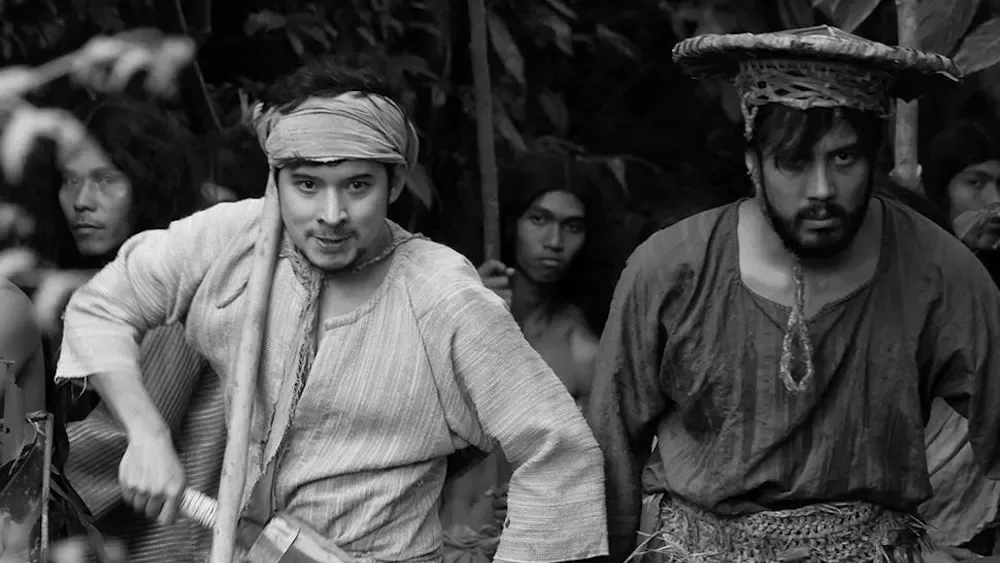
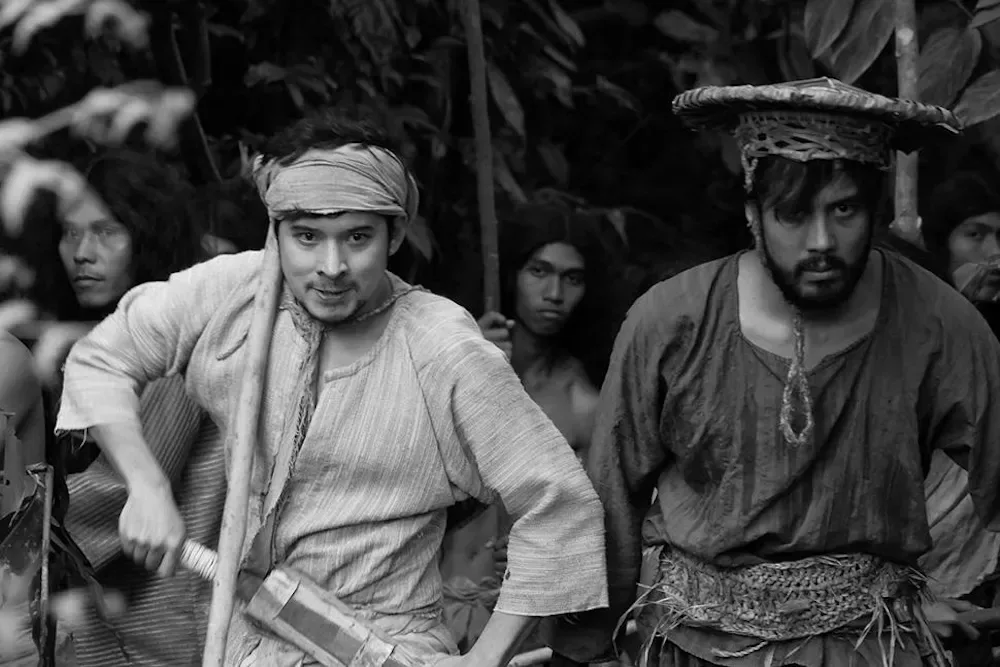
Díaz serves as director, screenwriter, cinematographer and editor, and the formal control is central to the film’s force. After the full-color visual scale of Magellan, this film returns to black-and-white photography. It is not austere in the sense of being visually empty. Rather, the monochrome image is rich in tonal variation, with jungle foliage, open clearings, faces, smoke and shadow occupying a broad range between deep blacks and bright whites.
The setting’s beauty never lets the violence off the hook. On the contrary, the luxuriant environment throws the colonial project into sharper relief. The landscape is not merely a backdrop for hardship; it is a living place being used, crossed and claimed by outsiders. The constant sense of insects and moving vegetation contributes to an atmosphere that can feel almost musical, even without turning the film into a conventional sensory escape.
The camera generally holds at a distance. Diaz favors wide and middle-distance compositions instead of relying on close-ups to instruct viewers when to feel. Characters often exist in carefully arranged spaces where multiple planes of action matter. That approach can make the viewer keenly aware of the camera’s position: we are not simply absorbed in a character’s face, but asked to observe bodies, labor and authority within the physical world that contains them.
One arresting exception comes when Babayeng, sitting in the darkness of her confinement, looks upward and directly toward the camera before smiling. The moment invites several readings without settling on one. She may be seeing divinity, imagining deliverance, or looking across time toward those who will come after her. In a story obsessed with ancestral inheritance, that last possibility carries particular force. The audience is no longer safely outside the historical frame; it may be implicated in what survives from it.
A future-tense vision of freedom
Violence in Let Us Through, Dear Ancestors is frequently approached indirectly. Diaz is less interested in staging violent climaxes than in recording what surrounds them: the fearful anticipation, the bodies and structures left behind, the uncertainty of what exactly happened beyond the frame. Even Padre Enciso’s ultimate fate is not cleanly resolved. The film withholds easy punishment in the same way it withholds easy liberation.
Its closing declaration looks toward a vision of liberation that “shall be achieved,” language that matters because it remains future tense. Diaz does not suggest that a film can repair a nation’s colonial wounds or complete the work of freedom. Instead, he makes an act of attention: restoring weight to people and practices that empire attempts to diminish, and refusing to turn history’s pain into a conveniently finished lesson.
Produced by A C’est Lovi Productions, Epicmedia Production and sine olivia pilipinas production, the film features dialogue in Tagalog and English. Its supporting cast includes Bong Cabrera, Rafa Siguion-Reyna, Amado Arjay Babon, Nick Pataunia, Grace Adajar and Jen Dayo. Anchored by Guingona, Bables, Sandoval, Lazaro, Servo and Palisa, Let Us Through, Dear Ancestors stands as a severe, patient and visually commanding drama about what colonial power builds—and whom it asks to bear the cost.