Georgia Oakley’s Sense and Sensibility takes a deliberately earthbound route through Jane Austen’s story of the Dashwood sisters. Its England is beautiful, but it is not an easy pastoral escape: journeys wear people down, hills must actually be climbed, and the apparent freedom of open country sits beside a social system designed to leave women with very little control over their futures. That material reality gives this 132-minute adaptation a clear identity. It is a moody period drama interested in texture, fatigue, desire and the emotional price of keeping one’s feelings under control.
The result is a substantial and carefully made interpretation, directed by Oakley from a screenplay by Diana Reid. It arrives after Oakley’s BAFTA-winning debut Blue Jean, and the same affinity for restraint and physical immediacy informs the new film’s larger-scale setting. The approach does not always capture the comic sharpness associated with Austen, but it gives the Dashwoods’ setbacks weight rather than treating them as merely elegant obstacles on the way to romance.
Austen’s inheritance problem remains the engine
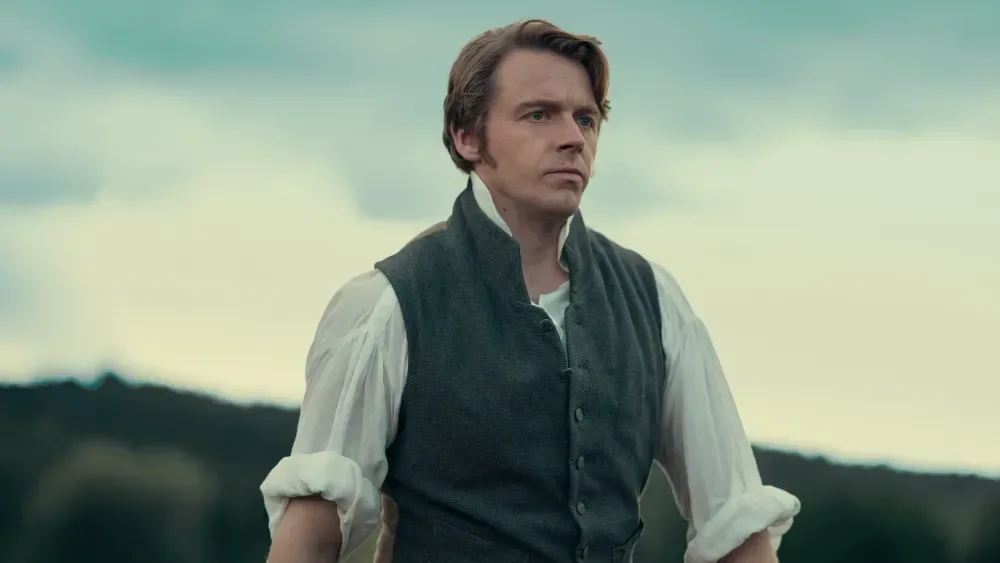
The story’s central pressure is not simply whether the sisters will find love. It is money, property and who has the legal power to make decisions. After Mr. Dashwood dies, his estate passes to John Dashwood, his son from a previous marriage, played by Tom Brooke. Mrs. Dashwood, played by Caitríona Balfe, is left powerless and without the financial security her family needs. Her daughters Elinor and Marianne must leave their home for a much humbler cottage in Devon.
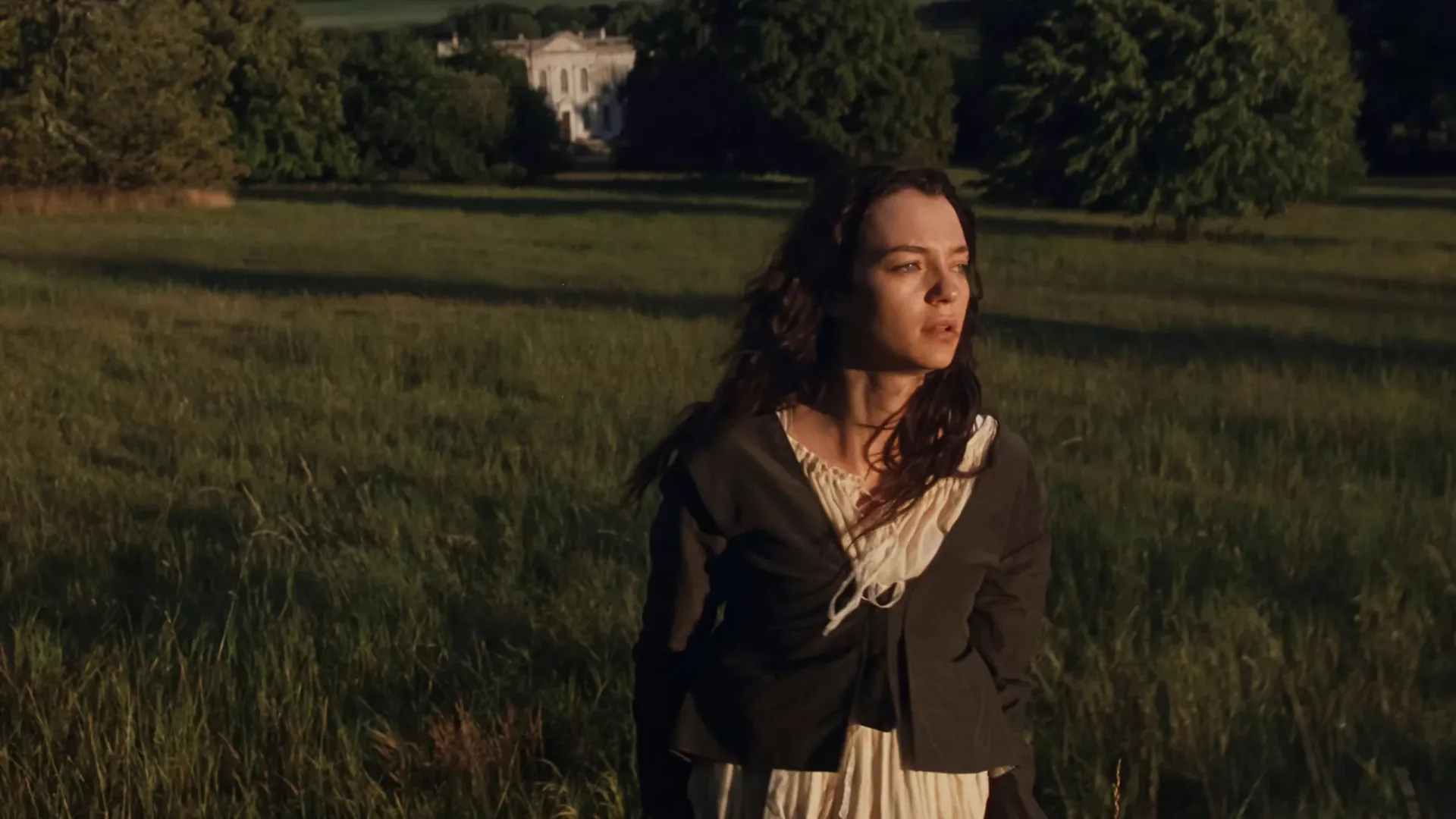
That setup matters because it turns every courtship into something more than a personal choice. Elinor, played by Daisy Edgar-Jones, and Marianne, played by Esmé Creed-Miles, are both navigating profound limits on their independence. Oakley emphasizes those limits through the physical world around them: cramped candlelit rooms, game hung on hooks, muddy outdoor travel and a landscape that can be lush without being forgiving. The film’s natural imagery includes cattails, spiders marked with dew and lily pads, but it does not frame nature as a simplistic emblem of feminine purity or liberation. The countryside has grit, distance and labor in it.
This is one of the adaptation’s strongest ideas. “Naturalism” here means an attempt to make the environment and behavior feel materially present rather than merely decorative. It is not a claim that the film is documentary-like; it is a stylistic emphasis. Carriage travel takes time. A climb exacts effort. A woman’s emotional disappointment is inseparable from the economic structure that makes a bad match, a broken promise or an unavailable man genuinely consequential.
Two sisters, two methods of surviving
Elinor and Marianne represent different responses to the same confinement. Elinor is prudent, composed and accustomed to suppressing what she wants. Marianne is forthright, romantic and impatient with caution. Oakley makes the contrast visible from early on: the camera follows Marianne with a degree of restless movement as she goes into the forest and receives news of her father’s death. Her energy is outward, immediate and difficult to contain. Elinor’s feelings, in contrast, have to be read through quieter signs.
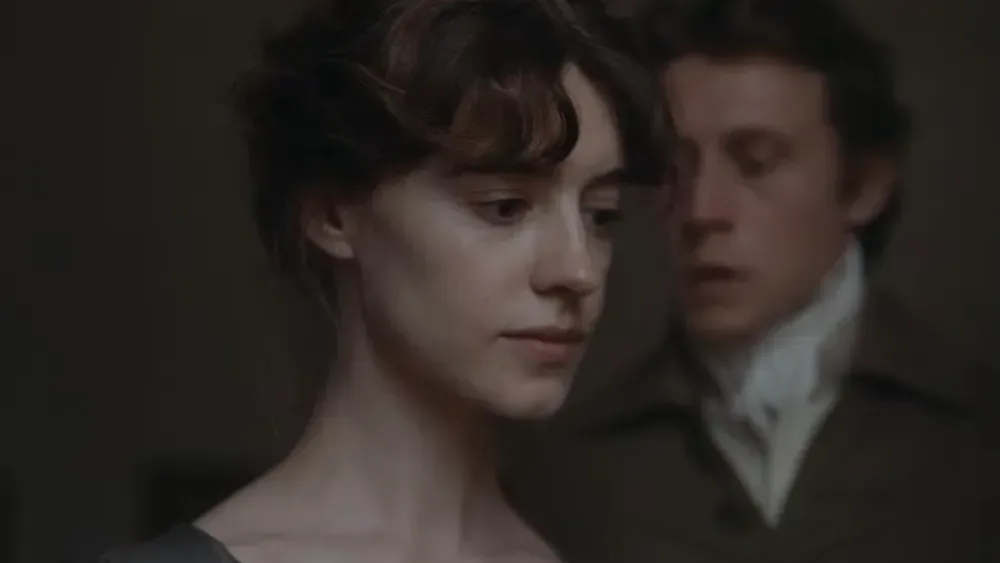
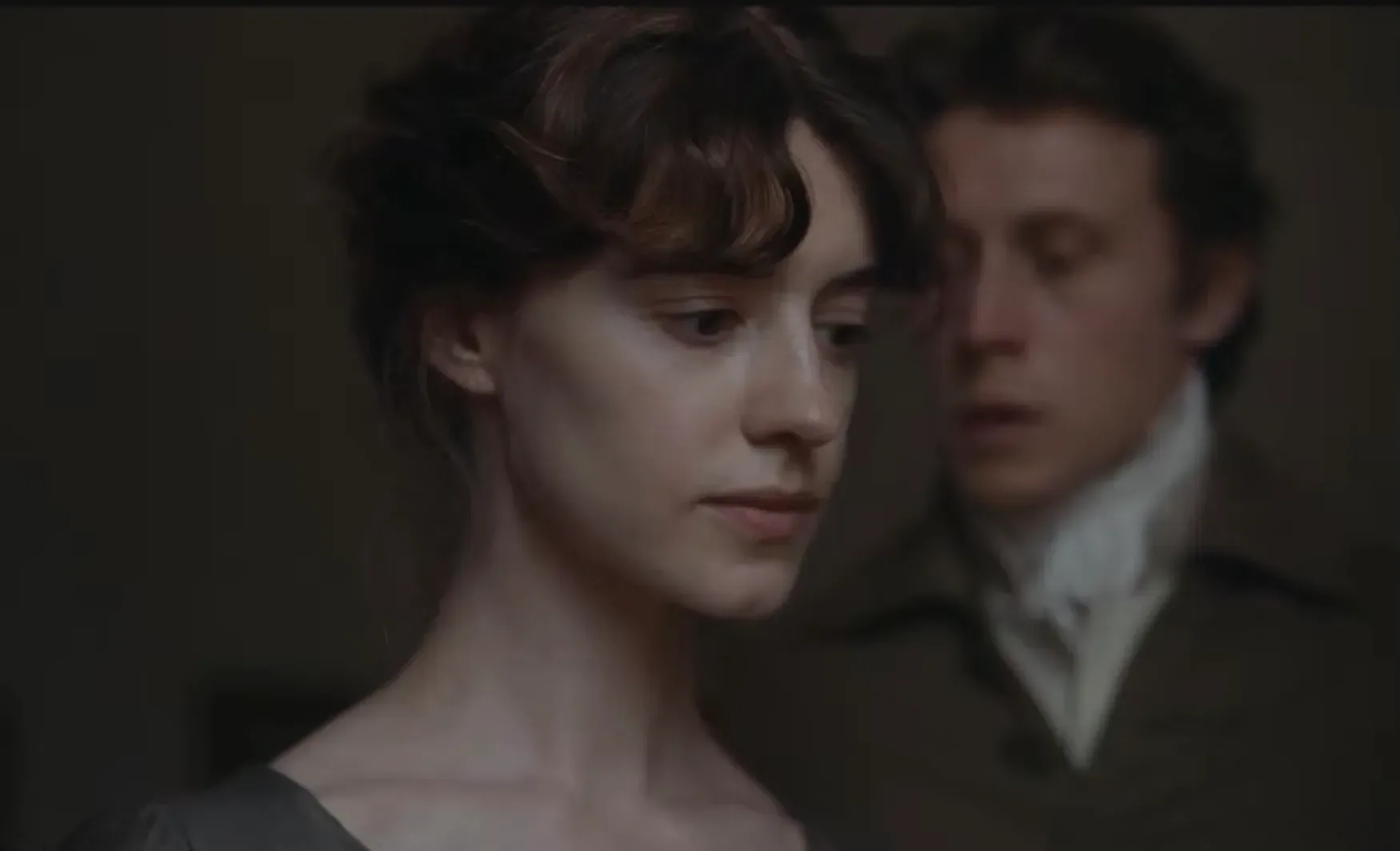
The romantic plot puts those temperaments under strain. Elinor forms an attachment with Edward Ferrars, played by George MacKay, brother to Fanny Dashwood. Their connection develops through walks and portrait sittings, with Elinor drawing Edward in a gentle reversal of the more familiar period-romance gaze. But Edward proves unable to act decisively on his feelings, and Elinor’s measured exterior becomes a burden she has to maintain even when she learns he is engaged to another woman.
Marianne’s attachment to Frank Dillane’s Willoughby moves in the opposite emotional register. He is dashing, attentive and willing to make grand gestures, including giving her a white horse. Their Devon courtship unfolds through piano playing and intimate outdoor scenes, and the force of Marianne’s belief in passion makes his departure for London particularly destabilizing. Her later discovery that he is attached to a wealthy fiancée turns idealism into visible disorientation.
Oakley’s visual strategy is especially effective in these moments. Low-angle close-ups expose the precariousness under Elinor’s calm when Edward reveals his engagement. Marianne’s reaction to Willoughby is less controlled, more physically jittery and shattered. This is psychological realism: the camera and performance are used to show how a character’s interior state interrupts the face they present to the world. It helps the adaptation avoid reducing the sisters to a simple “sensible one” and “emotional one” binary, even though the script sometimes pushes Marianne’s language about passion so insistently that it risks flattening her into a repeated idea.
Devon and London speak different visual languages
The move between Devon and London gives Oakley a useful way to map the sisters’ predicament. In the country, the Dashwoods’ weathered white clothes and loose hair create a contemporary cottage-core echo. In London, gilded interiors and tightly controlled hairstyles establish a more formal and restrictive social arena. Neither place offers uncomplicated refuge. Devon permits openness and movement, but it is also where Willoughby’s apparent devotion fails to become commitment. London may contain Edward, but it also turns private disappointments into public encounters governed by rank, wealth and appearance.
Holly Blakey’s choreography makes those distinctions unusually clear. Marianne and Willoughby share a lively folk dance in the country, with a sense of release and motion. Elinor and Edward meet again at a London ball for a waltz that is more restrained, though still sensual. Dance becomes character writing. Marianne and Willoughby’s movement matches an attraction that feels unruly and performatively alive; Elinor and Edward’s carries desire inside conventions that regulate how much either person can reveal.
Costume and movement therefore do more than provide period detail. They indicate which rules are operating in a scene and who has room to bend them. That close attention to fabric, presentation and tactile expression is also why a title such as Dressmaker, a game centered on tailoring in a cozy town, makes an interesting adjacent point of reference: clothing can be part of storytelling, not just surface decoration. In Oakley’s film, the gap between worn country garments and polished London styling helps articulate the Dashwoods’ precarious position without requiring the dialogue to announce it at every turn.
A capable ensemble with one especially playful rogue
Edgar-Jones and MacKay are tender as Elinor and Edward, and their performances suit the production’s low-key emotional temperature. Yet their versions of these characters do not radically reinvent roles that have long histories on screen. The film finds more spark in Creed-Miles, whose Marianne has sharpness and a bright, mischievous edge as well as intensity. Her performance comes closest to giving the film an unpredictable burst of star presence, even when the screenplay’s repetition around her ideal of passionate men narrows the character’s range.
Dillane stands out as Willoughby. He plays the character as a slouching, self-satisfied scoundrel, with enough casual humor to puncture the production’s held-breath solemnity. That quality is valuable in a film that often prefers feeling to wit. Willoughby’s charm must be credible for Marianne’s commitment to make sense, but his charm also needs to carry a flicker of selfishness. Dillane’s lightness supplies both.
Fiona Shaw brings a kindly coarseness to Mrs. Jennings, the figure who provides the Dashwoods with a home in Devon and later arranges the London trip. Stacy Martin gets pointed comic material as Fanny Dashwood, whose stinginess and insults underline the family’s fragile status. Herbert Nordrum’s Colonel Brandon, meanwhile, is awkward and understated, speaking with a calm baritone as he tries to reach Marianne. Balfe’s Mrs. Dashwood and Brooke’s John Dashwood establish the power imbalance at the story’s outset: one family member inherits authority, while another is left to cope with the consequences.
Where the mood gains power—and where it costs the film
The adaptation’s chief achievement is the coherence of its atmosphere. Arnaud Potier’s camera work, Izabella Curry’s editing, Roger Goula’s wistful score and Oakley’s direction all support a world of muted colors and constrained feeling. Candlelight, animal life, weathered surfaces and the recurring presence of dogs—pugs, sheepdogs, mastiffs and whippets among them—make the setting feel lived in rather than museum-clean. These choices complement the story’s romantic disappointments by locating them in a tangible world.
At the same time, the unwavering seriousness creates a real trade-off. Austen’s social observations often gain their force through humor: characters reveal their vanity, greed or foolishness in ways that can be both painful and funny. This version has moments of comedy, especially through Fanny and Willoughby, but its grounded dramatic mode tends to soften that satirical edge. The film understands the damage caused by decorum, inherited wealth and emotional timidity; it is less eager to relish the ridiculous performances those systems force people to give.
That distinction explains why the film may feel more subdued beside Ang Lee’s earlier screen version, scripted by Emma Thompson, which combined emotional release with a more pronounced comic voice. Oakley is not trying to duplicate that rhythm. Her adaptation takes a quieter route, asking viewers to sit with pauses, exhaustion and private collapse. It often succeeds on those terms, even if it leaves some of Austen’s particular mischief at the door.
What to expect from this version
Oakley’s Sense and Sensibility is rated PG and runs 132 minutes. It is an English-language U.K. production presented by Focus Features and produced by Working Title, with Tim Bevan, Eric Fellner, India Flint and Jo Wallett credited as producers. The credited creative team also includes Reid, cinematographer Potier, editor Curry and composer Goula.
For viewers, the practical expectation is clear: this is not a broad, fizzy Austen comedy dressed in rural splendor. It is a patient romantic drama shaped by material insecurity and the exhausting work of self-command. Its strongest scenes give the Dashwood sisters’ longing a physical dimension—through travel, dance, silence, faces caught in close-up and a countryside that is as demanding as it is lovely. While its grave mood can make the characters feel safer and less surprising than they might be, Oakley’s film still offers a considered, tactile reading of a classic conflict between restraint and desire.