Major spoilers for Percy Jackson and the Olympians Season 3, Episodes 2 and 3 follow.
Season 3 of Percy Jackson and the Olympians pulls Annabeth Chase away from the series’ familiar three-person quest structure, and Leah Sava Jeffries has described the unusually physical, isolated work that comes with it. Her character is taken by a manticore in the season premiere, separating Annabeth from Percy, played by Walker Scobell, and Grover, played by Aryan Simhadri, while the pair pursue a rescue.
That shift matters because the season adapts The Titan’s Curse, Rick Riordan’s third Percy Jackson novel. The first two seasons placed Percy, Annabeth and Grover together for their major journeys. Here, Annabeth’s plot gives her scenes with Luke, played by Charlie Bushnell, and Artemis, played by Dafne Keen, while putting her through a mythological trial tied to Atlas.
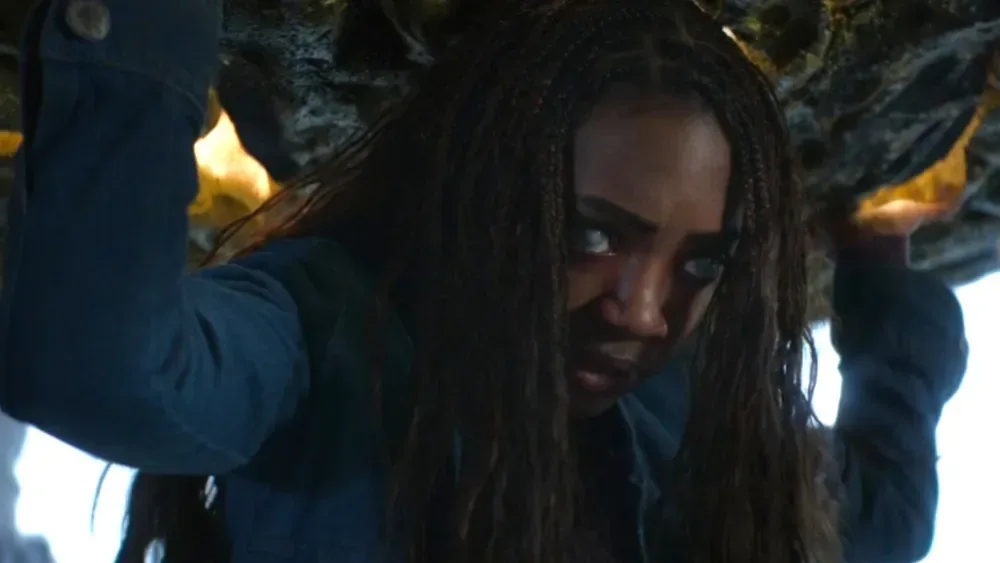
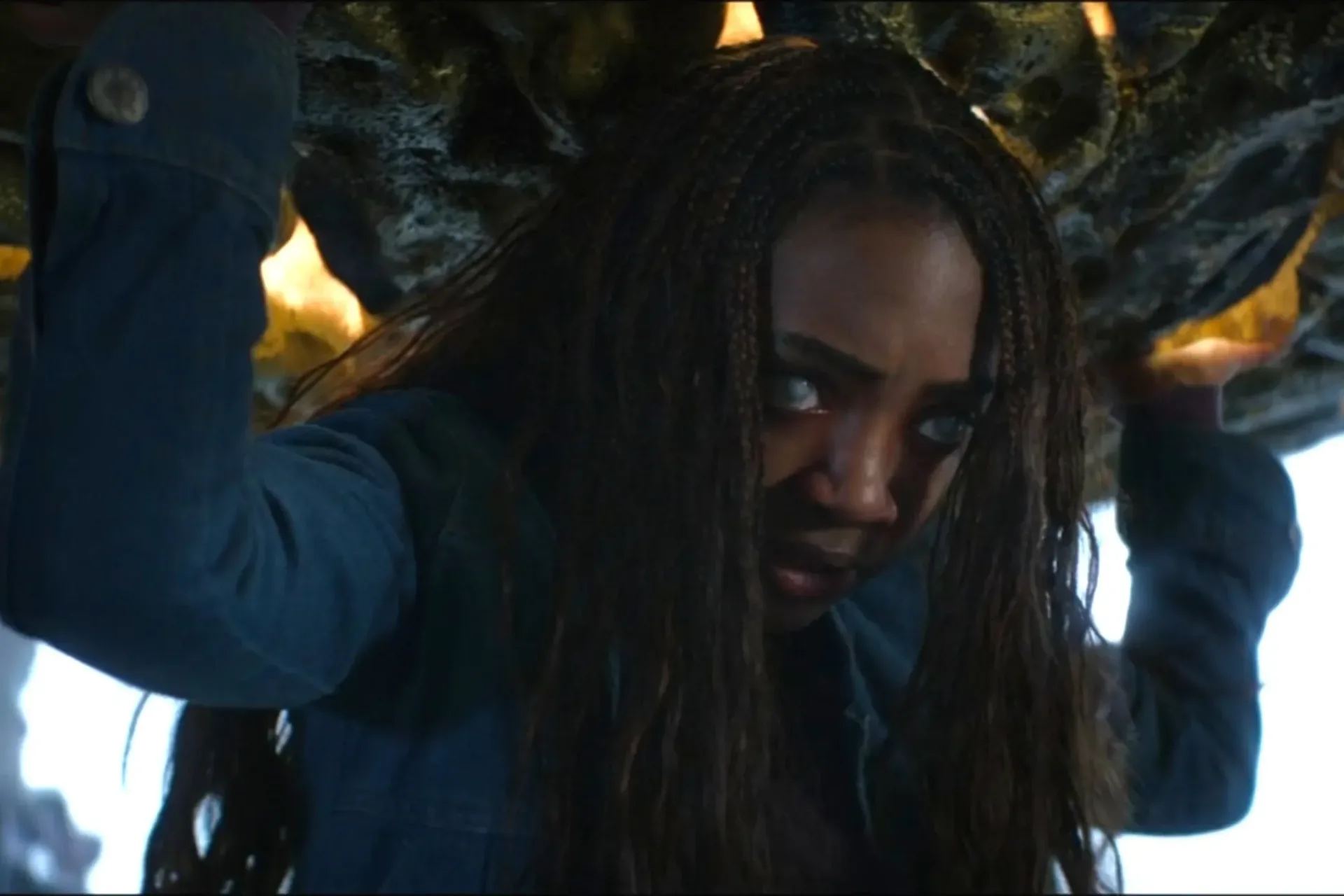
In Greek myth as used by the show, Atlas bears the sky. Episode 2 places Luke under that punishing burden, and Annabeth makes the choice to take it from him. The premise is simple enough to state, but it asks for a performance built around pressure that cannot be photographed directly: pain, exhaustion, responsibility and a character trying to remain present while carrying something incomprehensibly heavy.
A visual idea from Annabeth’s actor
The show gives the sky-bearer a distinct visual marker: a gray, hazy effect across the eyes. Jeffries said the color contacts behind that detail began as her own suggestion to writer Daphne Olive, and production eventually approved it.
It is a smart piece of visual storytelling. Contacts are not merely costume decoration in this context; they help translate an internal condition into a signal the audience can read immediately. Annabeth has entered an altered, deeply strained state, and the eyes make that visible even when she has little dialogue or is framed at a distance.
Jeffries’ explanation of the effect emphasizes the sense that Annabeth is no longer fully situated in ordinary reality. The grayness conveys strain and places the character in a different, dreamlike space. That becomes especially useful in Episode 3, when Annabeth remains affected by the burden and experiences a vision involving Percy and Thalia, played by Tamara Smart.
The practical implication for viewers is that the eye effect is not an arbitrary flourish added after the fact. It was conceived as part of the scene’s emotional language. In an effects-heavy fantasy series, that kind of choice can do considerable work: a small alteration to an actor’s face anchors a supernatural condition in something immediate and human.
The scream was a technical challenge, not a spontaneous one
Annabeth’s transfer of the sky’s weight is accompanied by a scream Jeffries found difficult to produce. She has said that screaming on demand does not come naturally to her, so she developed a physical routine to help create the necessary force: pressing against an object or doing a quick sit-up to activate her core, then growling before the take.
That is a useful reminder that a convincing outburst in a finished episode is often a technical acting problem as much as an emotional one. “Core” in this setting means the muscles around the torso that support breath and controlled physical exertion. Engaging them can give an actor more stability and power when producing a sustained vocal sound, particularly during a scene that also requires a tense body position.
Jeffries had recorded a deeper, rougher version of the scream, but said her voice was affected at the time of the version used in the episode, making the final sound higher than she remembered. The important detail is not that one vocal take is inherently more authentic than another. It is that the sequence reflects an actor adjusting in real time to the physical realities of production.
That aligns with the scene’s dramatic requirement. Annabeth’s response cannot look casually heroic. The moment needs to communicate that she has voluntarily taken on something agonizing, and that resolve does not remove the damage or fear involved.
A cliff, wires and stand-in weights
Episode 3’s vision adds another layer of behind-the-scenes ingenuity. On screen, Annabeth is holding on as Percy and Thalia hang over a cliff. For Jeffries, the sequence involved a practically built cliff, safety wires and two weights in place of her absent co-stars.
“Practical” refers to a physical element constructed and used on set, rather than a location or environmental feature created entirely digitally. The cliff setup gave Jeffries something tangible to climb onto and react against, while wires protected her from a fall. Scobell and Smart were not present when the camera focused on Jeffries, so the weights provided the resistance and positions she needed to play the act of holding onto two people.
It is an inherently awkward arrangement, one Jeffries has described with humor, but it also demonstrates how screen illusion is assembled from separate pieces. The audience sees a perilous emotional connection among three characters. The actor, meanwhile, has to supply the imagined faces, danger and stakes while hanging over a constructed edge and managing understandable nerves about looking down.
Jeffries said she took quiet time before the more emotional material on her acting coach’s advice. That preparation was a contrast with her natural tendency to joke around, but it helped her focus. The distinction is significant: levity on set and concentration for a take are not opposites. They can coexist, with the performer finding the point where a demanding scene needs stillness and attention.
Adapting a book chapter readers have not seen on screen
Season 3 also occupies new territory for Percy Jackson on screen. Earlier film adaptations covered the first two books in the series, while The Titan’s Curse had not previously been adapted in live action. Jeffries has framed that as both an opportunity and a responsibility: honoring how readers understand Annabeth while still bringing her own interpretation to the role.
That balancing act is central to any long-running literary adaptation. Readers often arrive with precise memories of character descriptions, plot turns and relationships. Television, however, must work for people who have never opened the novels as well as those looking for details and references. Jeffries has specifically said she does not want the show to be made solely for established readers, noting that some viewers came to the books after watching the first two seasons.
Annabeth’s separation is an example of why that approach matters. Existing fans may recognize the narrative structure from the novel, but a newcomer does not need prior knowledge to understand the immediate stakes: Percy and Grover are trying to reach their friend, while Annabeth must endure threats and make decisions on her own. The season can preserve a book-driven plot without requiring viewers to treat prior reading as homework.
For more on the broader relationship between television storytelling and well-known public figures, Joking Joystick has also covered a recent TV project centered on Muhammad Ali’s story.
New scene partners and instinctive collaboration
With Annabeth and Percy spending much of the season apart, Jeffries’ scenes with Bushnell take on increased importance. She has praised him as a considerate scene partner, particularly around fight material, where he checked in after scenes and took care not to strike her accidentally during a take. She also pointed to his confidence and evident enthusiasm for the work as qualities she has learned from.
The pair’s scenes in Episodes 2 and 3 bring Annabeth into closer proximity with Luke at a point when the Atlas storyline raises the stakes. Jeffries has also teased that their work in Episode 5 includes substantial improvisation. Improvisation means actors creating or reshaping moments beyond the fixed written dialogue, typically within the boundaries set by the production. Without seeing the episode, it is impossible to know how much of that material reached the final cut, but Jeffries’ enthusiasm suggests viewers should pay attention to the dynamics between Annabeth and Luke.
Her process with Scobell was different. Rather than extensively discussing every choice ahead of their Season 3 scenes, Jeffries said they would first play the moment from instinct, then talk through what else they could explore. Since they had already worked together extensively in Seasons 1 and 2, that approach allowed their established rapport to inform scenes without overplanning them.
It also suits a season built around distance. Percy and Annabeth have fewer shared moments, so every reunion, vision or emotionally charged connection carries more weight. The actors’ decision to discover some of those moments during takes may help retain the uncertainty the story requires.
What Jeffries is teasing for the rest of Season 3
Jeffries has singled out two upcoming points: her Episode 5 material with Bushnell and a surprise in the Season 3 finale. She has said the finale development means a great deal to her and is something many people had wanted to see, but she did not identify it.
That leaves room for anticipation without turning a performer’s tease into a confirmed plot claim. For now, the episodes already streaming make the clearer case for Season 3’s direction. The show is using separation to test Annabeth independently, pairing an ancient mythological punishment with practical staging, a performer-led costume detail and a character perspective shaped by fear as much as bravery.
For Jeffries, the challenge is not simply carrying the sky in a fantasy scene. It is making the audience feel the cost of choosing to do so.