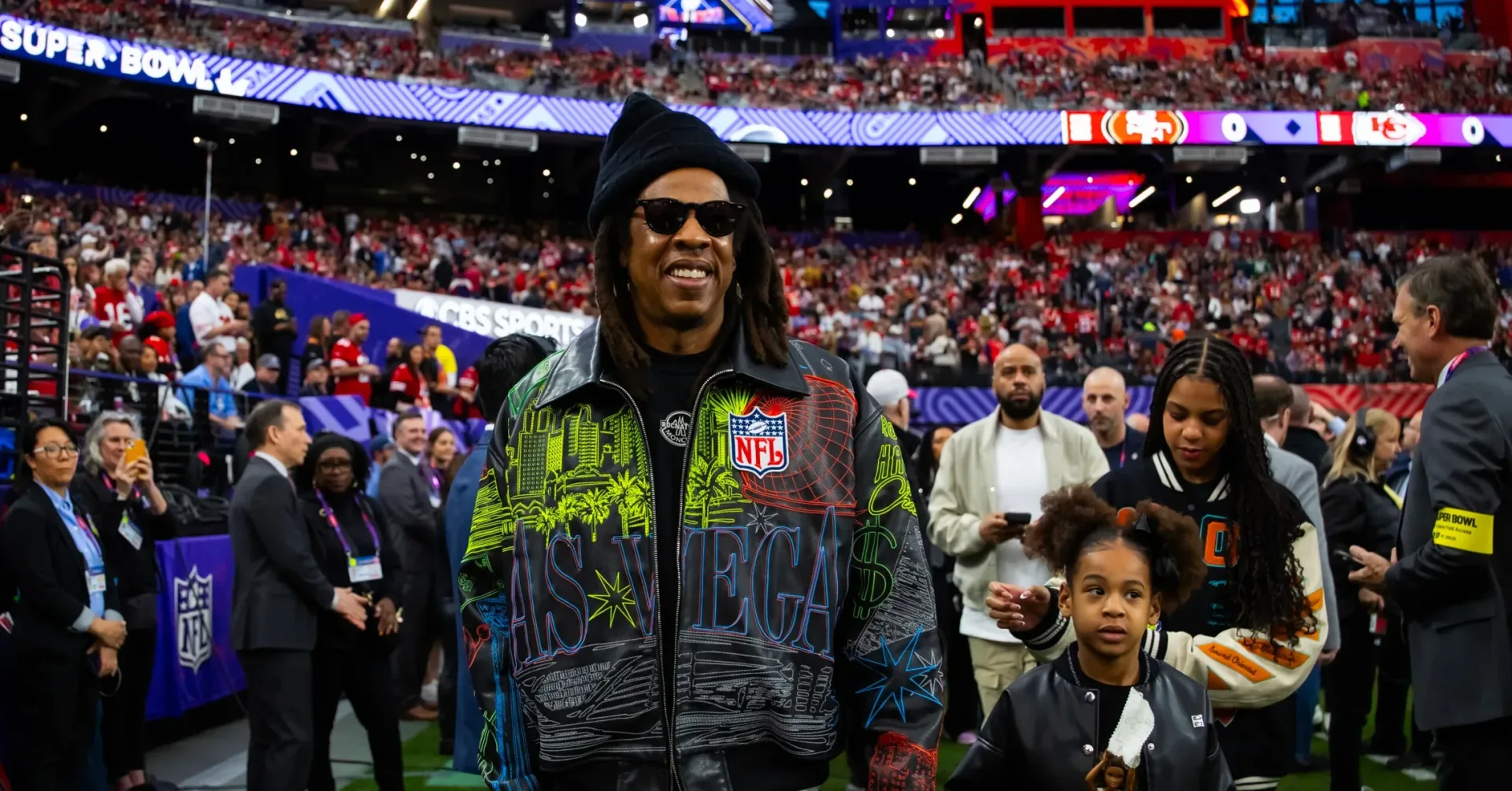
JAY-Z has shared a playful memory of Muhammad Ali while discussing The Greatest, the eight-episode television series about the boxer’s life and career. JAY-Z is among the producers attached to the show, alongside Lonnie Ali, Michael B. Jordan and Josh Wakely, while Jaalen Best plays Ali.
The anecdote surfaced during a roundtable conversation featuring JAY-Z, Best, Lonnie Ali and Frazier Tharpe. Asked about his relationship with Ali, JAY-Z described a recurring bit between them: Ali would jokingly act as though he wanted to punch him in the face.
“Yeah, for some reason he always wanted to punch me in the face,” JAY-Z said. “It was great. It was fantastic. Anytime he saw me… he put his hand on my chin.”
The story is funny precisely because it turns the intimidating reputation of a world-famous fighter into a personal, comic gesture. Rather than presenting Ali as a distant historical monument, JAY-Z’s recollection frames him as a person who could use his physical presence and showmanship to make an encounter memorable.
That sense of personality matters for a dramatization centered on Ali. A series about an athlete’s life can easily become a chronology of milestones. The supplied details describe The Greatest as recounting Ali’s life and career, but the people involved in the conversation point to another challenge as well: portraying an individual whose public identity was inseparable from charisma, humor, conviction and confrontation.
Why Ali’s conviction resonated with JAY-Z
JAY-Z’s comments did not stop at the joke. He identified Ali’s conviction as the quality that has remained most useful to him. By conviction, he was not referring simply to confidence or fame. In this context, it means a willingness to stand by what one believes is right even when a large audience does not agree.
“To this day, when you attain a certain platform, you’re not going to please everyone. It’s just impossible to do,” JAY-Z said. “But having that conviction is one of the things that drives me. Just do what you believe is right… You’re not going to be right all the time. That conviction is a major thing that I take from Ali to this day.”
It is a measured reading of influence. JAY-Z did not argue that conviction guarantees correctness, nor did he suggest that public visibility solves the problem of making difficult choices. His point is nearly the reverse: a bigger platform ensures that decisions will be judged by more people, often with incompatible expectations.
That distinction gives his admiration for Ali a practical dimension. The lesson is not to chase universal approval. It is to act with an intelligible set of principles, accept that mistakes are possible and resist treating disagreement as proof that a decision was automatically wrong. For an artist and business figure with a major public profile, that is the aspect of Ali’s legacy JAY-Z says continues to guide him.
The Greatest: what is known about the series
The Greatest is available on Amazon Prime and consists of eight episodes. It officially arrived on November 4. The program centers on Muhammad Ali’s life and career, with Jaalen Best taking on the role of Ali.
Best joins a line of performers who have portrayed the boxer, including Will Smith. That comparison is useful only as context, not as a claim that the productions take the same approach. The available information does not detail the series’ episode structure, timeline, supporting cast or specific events depicted. What is clear is that the project has involvement from people connected to several sides of Ali’s continuing cultural legacy: Lonnie Ali, members of the production team and the actor tasked with embodying the central figure.
JAY-Z’s producer role also places the series within a familiar intersection of music, screen storytelling and sports mythology. His discussion of Ali focuses less on boxing technique than on the force of Ali’s character. That emphasis is consistent with the way the conversation approached the project: not merely as the retelling of a sporting career, but as a chance to examine why Ali remains significant to people working far outside the ring.
Music and hip-hop figures frequently help keep larger cultural conversations in circulation, whether through a screen project, a personal story or an explicit statement of influence. For another recent example of rap artists turning a personal connection into a song release, see Snoop Dogg and Feid’s “Gracias X Todo” collaboration.
Anecdote, legacy and adaptation
The hand-on-the-chin detail is brief, but it does substantial work. It gives the discussion a human-scale moment that broad statements about “legacy” often lack. Ali was not just an admired subject whom JAY-Z encountered through archival footage, records or formal praise; JAY-Z describes a repeated, direct interaction with a distinctive comic rhythm.
For viewers, that is one reason celebrity recollections can complement a biographical drama without replacing it. A scripted series has to organize a life into scenes and episodes. A firsthand story can instead preserve a small, seemingly incidental behavior: a joke, a gesture, the feeling of being in the room. Neither form supplies the whole person on its own. Together, they underline why an eight-episode account of Ali’s life has more to contend with than a list of accomplishments.
JAY-Z’s remarks also offer a straightforward lens through which to approach The Greatest. Viewers interested in the series can consider the relationship between Ali’s public platform and the convictions JAY-Z says he drew from him. That does not require assuming the program endorses every interpretation of Ali or presents a single definitive account. It simply identifies the quality that one of its producers believes is central to Ali’s ongoing influence.
There is also a notable difference between remembering a famous person and using that person as a symbol. JAY-Z does both here, but the order matters. He first recalls Ali as funny and physically expressive, then explains the seriousness of Ali’s impact on his own decisions. The result is a portrait, however small, of someone who could make a guest laugh while also leaving them with a lasting model for navigating public disagreement.
What the conversation adds
With only the available details, it would be premature to make broad claims about the full scope of The Greatest or how it compares with earlier portrayals of Ali. The roundtable does, however, clarify what its participants see in the material: a story with professional, personal and cultural weight.
Best’s presence makes the exchange especially relevant to the series itself. He plays Ali, while JAY-Z and Lonnie Ali represent different relationships to the boxer’s legacy and the production behind the show. Their participation suggests that the discussion was not just promotional in the narrow sense of explaining where to watch. It was also an opportunity to articulate what Ali represents to the people helping put his story on screen.
For JAY-Z, the answer is both humorous and serious. Ali was the man who would greet him with a mock threat and a hand on the chin. He was also an example of how to live with the fact that no public figure can satisfy everybody. JAY-Z’s takeaway is not perfection; it is conviction tempered by the acknowledgment that one can be wrong.
That is a more demanding idea than uncomplicated hero worship. It asks audiences to distinguish steadfastness from infallibility, and to understand why a person’s influence can persist across generations and industries. The Greatest now gives viewers an eight-episode opportunity to revisit the life and career behind that influence, with Best portraying Ali and JAY-Z among the producers helping bring the project to television.