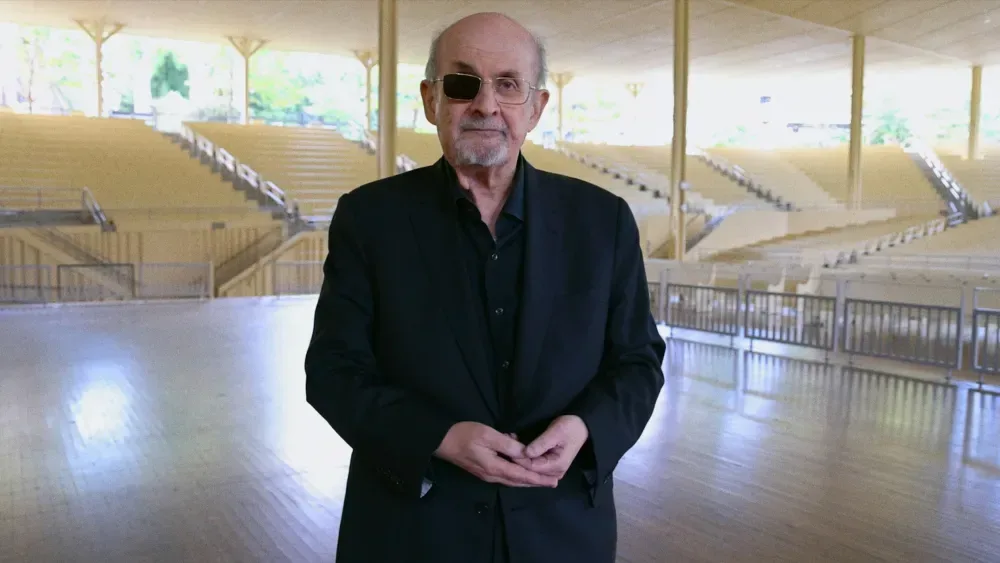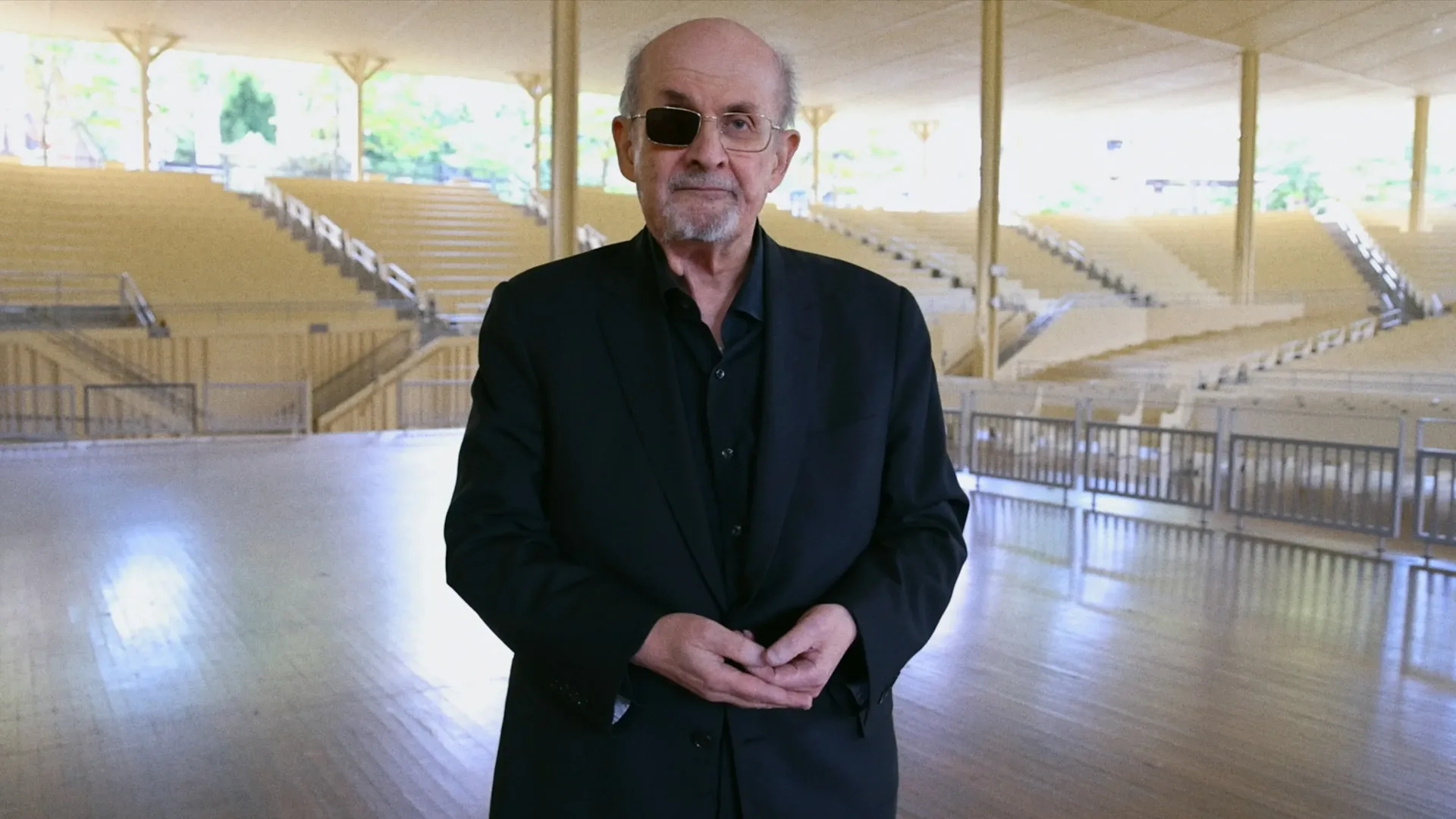
Knife: The Attempted Murder of Salman Rushdie puts Salman Rushdie’s own account of survival at the center of a story that has too often been reduced to its most public political contours. Directed by Alex Gibney, the 107-minute documentary follows the author after he was repeatedly stabbed on stage at a literary festival in upstate New York on August 12, 2022. It also returns to the decades of threats, isolation and public argument that followed the 1988 publication of Rushdie’s novel The Satanic Verses.
The film’s defining material is not a new revelation about that long history. It is the immediate, physical record of what the 2022 attack did to Rushdie. Footage shot by his wife, writer Rachel Eliza Griffiths, during his hospitalization shows the extent of his injuries and recovery. The images include damage to his hand, a long line of abdominal stitches and severe trauma around his right eye. Their inclusion makes the documentary’s argument about artistic vulnerability tangible rather than abstract.
That choice carries a particular force because the film does not treat Rushdie merely as a historic symbol in a free-speech dispute. He narrates throughout, and the story begins from his point of view. A dramatized reconstruction renders the attack through blinding stage lights, an indistinct approaching figure and sound rather than lingering on the attacker. The approach keeps the emphasis on Rushdie’s fractured perception and its aftermath, not on granting spectacle or notoriety to the violence.
A personal document inside a familiar public history
Gibney’s film is built from several threads: Rushdie’s present-day reflections, Griffiths’ diaristic hospital footage, archive material, earlier interviews and animation accompanying passages from The Satanic Verses. That construction gives the documentary a dual purpose. It is at once a recovery narrative and a concise profile of a writer whose life was dramatically altered by his work.
For more context, explore Final Fantasy X vs Kingdom Hearts: Choose Your First PS2 RPG by Combat, Exploration and Save Pressure.
Rushdie reflects on why he did not run or fight back, which opens up a broader consideration of death and fatalism. Those questions are inherently personal; there is no clean or instructional answer to how a person should respond during a sudden attack. The film’s value is in allowing that uncertainty to remain. Recovery is likewise shown as a process involving both the author and a close support network, with Griffiths occupying a crucial role through the footage she captured and her place beside him.
The documentary also looks back to Rushdie’s early life between India and London, including difficult experiences with his alcoholic father. Still, its primary historical focus begins after The Satanic Verses arrived in 1988. The novel became the subject of profound controversy, and Ayatollah Khomeini, then Iran’s Supreme Leader, issued a fatwa calling for Rushdie’s assassination in 1989.
What “fatwa” means in this context
A fatwa is generally a religious legal opinion. In the history examined by the documentary, the word has a much more frighteningly specific meaning: Khomeini’s 1989 decree called for Rushdie’s killing. The film places that action amid protests and book burnings in the United Kingdom, Pakistan and India, as well as attacks on bookstores and editorial offices elsewhere. Hitoshi Igarashi, Rushdie’s Japanese translator, was murdered.
These details matter because they establish that the threat around Rushdie was never solely a debate conducted in essays, television appearances or lecture halls. It had consequences for people connected to the publication and circulation of a book. The 2022 assault therefore functions in the film not as an isolated event, but as a devastating continuation of a danger that had shadowed Rushdie for decades.
Animation returns the novel to the discussion
One of the documentary’s more useful formal choices is its use of scratchy animated imagery for excerpts from The Satanic Verses. The novel concerns two Indian Muslim men in London who undergo spiritual upheavals after surviving a plane crash. By visualizing the literary and imaginative character of the work, the film brings attention back to the actual object at the center of the controversy: a work of fiction.
That distinction is not a technicality. A novel can be challenging, provocative, spiritually charged or offensive to some readers; it remains a created work of language and imagination. The gap between reading, criticizing or rejecting a book and answering it with threats or violence is the moral distance the documentary keeps in view. Its account of religious extremism is focused on the real-world harms enabled by absolutist responses to artistic expression, not on suggesting that disagreement with a book is itself illegitimate.
“Magical realism,” the literary mode associated with Rushdie’s work, is also relevant here. The term describes fiction in which extraordinary or supernatural elements coexist with an otherwise recognizable reality. In the context of this documentary, the animated passages appear designed to emphasize that The Satanic Verses is an imaginative novel, rather than a literal document. The animation also visually echoes the existential concerns in Rushdie’s narration.
Why the documentary’s restraint matters
Gibney is known for documentaries that use a comprehensive, investigative framework to study figures and systems of power. Knife applies some of that profile-driven discipline: it assembles archive coverage, past interviews and historical context into a clear timeline. But the most potent material is more intimate and less reportorial. Griffiths’ images from the hospital and Rushdie’s voiceover put the viewer close to bodily pain, vulnerability and care without allowing the film to turn entirely into a procedural account of the assault.
The alleged assailant, Hadi Matar, is mentioned by name only once. That limited emphasis is a meaningful editorial decision. The film instead treats the attacker as part of a larger history of incursions on Rushdie’s freedom and safety. It does not erase the individual event, but it resists making the person accused of carrying it out the documentary’s dominant subject.
There is a risk in any retrospective film about a much-discussed controversy: it can assume that recounting the headline history is sufficient. Knife appears to avoid that trap chiefly through its firsthand recovery material. Many viewers may already know the broad outline of the fatwa, the years of protection and the attack in 2022. Seeing the human cost of that history, and hearing Rushdie contemplate survival after it, is a different experience from encountering the events as reference points in a cultural argument.
What the film says about creative freedom
The documentary’s central idea may sound straightforward: artistic expression remains vulnerable to violent coercion. Yet its personal focus gives that proposition practical weight. Freedom of expression is often discussed as a principle belonging to governments, institutions, publishers or courts. Knife locates the issue in the body and daily life of one writer, and in the people who care for him.
That does not make Rushdie’s story universal; few artists experience this precise kind of danger. But the film makes clear why the principle cannot be separated from the people exercising it. Threats directed at writers, translators, publishers and booksellers do not only seek to punish an individual. They can also pressure the wider ecosystem around creative work, encouraging silence through fear.
The inclusion of Griffiths is therefore more than a sentimental counterpoint. Her documentation preserves a version of events that is close, domestic and unguarded, while her presence underscores that public violence is absorbed by families and friends as well as its direct target. Even a call from family friend Wes Anderson is presented as part of a larger network of attention around Rushdie’s recovery, rather than as a diversion into celebrity.
Knife: The Attempted Murder of Salman Rushdie is directed by Alex Gibney and features Salman Rushdie and Rachel Eliza Griffiths. Benjamin Bloodwell and Griffiths are credited for camera work; Andy Grieve edited the documentary and Will Bates composed the music. Producers include Erin Edeiken, Gibney and Sruthi Pinnamaneni. The film premiered at Sundance.