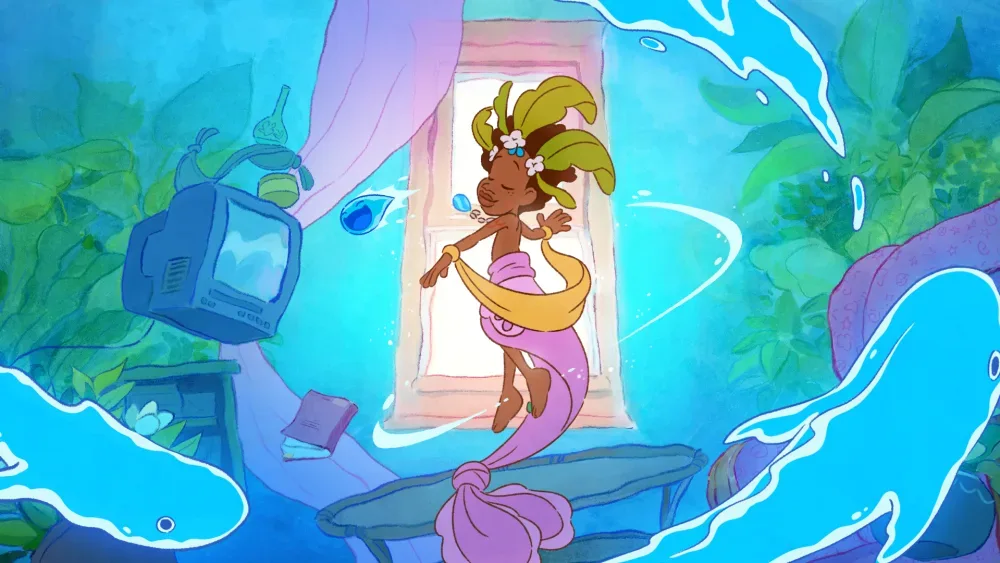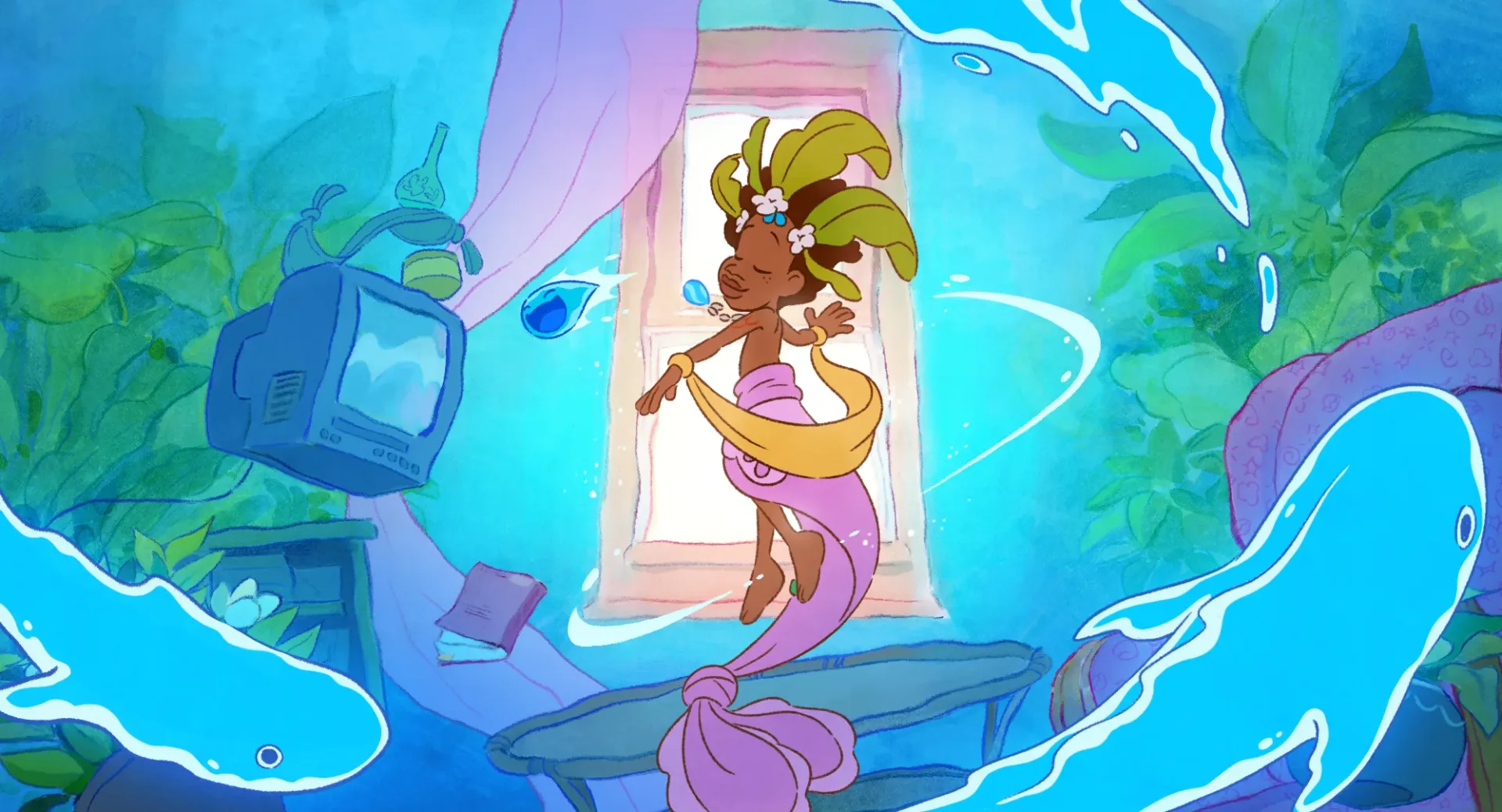
Animation can make a child’s imagination feel physically present: an apartment can suddenly seem ocean-deep, sea creatures can join an ordinary day, and a wish that might be dismissed by the grown-up world can become the central visual language of a movie. ‘Julián’, the feature directorial debut from Louise Bagnall, is built around that possibility while keeping its feet on Brooklyn pavement—cracked, weedy, imperfect pavement included.
Based on Jessica Love’s children’s book Julián Is a Mermaid, the animated feature follows 7-year-old Julián during a summer spent with his abuela in Brooklyn. Julián wants to become a mermaid, and his imagination gives the film room for rich aquatic fantasy. But the story also reaches into family history. As Julián learns more about his grandmother’s colorful earlier life in the Dominican Republic, she is pushed to confront memories and parts of herself that had been set aside after coming to the United States.
That premise gives the movie a deceptively large emotional map. It is about self-expression and the pleasures of a child getting to be fully himself. It is also about migration, memory, generational friction, bullying, yearning and the sometimes difficult work of being seen by the people closest to us. A mermaid story may sound like a breezy route to sparkling scales and undersea spectacle—and presumably there will be no shortage of color—but ‘Julián’ is aiming for something more layered than an extended swim through fantasy.
A child’s dream, and an abuela’s buried past
Julián’s desire to be a mermaid drives the action, yet the film does not frame the grandmother as a simple obstacle designed to be overcome. Her tension with Julián is connected to loss and to a past she has suppressed. The relationship becomes a two-way process: Julián’s openness and curiosity act as a catalyst for her own recognition of identity, history and joy.
That makes the central family bond especially important. Children’s stories often understand something adults can forget: self-discovery rarely happens in isolation. Julián has an imaginative inner world, but his ability to share it depends on his home, his neighborhood and the response of the adult who cares for him. His abuela, meanwhile, is not only a guardian looking toward the future of a child. She is a person with unfinished feelings about her own past.
The film’s emotional ambitions sit in the overlap. Julián explores who he wants to be; his grandmother reconsiders what she thought she had left behind. Neither journey erases the other, and that is where the adaptation’s potential weight lies. The film has room for celebration without suggesting that affirmation is automatic or that family histories arrive neatly resolved.
Bagnall previously received an Oscar nomination for the animated short Late Afternoon. For ‘Julián,’ she is working with screenwriter Juliany Taveres, whose Brooklyn roots add local specificity to the project, and Guillaume Lorin, who co-directs with Mark Mullery and grew up in the Caribbean. Those perspectives matter to a film connecting a Brooklyn summer with Dominican heritage, rather than treating either setting as a generic backdrop.
Brooklyn without a glossy filter
‘Julián’ is described as joyful and colorful, drawing from Latin culture, sea life, mermaids and a seven-year-old’s capacity to make the mundane enormous. Yet its visual approach is not meant to sand away the texture of city life. The Brooklyn of the film is intended to retain evidence of wear: vegetation breaking through pavement, marks and cracks on walls, and the rough little details that make a neighborhood feel inhabited rather than freshly rendered for a postcard.
That choice supports the movie’s larger concerns. A pristine setting could make beauty feel conditional, as though only the polished or perfectly ordered deserves wonder. ‘Julián’ instead connects beauty with particularity and imperfection. The apartment, sidewalks and streets can be real places with real edges, even as they open into magical-realist passages.
Magical realism is a natural fit for the material because it does not require the film to choose between a child’s fantasy and the seriousness of daily life. Julián can imagine swimming with sea creatures, only for the spell to break and leave water across the apartment. The joke and the magic can coexist. So can the imaginative sequence and the emotional truth behind it: a child is testing out a way of being in a world that may not immediately know what to do with it.
That balancing act is also why the story’s family tension need not cancel its playfulness. The film can move from oceanic wonder to household consequences without treating either register as less valid. For an animated feature, that flexibility is a strength. Animation can make inner feeling visible while preserving the tactile reality of a room, a family and a neighborhood.
Hand-drawn tools in an AI-era conversation
The production’s materials are central to its identity. Although animation is created on the computer, the characters remain hand-drawn, and the backgrounds are made on paper using pencils and markers. The creative idea is charmingly direct: use the kinds of tools Julián himself might have in a pencil case.
It is more than a cute production detail. A pencil-and-marker approach can create a meaningful continuity between the child protagonist’s imaginative act and the film’s own construction. Julián is not simply a character inside a finished digital object; the movie’s visuals are designed to feel connected to the accessible, handmade instruments through which a child might sketch an ocean, a costume or an impossible new version of the self.
The choice also arrives during an ongoing wider conversation about artificial intelligence and creative labor. ‘Julián’ does not present a technological purity test: computer animation remains part of the workflow. But its commitment to paper-made backgrounds and hand-drawn character work emphasizes human marks, material texture and artistic decisions that are visible in the image. In a story centered on expression, that feels especially apt.
There is a useful connection here to other screen stories where memory and community carry as much weight as plot mechanics. Readers interested in that corner of pop culture can also explore ‘Ancestors’ and its exploration of memory, mythology and queer community. The projects are distinct, but both point to the way identity stories gain texture when personal imagination meets a larger social and familial past.
A feature adaptation with an expansive creative team
Jessica Love’s original book supplies the foundation, while the feature format gives Bagnall and her collaborators space to deepen both Julián and his abuela. That added space is key to the film’s move beyond a single transformative moment. The adaptation can explore Julián’s heritage, his grandmother’s life before Brooklyn and the emotional distance that may exist between loving relatives.
Zoe Saldaña is an executive producer. The production team includes Nora Twomey, Tomm Moore, Paul Young, Anthony Leo, Andrew Rosen, Stephan Roelants, Fabien Renelli, Charlotte de la Gournerie and Lewis Taylor. Film New Europe is handling international sales, while CAA Film Sales has U.S. sales responsibilities.
‘Julián’ is at TIFF seeking distribution. No release date, platform or distributor has been confirmed in the available details, so audiences will need to wait for firmer news on when and where the film may be seen.
Why ‘Julián’ stands out
The strongest promise of ‘Julián’ is its refusal to reduce self-expression to a slogan or family complexity to a villainous misunderstanding. Julián’s mermaid dream is vivid, funny and visual. His abuela’s history carries sadness, displacement and recovery. Brooklyn is beautiful but not polished into unreality. The Dominican Republic is not merely an origin point in exposition, but part of the emotional current running through the characters’ lives.
At its best, animation is uniquely equipped for this kind of storytelling. It can make water splash across an apartment after a fantasy ends, turn a child’s feeling into a living environment and preserve the scratchy intimacy of paper and marker. ‘Julián’ is positioning those capabilities in service of a family tale where imagination does not distract from reality—it gives the characters a way to face it.