David Turpin’s Ancestors arrives with a premise rooted in memory: not merely the memory of a devastating public-health crisis, but the intimate, uneven memory of the people and relationships shaped by it. Set in late-1980s London amid the HIV-AIDS crisis, the film centers on Beau, an Irish immigrant who is trying to find companionship, freedom and a dependable sense of self in a new city.
That framework makes Ancestors a character-led drama rather than a history lesson. Its focus is on the ordinary places where a life can be built, or at least briefly held together: a shared home, a café, a close friend, the people who offer guidance, and the fantasies that make a hard reality survivable. Turpin has described the project as a story about human connection and love, as well as the emotional lift people can find in dreams and imagined worlds when more concrete sources of comfort are failing.
The film is set to premiere at TIFF, with Mister Smith Entertainment handling international sales. No broader release information is established here, but the details surrounding the story and cast suggest a film interested in the texture of an era without treating its characters as artifacts trapped inside it.
Beau’s search for a place to belong
Éanna Hardwicke plays Beau, whose move from Ireland to London is also a search for community. He lives with Michelle, his best friend, played by Jessica Reynolds. Beau also works in a café overseen by Maurice, portrayed by Rupert Everett. Maurice is described as an older “auntie” figure for younger gay men in the neighborhood: someone whose role extends beyond the daily routines of serving customers and keeping a business running.
That intergenerational connection is especially meaningful in a story set during a period when AIDS was killing vast numbers of people, particularly gay men. Turpin, born in 1982, has spoken about the crisis as something that continued to echo through his life despite his being a child during the years often identified as its peak. The losses are not only statistical or historical. They can be felt later as a missing continuity between generations, including the absence of potential mentors, elders and familiar points of reference.
Ancestors appears to take that absence seriously. Beau’s desire to be fully himself is not presented as a simple matter of arriving in a more accepting city. It is tied to the people around him, the safety they can offer one another, and the way a fragile sense of stability can be altered. That change comes with Tiny, played by Jack Wolfe, entering Beau and Michelle’s orbit. Tiny’s arrival is said to transform the life Beau has carefully assembled.
It is a setup that leaves room for tenderness but does not imply ease. Turpin has highlighted Beau’s contradictions: he can be emotionally open and gentle, yet also repel people. Hardwicke’s performance was conceived as carrying both vulnerability and a tougher, more guarded quality. Turpin has referenced the screen presence of Montgomery Clift and a young Marlon Brando in discussing that mixture.
Maurice and the serious meaning of screen idols
One of the film’s most distinctive details is Maurice’s devotion to classic movie stars. Their images cover the walls of both his café and his home, while Maurice makes sure the younger people in his life understand why these women matter. Christina Hendricks appears as one of those screen goddesses in a part that operates both literally and metaphorically.
The idea could be reduced too easily to a familiar visual shorthand: the witty older gay man with portraits of Hollywood legends and a ready-made camp sensibility. Turpin’s approach is more deliberate. He has pushed back on the notion that the relationships many gay men had with stars such as Bette Davis, Joan Crawford and Elizabeth Taylor should be dismissed as a joke or as shallow celebrity worship.
For people pushed away from established systems of belonging, a performer’s image, persona and resilience could carry a profound emotional or even spiritual resonance. A star might represent defiance, glamour, survival, self-invention or the freedom to be larger than the limits imposed by others. In that reading, the posters on Maurice’s walls are not disposable decoration. They are part of a private language of aspiration and recognition.
That perspective also helps clarify why Hendricks’ casting matters to the film’s design. Turpin has said he regarded her as an icon long before she became involved, recalling the impact of seeing her in Mad Men. Her eventual participation gave the film a performer capable of embodying the distance and fascination that a screen idol can hold, while still approaching character work with precision.
Screen history and screen fantasy can become forms of inheritance. They do not replace the people who have been lost, nor do they solve the social and personal wounds left by a crisis. But they can preserve feelings, gestures and possibilities that might otherwise go unspoken. That is an especially apt theme for a film named Ancestors, a title that points toward lineage while acknowledging that lineage is not always handed down in conventional ways.
Using music to reach the period and the characters
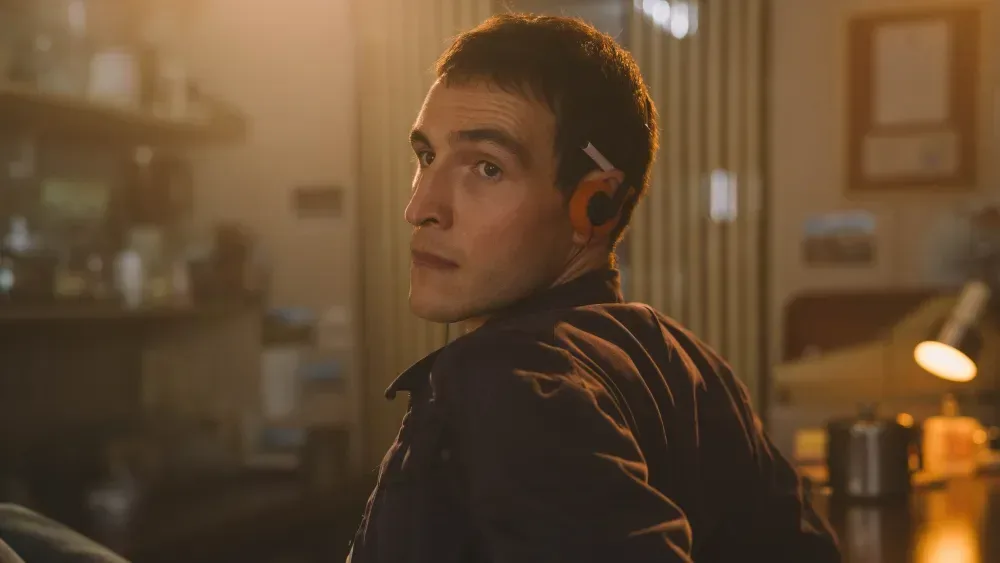
Turpin’s preparation with the cast included an appropriately analog detail. He gave each performer a cassette Walkman and a custom tape intended to reflect what their character might listen to. The exercise also revealed a generational gap: some younger members of the ensemble had never encountered a cassette before.
The goal was not nostalgia for outdated hardware. Music can access memories, moods and emotional associations that are hard to arrive at through discussion alone. A song selected for a character can suggest pace, confidence, loneliness, desire or a carefully protected interior world. In a late-1980s story, the cassette is also a practical reminder of how personal listening once worked: a physical object, assembled track by track, passed around or kept close.
That attention to character-specific music fits the broader premise. Ancestors is concerned with how people make emotional shelter from the materials available to them. A favorite performer on a wall, a tape in a Walkman, a café full of familiar faces, or a friendship that offers room to breathe can all become crucial. The film’s period setting carries unavoidable historical weight, but the smaller details are what may give its people their individuality.
A story about remembering without flattening the past
Historical dramas about the AIDS crisis can face a difficult responsibility. The era cannot be approached without acknowledging fear, grief, political neglect and the human scale of loss. At the same time, people who lived through it had friendships, humor, ambition, romance, bad days, private obsessions and cultural passions. Reducing them solely to suffering would create another kind of absence.
Turpin’s stated interest in affection, fantasy and community indicates that Ancestors is seeking that fuller frame. The past is not invoked simply for its costumes, music or tragedy. It is a setting in which people attempt to form a life while the ground beneath them is dangerously uncertain.
That kind of screen storytelling can also sit beside films that revisit other overlooked struggles and communities, including a recent drama centered on the 1977 disability-rights sit-in. The subjects are distinct, but both demonstrate why historical narratives matter when they restore individual experience to events often compressed into a few lines in public memory.
What David Turpin is developing next
Turpin is already working on another feature, titled The Foundling, which he hopes to shoot next year. He has characterized it as quite different from Ancestors, although love remains the connective thread. That continuity is visible in the new film’s premise as well: Beau’s story is shaped by the pursuit of community, the risks involved in letting people close, and the acts of care that help people endure.
For now, Ancestors stands as a late-1980s London drama built around Beau, Michelle, Maurice and Tiny, with the looming reality of the HIV-AIDS crisis informing every effort to connect. Its cast combines Hardwicke, Reynolds, Everett, Wolfe and Hendricks, while its central images—café walls covered in beloved stars, a cassette selected for a character, and a newcomer looking for somewhere to be free—point to a film about the ways people build family, memory and hope when none can be taken for granted.