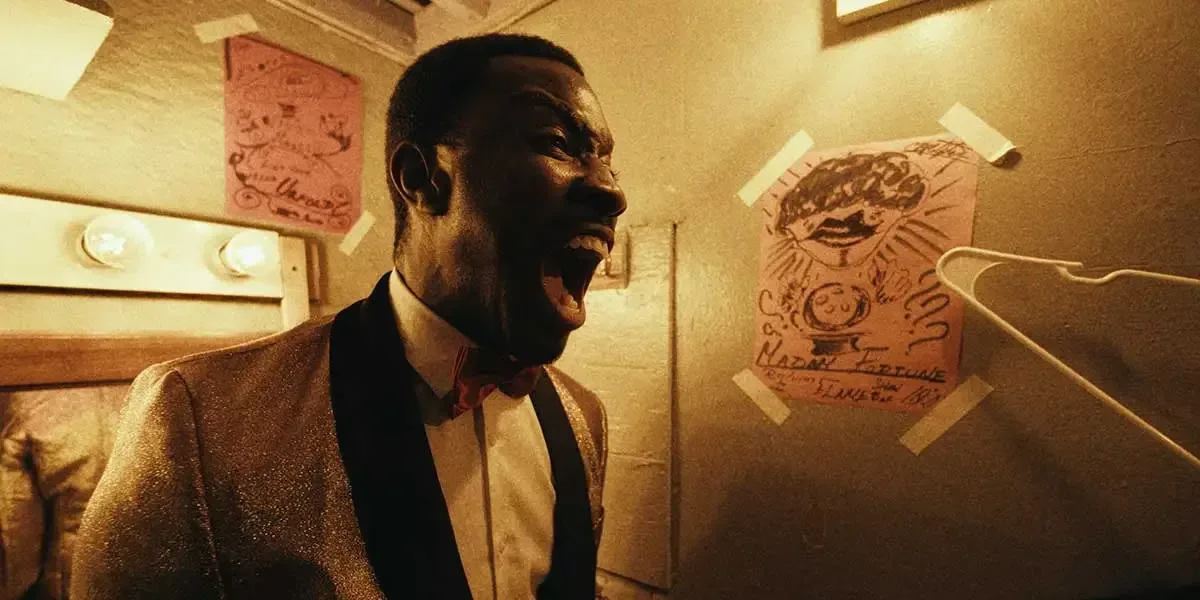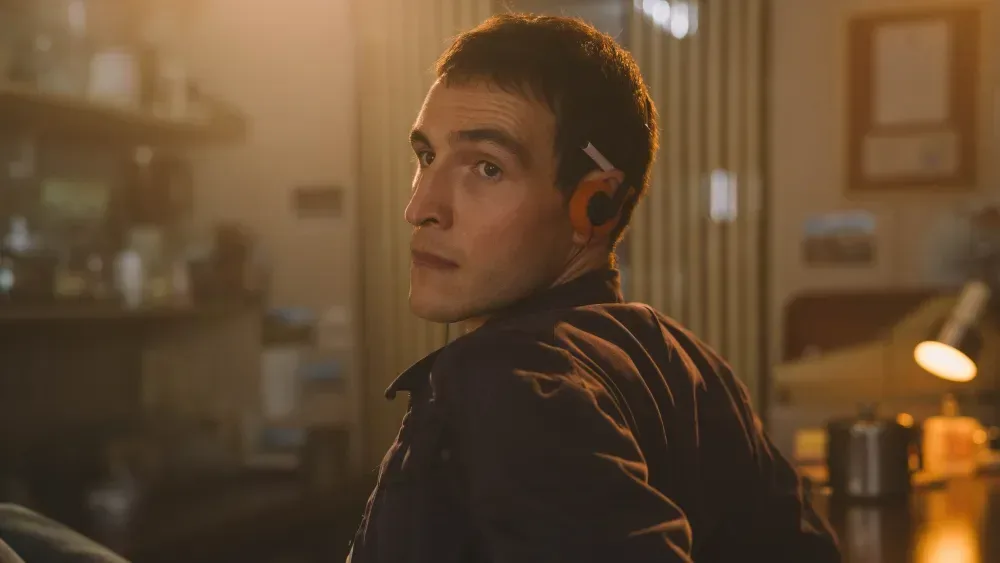
Ancestors is a 106-minute drama set in 1988 London, where connection, caretaking and disappearance become inseparable for Beau, a young Irish man played by Éanna Hardwicke. Written and directed by David Turpin, the Ireland-U.K. production approaches the AIDS crisis through a close, unstable relationship rather than an attempt to comprehensively map an era. Its focus is intimate: a man trying to find someone he could not save, while confronting the terror that has shaped his own life.
That narrower scale is a considerable strength. The film is concerned with community, but not community as a cleanly uplifting abstraction. It finds people who look after one another in incomplete, improvised ways: a café owner offers a sheltering presence, Beau gives Tiny a place to sleep, and affection persists even as illness, addiction and fear make reliable care difficult. The result is a queer elegy that recognizes both the necessity of chosen family and its limits.
Its closing statement, “No survivors, only descendants,” supplies the key to the title and the film’s outlook. Ancestors does not frame surviving a devastating period as a badge of moral superiority. Instead, it places the dead, the living and later generations in an ongoing relationship. People who came afterward inherit stories, losses, forms of solidarity and unresolved grief. That is a potent proposition for a film set amid a crisis that is often reduced to numbers or retrospective shorthand.
A search story shaped by grief
Beau has left Ireland, a country he describes as one in which his identity was illegal, and now works at a shabby London café run by Maurice, played by Rupert Everett. Maurice understands himself as an “auntie” figure to the younger queer people circulating around him. The term matters because it describes a role rather than merely a personality: a person offering nurture, practical refuge and cultural guidance outside a conventional family structure.
Into Beau’s orbit comes Tiny, played by Jack Wolfe. Tiny is young, directionless and working as a hustler. A single night’s bed gradually turns into a shared home. Turpin’s story avoids turning this arrangement into an expected romance. Beau and Tiny’s bond is built on a quieter, more difficult empathy. Beau becomes protective; Tiny, however, remains hard to protect.
When Tiny is diagnosed with AIDS, Beau’s sense of responsibility deepens. Yet a desire to care for someone does not confer the ability to control their choices or shield them from every danger. Tiny is vulnerable to addiction and fleeting attachments, and he eventually stops returning home. Beau begins searching through bars, clubs and cruising grounds, spaces that become less like a legible city map than a recurring nocturnal labyrinth.
This is where the film’s structure takes on its most haunting dimension. Beau is looking for Tiny, but the search also forces him toward his own fears. The boundaries between then and now, the external city and Beau’s inner life, and reality and reverie begin to loosen. The film does not treat a missing-person search as a straightforward detective plot. It treats it as an emotional condition: movement without certainty, hope without evidence, and dread that follows every new lead.
Hardwicke gives Beau a guarded, physical interiority
Hardwicke’s performance is the film’s center of gravity. Beau initially presents a composed, conventionally tough exterior: he is quiet, capable and seemingly built for endurance. But the role never mistakes stoicism for an absence of feeling. Hardwicke lets strain show in small increments, suggesting a man whose emotional defenses are firm because the world has made them necessary.
The performance also gives the story a compelling account of masculinity. Beau’s care for Tiny is not softened into sentimentality, nor is it played as possessiveness disguised as rescue. He feels duty, tenderness, frustration and fear. His silence is not a blank space; it is an active, often painful effort to contain what he cannot fix. As time and hope erode, Hardwicke makes Beau’s physical bearing register that pressure.
That specificity is important because Ancestors asks its audience to stay close to Beau even when the narrative becomes more abstract. His emotional logic remains clear. He is not simply grieving a person or fearing illness in the abstract. He is confronting the possibility that love, vigilance and a safe room may still be insufficient.
Wolfe’s Tiny is necessarily more elusive. The character’s instability is central to the drama, as is the tension between the version of Tiny Beau believes he can reach and the person who keeps slipping beyond his grasp. Everett’s Maurice, meanwhile, adds a different generational position to the film’s network of care. His café and home function as imperfect havens, places where people can be seen and fed even if they cannot be entirely kept safe.
Texture, fantasy and the risks of visual metaphor
Director of photography Patrick Jordan gives the waking world a grainy, muddied palette punctuated by neon. The look suits a London rendered as both refuge and maze. It is tactile rather than polished, keeping the film’s period setting from feeling like pristine nostalgia. Its clubs and bars are not decorative backdrops; they become shifting sites of encounter, escape, risk and possible disappearance.
Turpin also uses fantasy. In recurring monochrome passages, Beau talks with Gloria, played by Christina Hendricks, a figure drawn from the classic Hollywood images displayed on Maurice’s wall. Gloria is reimagined as a glamorous ferrywoman guiding queer souls toward an afterlife of their own.
The idea is easy to understand. A ferrywoman is a mythic guide who carries the dead across a boundary, so the device gives the film a vivid way to contemplate loss and queer ancestry. The contrast between those satin-like black-and-white sequences and the rougher color images of Beau’s daily life also makes the fantasy formally distinct.
But it is the film’s least persuasive recurring element. The Gloria scenes can feel imposed on an otherwise delicate, subjective drama, and their relation to Beau’s own imagination is not always convincing. That does not negate their thematic purpose, but it does make the symbolism feel more explicit than the rest of the film needs. Ancestors is at its best when it trusts gesture, performance and atmosphere to communicate what cannot be plainly resolved.
An elegy that makes room for kinship
The film premiered at the Toronto Film Festival, where it received the FIPRESCI critics’ prize. It arrives as a first feature with real ambition: not merely to revisit an AIDS-era story, but to find a visual and emotional language for how that history continues to live in people who did not experience every part of it firsthand.
Its approach makes it a useful companion in spirit to Elsinore, another festival-premiering film set in a nearby part of London and concerned with actor Ian Charleson’s AIDS diagnosis. Both include the Sisters of Perpetual Indulgence, recognizable in their wimples, moving through the city’s queer public life. The meaningful connection is not that the films offer duplicate accounts. Their settings suggest overlapping communities and histories, where people may have crossed paths without their stories becoming the same story.
That distinction is central to the emotional intelligence of Ancestors. It resists a single, self-contained account of a “lost generation.” People have different degrees of safety, resources, age, health and support. Beau, Tiny and Maurice are connected, but they do not occupy identical positions within the world around them. The film’s sense of kinship is therefore not simplistic unity. It is recognition: an awareness that people may be bound to each other by shared danger, care and memory even when their lives cannot be neatly reconciled.
There is also a contemporary usefulness to that perspective. Stories about relationships can explore closeness without promising that closeness solves every problem; that remains true across media, including interactive work such as Limerence’s relationship-focused PC story. In Ancestors, however, the stakes are deliberately historical and devastating. Care is portrayed as necessary, not magically curative.
What Ancestors ultimately achieves
Turpin’s debut occasionally reaches too aggressively for poetic grandeur, especially in its stylized afterlife imagery. Yet the occasional overstatement is outweighed by the film’s openness and feeling. Its most effective passages understand that grief is not only sadness after a loss. It can be a suspended state of looking, waiting, remembering and imagining what another person is doing somewhere beyond reach.
Hardwicke gives that state a remarkably durable form in Beau. The character is neither a saintly caregiver nor a passive victim of tragedy. He is a young man navigating a hostile inheritance while trying to build a home for someone else. That makes the title’s final implication resonate: ancestors are not remote figures sealed off in history. They are present in the ways people make refuge, extend care and carry forward names and stories that might otherwise disappear.
With Hardwicke, Wolfe, Everett, Hendricks and Jessica Reynolds in the cast, and music by Stephen Shannon, Ancestors is a demanding and often moving portrait of an AIDS-ravaged queer London. It does not offer easy comfort. Its compassion comes from recognizing how fragile connection can be—and how much it still means.