Voices takes a deliberately odd route into thriller territory: when its characters are most frightened, cornered or ashamed, they sing. Set largely inside a Detroit motel room in 1967, Deanté Gray’s 99-minute film combines the compressed pressure of a chamber thriller with musical performances built around anxiety, regret and ambition. It is an unusual pairing, but one that gives the film a distinctive identity when it commits to its tight three-person predicament.
The title may be plain, yet the central device is not. Musicals are often associated with romance, release or triumph; Voices uses song instead as an extension of panic. Its characters do not leave danger behind when they begin to harmonize. The danger remains in the room, and the singing gives it another form. At its best, that approach makes the musical material feel less like an interruption than an emotional pressure valve that reveals what the characters cannot safely say in ordinary conversation.
A motel-room story with Motown dreams
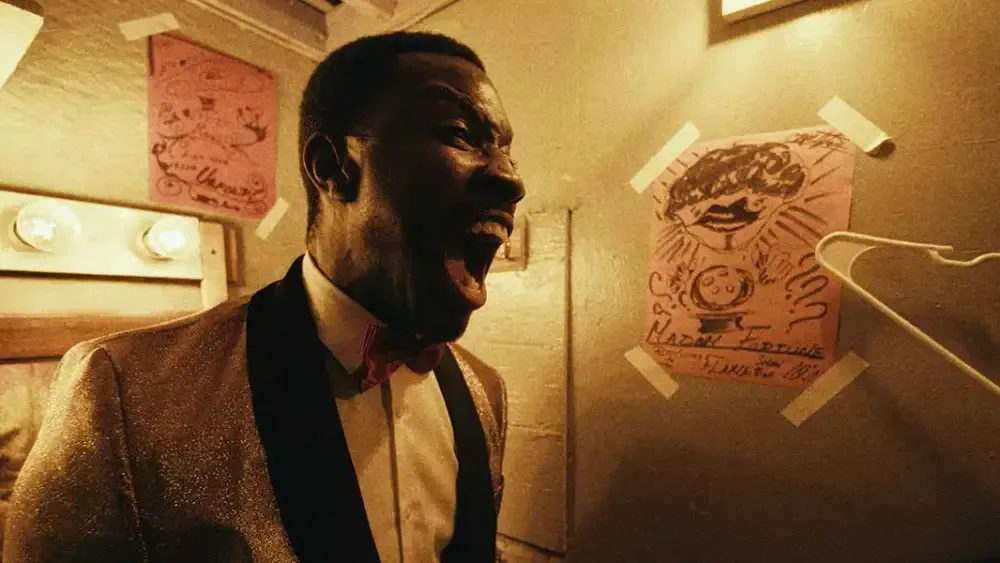
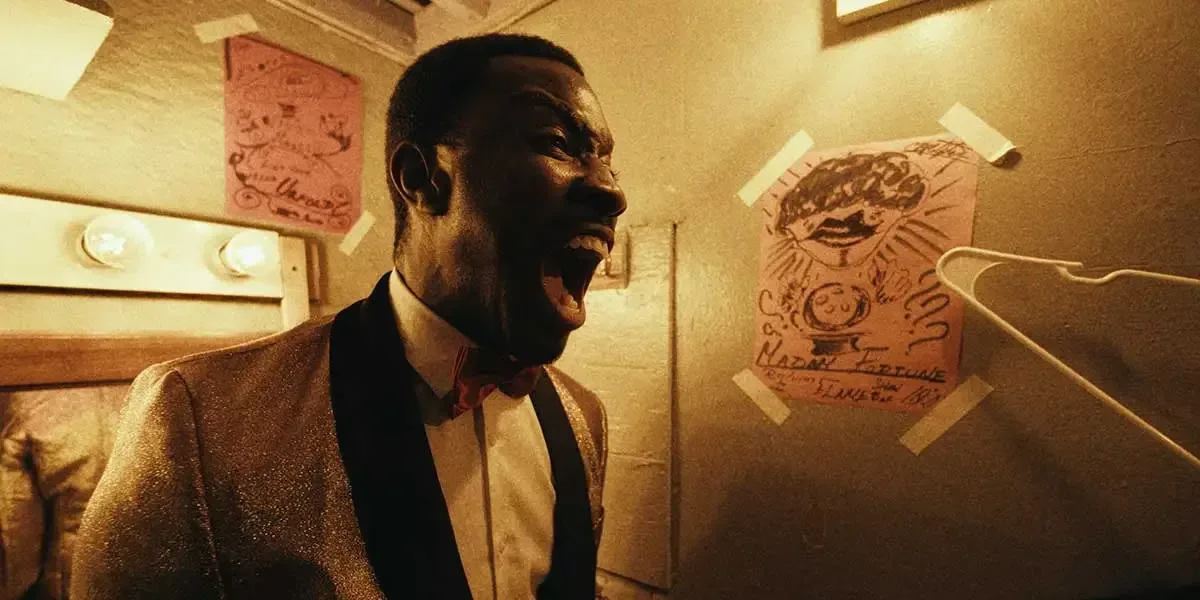
Francis Edemobi plays Jordan, an aspiring singer and musician who works at a motel frequented by performers passing through town. Jordan wants a breakthrough in the Motown world, and he believes an encounter with visiting act the Harmony Brothers could offer a route toward it. Joe Maye and Jamal Averett play the duo.
Instead of being welcomed into the orbit of artists he admires, Jordan is treated dismissively. After a serious accident, his desire to be noticed mutates into a much more urgent problem. He calls on his cousin Derrick, played by Ezekiel Ajeigbe, and Derrick’s girlfriend Mia, played by Raél Ba. Both are singers, and all three see the same grim possibility: the crisis might somehow become a springboard for their own careers.
That setup puts personal aspiration at the center of the film’s suspense. Jordan, Derrick and Mia are not simply trying to get away from a bad situation. They are repeatedly measuring the cost of escape against the lure of an opportunity they believe may never come again. The result is a morality-play structure: a small group, a contained environment and a succession of choices that worsen the situation rather than solve it.
The bulk of the action remains in the Harmony Brothers’ room until late in the story. That limitation is fundamental to the film’s effect. A chamber thriller is a suspense story designed around a small cast and few locations, often using confinement to force conflict into the open. Here, the motel room turns every conversation into negotiation. There is little room for the characters to retreat physically, and even less room to evade what their choices say about them.
When the songs arrive at the point of maximum stress
The screenplay is credited to Sam Buckner III and Charlie T Savage, and its key formal gamble is the placement of the musical sequences. Rather than holding the songs for respite between suspense scenes, the film introduces them as tension reaches a breaking point. That choice changes their function. A melody can clarify a conflicted motive, but it can also sharpen the contradiction between a character’s emotional honesty and the actions unfolding on screen.
One especially striking moment has Jordan singing while holding a gun. The contrast is the point: the performance draws attention to what he is feeling, while the weapon makes the stakes of what he might do impossible to ignore. The sequence gives Edemobi a chance to play Jordan as more than a straightforward desperate dreamer. His need for recognition and his fear of consequence sit side by side.
The musical writing is described through its harmonies and emotionally strained subject matter, with songs centered on regret and fraught feeling rather than celebration. That is why the thriller-musical fusion can work. The songs arise from the same emotional material as the plotting: envy, longing, guilt, fear and the temptation to turn a tragedy into an advantage.
Ajeigbe and Ba provide the film’s strongest pairing as Derrick and Mia. They must register as both lovers and unwilling partners in a dangerous scheme, continually balancing devotion to each other with the hope of a better future. Their song, “The Voices in My Head,” is the film’s standout number. It appears to capture the movie’s tonal collision—heightened musical feeling inside an increasingly dire thriller—with tangible emotional clarity rather than treating the clash as a novelty alone.
Maye, meanwhile, makes an impression in a smaller role as one half of the Harmony Brothers. His character’s temper and physical presence lend volatility to the motel-room scenario. Even before the story’s central trio has fully decided what to do, the film establishes that there is no easy way to contain the consequences of their choices.
The strongest version of Voices is the smallest one
The film’s most persuasive passages are also its most contained. Keeping attention on Jordan, Derrick and Mia lets ambition remain intimate and specific. Their shared musical aspirations give them a bond, but their individual needs make that bond unstable. They are collaborators under pressure, not a settled team, and their relationships provide the crucial human stakes beneath the premise.
This focus also makes Gray’s directorial understanding of the material clearest. The songs are most effective when they emerge from the trio’s fear and conflicted desire rather than stopping the plot for a detached performance. Their harmony is not proof that the characters are safe or united; it can underline the painful fact that people capable of making something beautiful together may still be making ruinous decisions.
The editing, credited to Buckner III and Gray, sustains momentum and finds visual variation within the limited setting. A single-room thriller can become static if every scene repeats the same spatial information. The film avoids some of that risk by using different angles and points of view, helping the motel room remain an active dramatic arena instead of merely a production constraint.
For readers following unusual screen premises alongside other dark pop-culture stories, our coverage of a recent crime drama’s streaming debut offers a separate look at how crime narratives continue to occupy a prominent place in the wider entertainment conversation.
Complications dilute a focused moral dilemma
Voices becomes less convincing as it widens its frame. Additional characters enter the story, and the film shifts away from its concentrated examination of aspiration and culpability. It also attempts to bring broader social and historical context into the narrative, including the experience of being Black in 1960s America.
That material has clear potential relevance to a Detroit-set story about performers chasing access and opportunity. However, the issue is not that the film seeks larger meaning; it is that the expansion does not appear fully integrated into the escalating central conflict. What begins as a tightly controlled personal moral problem starts to feel as though it is reaching for new engines of escalation.
The later plot grows more extreme as bodies accumulate, and the earlier productive friction between musical expression and thriller mechanics begins to lose some of its force. In the early sections, the unusual genre blend creates uncertainty: viewers are asked to understand why people sing at the edge of disaster, and the answer is rooted in character. Later, as events become harder to believe, the film’s emotional logic has more difficulty anchoring its increasingly outlandish turns.
An experiment that earns attention
Even with those strains, Voices is an intriguing experiment rather than a failed curiosity. Gray and the performers find genuine feeling in a concept that could easily have been played as a gimmick. Edemobi brings vulnerability and volatility to Jordan, while Ajeigbe and Ba make Derrick and Mia’s emotional connection persuasive enough to matter when their loyalties are tested.
The film does not fully reconcile every impulse it introduces. Its late complications weaken the clean, cruel efficiency of its motel-room setup, and its larger contextual ambitions do not land with the same confidence as the early interpersonal drama. But the best scenes demonstrate a coherent idea: fear can be musical, and a song can deepen suspense when it exposes the emotional truth beneath a desperate act.
Voices screened in the Discovery program at the Toronto Film Festival. Its cast also includes Pedro Louis and Jamal Averett. Gray directs, with cinematography by Damola Ajanaku. The film’s willingness to put harmony in the middle of dread gives it a quality few thrillers possess. When it stays close to three singers, one motel room and the terrible choices made in pursuit of a dream, it finds a tense, emotionally resonant sound of its own.