Julia Stiles returned to one of the most remembered moments of 10 Things I Hate About You during Dedication Night on Dancing With the Stars, using a contemporary routine to honor her late co-star Heath Ledger.
Stiles danced with partner Ezra Sosa to “Can’t Take My Eyes Off You,” the Frankie Valli song tied to one of the 1999 film’s signature scenes. In the movie, Ledger’s Patrick sings the song to Stiles’ Kat Stratford from the bleachers while she is at soccer practice. For the ballroom performance, the song was not simply a nostalgic selection: it served as the central connection between the dance and the film memory being recognized.
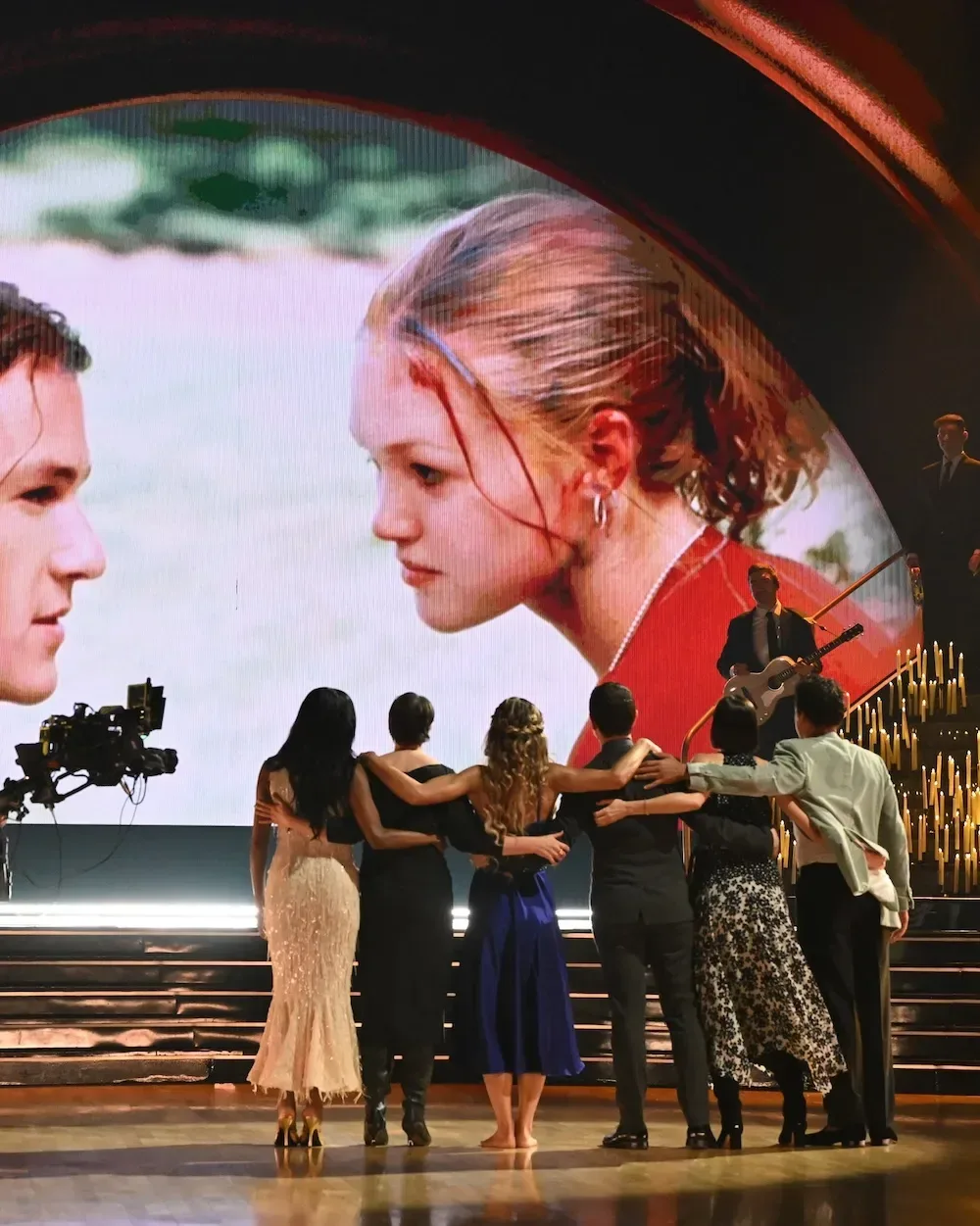
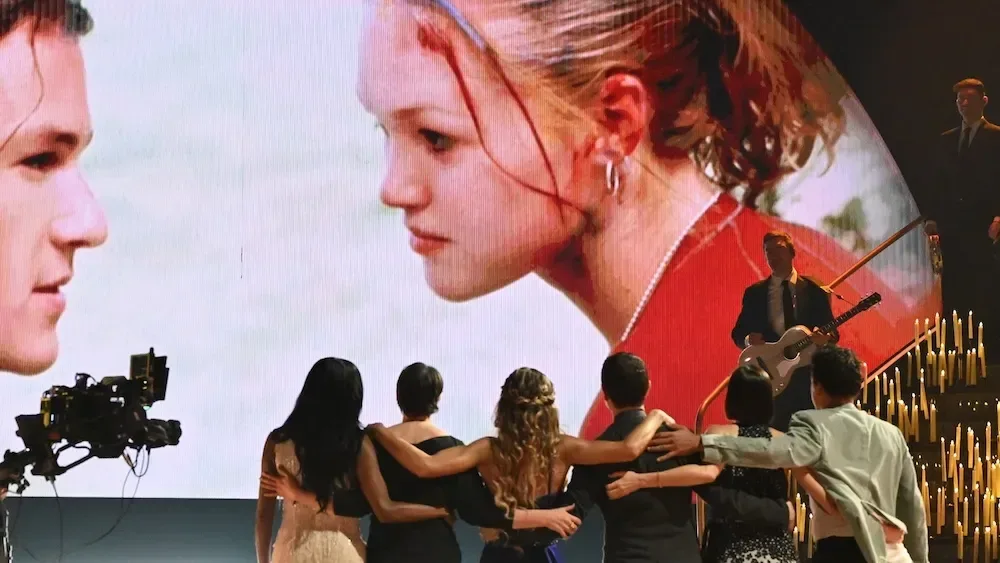
The performance ended with audio from Stiles’ character reciting the poem from the movie. At that point, several of her 10 Things I Hate About You co-stars joined her on the ballroom floor: Joseph Gordon-Levitt, Larisa Oleynik, Andrew Keegan, Gabrielle Union and Susan May Pratt. The reunion made the routine a tribute not only to Ledger, but also to a film ensemble whose work continues to hold a meaningful place for its cast and audience.
The judges awarded Stiles and Sosa four nines for the dance.
For more context, explore Park Min-young, Yook Sung-jae and Go Soo Set for Prime Video Office Romance ‘Nine to Six’.
A familiar song carrying a much larger memory
“Can’t Take My Eyes Off You” has a specific dramatic function in 10 Things I Hate About You. Patrick’s bleacher performance is direct, playful and unmistakably public, matching the film’s heightened teen-romance tone. Bringing that song into a contemporary ballroom routine changed its context. Instead of recreating the scene exactly, Stiles and Sosa used its emotional association as the starting point for a different kind of performance: one shaped by remembrance and by Stiles’ personal connection to Ledger.
Contemporary dance, in this setting, is less a rigidly standardized ballroom discipline than an expressive style that often prioritizes emotional storytelling, flowing movement and dramatic musical interpretation. That made it an appropriate vehicle for material that could easily have become a literal film reenactment. The reported structure suggests the pair aimed for something more reflective: a dance informed by an iconic scene, capped by Stiles’ voice from the film and the arrival of her former castmates.
That distinction matters. A tribute can acknowledge a celebrated work without treating a real person’s memory as a simple nostalgia device. Sosa addressed that balance before the live show, saying the creative team had approached the performance with care, sensitivity and intention. He emphasized that the dance was not meant to define a relationship or claim a story that was not theirs to tell. Instead, its purpose was to recognize a beautiful moment, the effect of the film and Ledger’s enduring impact.
Related coverage includes Julia Stiles Honors Heath Ledger With Emotional ‘DWTS’ Tribute.
His comments also indicated that the tribute was developed with close guidance from people who hold Ledger and his memory closest. That context helps explain the measured approach: the performance was built around a recognizable shared screen moment, but did not attempt to make broad claims about private history.
Stiles describes the weight of revisiting the film
In the pre-dance package, Stiles became emotional while speaking about Ledger. She said she learned a great deal from him and remembered working with him as easy. She also expressed the wish that she could call him and say hello, a simple thought that underscored how grief can persist even when a project belongs to the distant past.
Stiles said her reaction during the original scene was genuine and spoke of wanting to recreate Ledger’s “musk for life,” as it was phrased in the segment. The central sentiment was clear: she associates the film sequence with his energy and with memories that remain vivid.
Before the performance, Stiles had acknowledged that the rehearsal process affected her more intensely than she expected. She initially believed enough time had passed to create a degree of emotional distance. But returning to clips from the film, photographs, and both her own and Ledger’s voices brought those memories back strongly. She said she cried during practice.
That response provides the key to why the segment resonated beyond a routine built around a famous movie song. The footage, the music and the recorded dialogue each acted as an archive of a particular time in the actors’ lives. For viewers, those elements may summon a favorite scene. For Stiles, they also return her to a collaboration and friendship interrupted by Ledger’s death in January 2008, when he was 28.
The cast reunion gave the tribute a communal shape
The appearance of Gordon-Levitt, Oleynik, Keegan, Union and May Pratt expanded the final image beyond one actor honoring one co-star. Their presence linked the routine to the wider cast of 10 Things I Hate About You, recognizing that a film’s lasting cultural life is often shared among many performers.
There is an important difference between a reunion and a recreation. The group did not return to perform the movie’s original scenes on the ballroom floor. They joined Stiles at the end, after the poem audio played. That arrangement placed the former castmates in a supportive role rather than turning the routine into a checklist of references. The emphasis remained on Stiles’ dance with Sosa and on Ledger’s place in the memory of the film.
The poem is especially meaningful within the movie because it gives Kat a moment of emotional candor. Using the recording at the conclusion created a bridge between the film’s fictional romance and the real-world affection and loss expressed by Stiles in the lead-up to the performance. It was a carefully chosen piece of audio because it is inseparable from the movie, Stiles’ performance and Ledger’s presence in the scene, yet it did not require new dialogue or an imitation of him.
Why a screen memory can work on a live dance show
Dedication-themed performances ask participants to translate something personal into a brief live format. That can be challenging when the dedication concerns a public figure, especially one connected to an immensely familiar piece of entertainment. The audience arrives with its own memory of the film, while the performer carries personal memories that are necessarily different.
Stiles and Sosa’s choices appear designed to meet both sides of that challenge. The music immediately established the movie reference. The contemporary format allowed for an emotional rather than literal interpretation. The poem audio provided a direct connection to the film’s language. Finally, the cast reunion situated the tribute within the group of people who made that screen memory together.
This is also why Sosa’s insistence on boundaries was significant. A tribute need not reveal more private detail to be sincere. In fact, limiting the scope can be an act of respect. The dance honored Ledger’s work, recognized the film’s influence and allowed Stiles to share the impact of returning to it, without presenting speculation as intimate knowledge.
Stiles herself framed Ledger’s continuing legacy through performance. She noted that artists hope their work makes people feel something and makes audiences care. In her view, the fact that his memory remains so present reflects the strength of his performance. The ballroom tribute put that idea into action: a song and scene from a 1999 movie were still capable of supplying the emotional framework for a major live-TV moment years later.
What the score says—and what it does not
The four nines were a strong result for Stiles and Sosa, reflecting the judges’ response to the routine on the night. Yet the score is only one part of this particular performance’s story. Competitive dance programs quantify a routine with numbers, but a tribute is also evaluated by tone, clarity and restraint—qualities that do not fit neatly on a scorecard.
For fans of the film, the larger takeaway is the way the routine used a beloved scene without reducing it to a throwback. Stiles’ comments made clear that revisiting the material had personal consequences. Sosa’s statement made clear that the pair understood the responsibility involved. And the on-floor gathering of former cast members showed how a film can continue to connect the people who made it long after production has ended.
The tribute did not change the meaning of the original bleacher sequence so much as reveal another dimension of it. What began as a buoyant romantic gesture within a teen comedy has become, for Stiles and many viewers, a lasting marker of Ledger’s warmth, talent and screen presence.
That lasting connection is part of why pop-culture reunions can matter when they are handled with care. They are not only about revisiting old roles; at their best, they let artists recognize what a project meant then, what it means now, and whose work continues to be felt after the cameras stopped rolling.