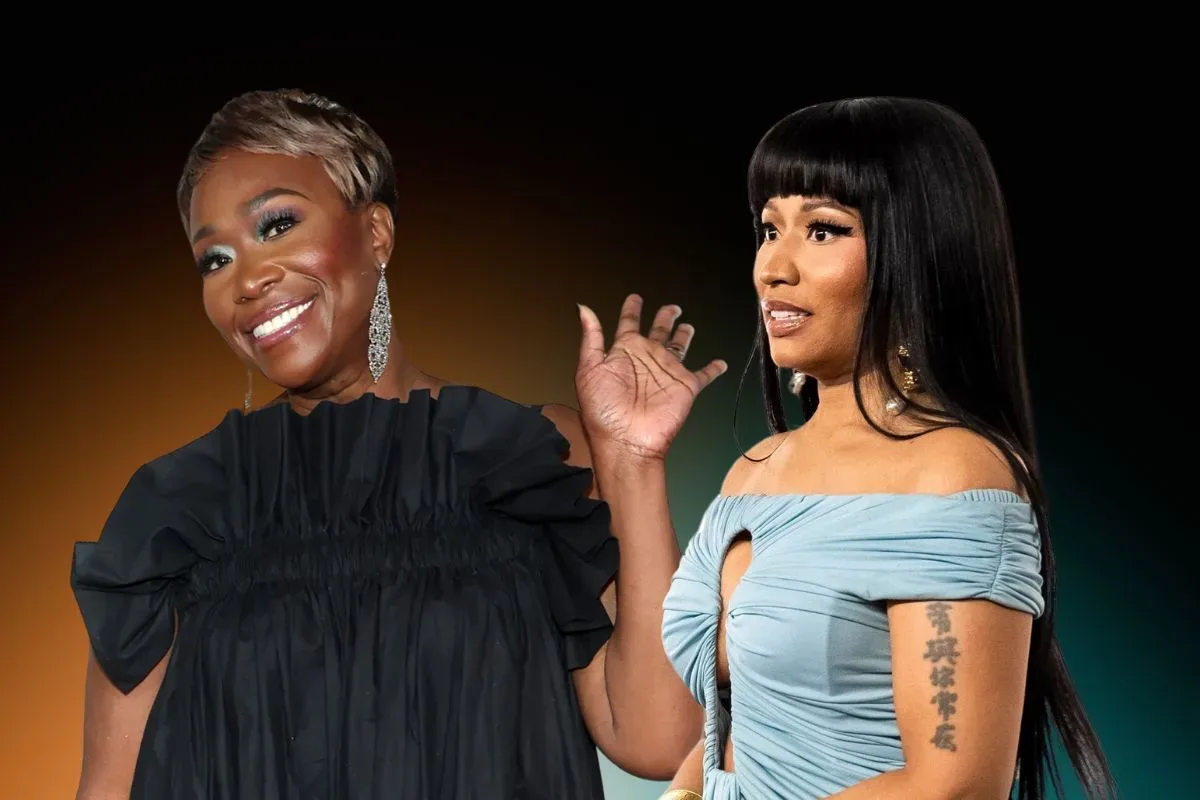
Joy Reid has revived her long-running public dispute with Nicki Minaj, using an appearance on Club Shay Shay to explain why she remains sharply critical of the rapper’s support for Donald Trump and his political movement.
Asked by Shannon Sharpe whether she had gone too far in previously calling Minaj a MAGA “house pet,” Reid acknowledged that the wording may have been harsh. But she did not retreat from the larger argument behind it: that Minaj’s public alignment with Trump is being used in a way Reid considers diminishing and politically useful to the people elevating it.
Reid’s comments moved beyond the original insult and toward a broader question that repeatedly surrounds celebrity politics: what happens when a famous artist’s visibility becomes part of a political campaign’s cultural presentation? Her answer was not that Minaj lacks agency. In fact, Reid explicitly distinguished Minaj’s choices from the historical case she referenced.
The Sarah Baartman comparison — and the distinction Reid made
Reid compared the way she believes Trump’s movement presents Minaj to the public exhibition of Sarah Baartman, a South African woman who was exhibited in Europe in the early 19th century. The comparison is inherently weighty, and Reid stressed a crucial difference: Baartman did not choose the circumstances in which she was displayed.
Reid’s argument was that Minaj has chosen to appear alongside Trump and to defend that association, while the political presentation of her celebrity still strikes Reid as dehumanizing. In other words, Reid was not equating Minaj’s experience with Baartman’s. She was criticizing what she sees as a contemporary political impulse to put a Black celebrity’s image, persona and cultural credibility on display.
That distinction matters because agency is central to the disagreement. Agency means a person’s ability to make their own choices. Minaj’s own comments leave little ambiguity that she sees her support as a choice: in an interview with Lara Trump, Minaj said she loves the president and does not make excuses for it.
Reid, meanwhile, is arguing that voluntary participation does not end the conversation about how an image is used. A celebrity can choose an alliance, while critics can still challenge the incentives, framing and symbolism surrounding it. That is the tension at the center of this latest exchange.
A dispute that began with vaccine posts
The Reid-Minaj conflict did not begin with Trump. Its public roots go back to September 2021, when Minaj shared an unsubstantiated claim about the COVID-19 vaccine. Reid addressed Minaj’s posts on The ReidOut, arguing that a star with Minaj’s enormous reach should not use that platform in a way that could discourage people from protecting themselves. Reid also said her criticism came with disappointment as a fan.
Related coverage includes Joy Reid Revives Nicki Minaj Feud With Sarah Baartman Comparison.
Minaj pushed back at the time, saying Reid had not read all of her posts and had misrepresented her position on television. She pointed to other messages in which she said she would probably get vaccinated before going on tour.
That exchange established a pattern that has followed their dispute ever since. Reid has focused on what she considers the public consequences of Minaj’s statements; Minaj has argued that Reid’s account omits context and flattens a more complicated position. Neither side has accepted the other’s framing.
The earlier vaccine clash also helps explain why this is not simply a disagreement over one endorsement or one interview. For Reid, Minaj’s political presence fits into a wider concern about influence, misinformation and celebrity responsibility. For Minaj, the recurring criticism has become evidence that prominent media figures are unwilling to fairly engage with what she actually says.
From public-health disagreement to political symbolism
By February, the feud had shifted more directly into arguments about Trump, the Republican Party and culture. Reid said Republicans sought Minaj’s Black “cultural cool,” rather than engaging with her work as a musician. That phrase describes something broader than a standard celebrity endorsement: the political value of being seen near an artist whose popularity and style can signal relevance to audiences a movement may otherwise struggle to reach.
Reid reiterated that idea in the newer interview, saying she doubts many of the people now applauding Minaj’s politics actually know her music. The claim is an interpretation of the attention around Minaj, not a measurable assessment of every supporter’s listening habits. Still, it gets at the point Reid is making: she believes Minaj’s value to these political audiences is primarily symbolic.
Cultural cachet is the useful term here. It refers to the social credibility or perceived coolness that comes from association with a respected or famous figure. Political groups often seek that cachet because fame can widen an audience, energize existing supporters and make a message feel more current. Artists, actors, athletes and online personalities bring recognizability that ordinary political messaging often lacks.
But cachet is not neutral. When an artist’s identity becomes more important to the political story than their body of work, critics may see a form of tokenization: treating someone mainly as evidence of a movement’s appeal to a demographic or cultural community. Reid’s comments clearly fall within that critique.
Minaj’s response has been direct
Minaj has not left her position to guesswork. In addition to contesting Reid’s account of the 2021 vaccine posts, she returned to that dispute on July 31 with a mocking post written as a fake diary entry from Anthony Fauci. Trump adviser Alex Bruesewitz also called for Minaj’s critics to apologize.
The details matter because the disagreement has become a public back-and-forth involving more than the two central figures. Each new response invites allies, detractors and highly engaged fan communities to treat the feud as another front in a wider culture-war argument. At that point, nuance can become difficult to maintain: one side’s critique of political imagery is received as contempt for the artist, while the other side’s declaration of personal political support is received as an endorsement of every surrounding political message.
Minaj’s position is ultimately her own. She has defended Trump publicly and has said she does not intend to apologize for that support. It is equally clear that Reid views the relationship as politically consequential, particularly because of Minaj’s influence and the way Trump-aligned figures showcase it.
Why the argument is bigger than one celebrity feud
Celebrity endorsements are often discussed as if they work like a simple transaction: a well-known person backs a candidate, fans take notice, and politics gains a little entertainment-world gloss. The Reid-Minaj argument shows why the reality can be more contested.
First, a celebrity’s fan base is not a single voting bloc. Listeners can admire music without sharing the artist’s politics; political supporters can welcome a famous backer without knowing much about the work that made that person famous. Reid’s doubt about whether Minaj’s new political admirers know her catalog speaks directly to that divide.
Second, the very visibility that gives an artist influence can lead others to argue over what the artist “represents.” That is especially fraught when race, gender and political identity are all part of the public reading. Reid’s reference to Baartman was designed to address that framing, though its historical weight means it will also draw scrutiny and disagreement.
Third, online conflict rewards the bluntest possible version of an argument. The original “house pet” label is memorable, provocative and easily repeated. It can overshadow the more complicated explanation Reid offered later about agency, political display and what she views as dehumanization. Likewise, Minaj’s critics may focus on her Trump support while paying less attention to her insistence that earlier vaccine-related coverage did not fully reflect her posts.
That dynamic is familiar across entertainment coverage: a dispute that begins over specific statements becomes a referendum on loyalty, identity and who has the right to criticize a public figure. For artists working in pop and hip-hop, the stakes can be especially visible because their cultural reach extends well beyond records and performances. Questions around touring, public image and business power already affect the industry, as seen in recent discussion of Meek Mill’s allegations involving touring opportunities.
What is established, and what remains interpretation
Several parts of this story are straightforward. Reid criticized Minaj’s vaccine-related posts in 2021. Minaj said Reid failed to consider all of her messages and misrepresented her. Reid later criticized the political value Republicans placed on Minaj’s support. Minaj has publicly defended her support for Trump. And Reid has now expanded on her criticism in the Club Shay Shay interview.
Other claims are necessarily interpretive. Reid’s questions about why Minaj has made these choices, and her view that Trump’s presentation of the rapper is dehumanizing, are Reid’s analysis. Her belief that political admirers are more interested in Minaj as cultural symbolism than as a musician is also an assessment, rather than a fact that can be settled from the exchange alone.
That does not make the debate meaningless. It clarifies what the two women are actually arguing about. Minaj is asserting the legitimacy of her political choices and pushing back against characterizations she considers unfair. Reid is arguing that those choices have public meaning beyond Minaj’s intent, particularly when they are amplified by a political movement seeking cultural validation.
The conflict is therefore unlikely to be resolved by revisiting one old post or one sharp phrase. It is a disagreement about influence itself: whether a celebrity’s political participation should be treated chiefly as individual expression, or whether it must also be interrogated for the broader political image it helps create. Reid’s latest comments firmly choose the latter view; Minaj’s previous replies show she rejects Reid’s framing.