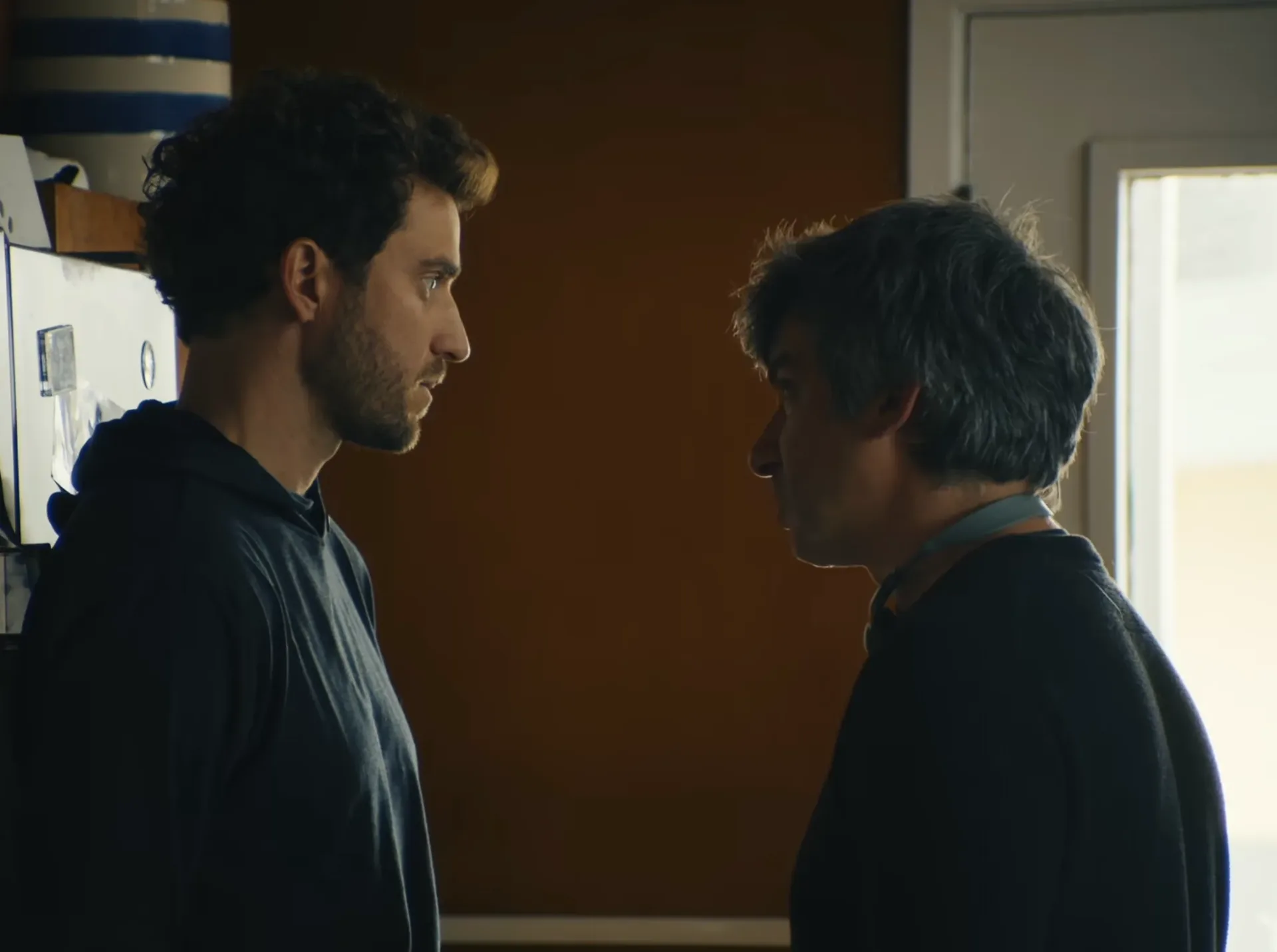
John Oliver’s latest political segment found an unexpectedly specific detour: You Can See Everything, the Nathan Fielder and Lance Oppenheim documentary centered on Elizabeth Holmes and her partner, Billy Evans.
While discussing Republican candidates’ relationship to Donald Trump ahead of the Nov. 3 midterms, Oliver played a response from Michigan Senate candidate Mike Rogers. Asked whether a vote for him represented a vote for Trump’s agenda, Rogers said he was having trouble with his earpiece. Oliver treated that answer as an unmistakable dodge—and used it to launch into the documentary reference.
His punchline was deliberately disproportionate. He said he had not seen somebody evade a question so brazenly since spending three hours reacting in disbelief to “two complete lunatics who’ve never blinked once in their lives,” while an image of Holmes and Evans appeared. The joke’s immediate target was Rogers’s non-answer, but its second target was the apparent spell the film has cast over Oliver’s own workplace.
Oliver said that anyone working on Last Week Tonight could be approached to discuss the movie, adding that the fixation had disrupted the staff’s workflow to an unacceptable extent. It is a small aside inside an election-focused segment, but it also conveys a great deal about the documentary’s effect: it has become, at least in that writers’ room, the kind of subject that derails ordinary conversation.
A political dodge becomes a documentary punchline
The larger discussion concerned the awkward distance between Trump and Republican midterm campaigns. Trump has repeatedly framed a Republican vote as support for him, while a reported breakdown of GOP advertising found that more than 99% of spending was going to ads that did not mention Trump.
That contrast is the foundation for the Rogers clip. A direct question about whether his campaign represented Trump’s agenda asks a candidate to clarify an association that can be politically useful to some voters and costly to others. Claiming an earpiece problem does not answer the substance of that question. Oliver’s premise was that the evasiveness was too visible to pass as a technical hiccup.
The Holmes-and-Evans reference raises the comic stakes. It does not argue that the situations are equivalent; it turns the candidate’s attempt to move away from a straightforward answer into an exaggerated comparison with the intense viewing experience Oliver associates with the documentary. In comedy terms, it is an escalation: a modest moment of political discomfort is enlarged through a pop-culture image the audience can recognize or investigate afterward.
That kind of pivot is especially useful in a densely political monologue. Rather than simply restating that Rogers avoided the question, Oliver converts the observation into a second subject—the unnerving, apparently all-consuming pull of You Can See Everything. The documentary is not presented as election reporting, and the election segment is not a review of the documentary. The connection is tonal: Oliver sees a similar quality of conspicuous avoidance and uses it as a route to a more surreal cultural reference.
Related coverage includes John Oliver Turns a Midterm Dodge Into a ‘You Can See Everything’ Reference.
What Oliver was addressing in the election segment
Oliver also addressed Trump’s increasingly extreme rally rhetoric. At a recent midterm convention, Trump led attendees in a pledge to vote Republican. The pledge described him as “the greatest president in the history of the United States” and included the line that he “loves us so much he can’t even breathe.” Trump also told the crowd that people who did not vote would go to hell.
Oliver’s response focused on the strange construction of the pledge as well as its threat-like voting message. He questioned the phrase about being unable to breathe, then used a deliberately dark hypothetical involving Jeffrey Epstein and the Devil to underline the absurdity of treating civic participation as the decisive criterion for damnation.
There are two different rhetorical moves at work here. First, the show draws attention to wording that may sound bizarre when isolated from the energy of a rally. Second, it interrogates the message beneath the wording: vote for a particular party or face supernatural punishment. Comedy does not replace a policy debate in this instance. Instead, it makes the coercive framing and the unusual language harder to glide past.
The segment also places Trump’s language next to candidates who may prefer not to be explicitly tied to him. The reported absence of Trump’s name from the overwhelming majority of GOP ad spending suggests a strategic gap between a national political figure’s demand for personal allegiance and the messages campaigns believe will work locally. Oliver’s use of the Rogers exchange gives that gap a human-scale example.
Why the Holmes reference lands differently
Holmes is described in the segment as a convicted scam artist, and Evans is identified as her partner. Those facts provide the essential context for why merely showing their image carries such a charged comic meaning. Yet Oliver’s joke does not try to summarize their story or offer an assessment of the documentary’s filmmaking. Its point is narrower: the film has supplied him and his team with an arresting reference point for unsettling behavior.
Calling someone a “complete lunatic” is plainly Oliver’s comic characterization, not a clinical diagnosis. That distinction matters. In entertainment coverage, words such as “unhinged,” “obsessed” and “lunatic” often operate as heightened language designed to communicate an emotional reaction. They should not be confused with factual claims about a person’s mental health.
Similarly, Oliver’s remark about people who “never blinked” is visual-comedy exaggeration. The value of the line is its vividness: he presents the documentary as something so intense that viewers emerge ready to recruit strangers into an urgent conversation about it. His follow-up about the staff’s disrupted workflow extends the bit from a personal reaction into a shared office fixation.
That response is also a reminder of how documentaries can occupy pop-culture conversation without being treated like conventional franchise entertainment. A single memorable image, behavior or interpersonal dynamic can become shorthand for a wider feeling. Here, You Can See Everything becomes shorthand for a disquieting inability to look away. The film is not explained scene by scene, because Oliver is assuming—or inviting—the kind of curiosity that makes a brief reference spread.
Screen culture often creates these conversational shortcuts in unexpected places. Discussions of how audiences respond to established fictional worlds can be just as intense; for a separate example, see the debate around Resident Evil lore and audience expectations. Oliver’s use of a documentary reference works on a different register, but both cases show how a work can quickly become a common language for reactions larger than its immediate plot or subject.
The practical meaning of a political pop-culture pivot
For viewers, the key point is not that a documentary joke somehow resolves the question posed to Rogers. It does the opposite: it emphasizes that the original question remains unanswered. The earpiece explanation becomes memorable because Oliver refuses to let it function as a clean exit.
That is a useful way to understand political satire at its most effective. A comedian’s comparison may be intentionally wild, subjective and funny, but it can still preserve the basic factual issue underneath it. Here, the basic issue is simple: a Senate candidate was asked whether his campaign aligned with Trump’s agenda and did not provide a substantive answer in the cited exchange.
The Holmes and Evans tangent then gives the segment a second life beyond the immediate news cycle. It is not merely “candidate avoids question.” It is “candidate avoids question so conspicuously that it triggers a staff-wide documentary fixation.” That framing is built for recall, because it gives viewers both a political observation and a surprising cultural hook.
Oliver’s comments ultimately make You Can See Everything sound less like a casual recommendation than an unavoidable topic in the Last Week Tonight orbit. There is no score, formal review or availability information offered in the segment. What viewers do get is a strong indication of fascination: the documentary has become sufficiently lodged in the team’s collective mind that it can interrupt an election monologue—and apparently the workday around it.