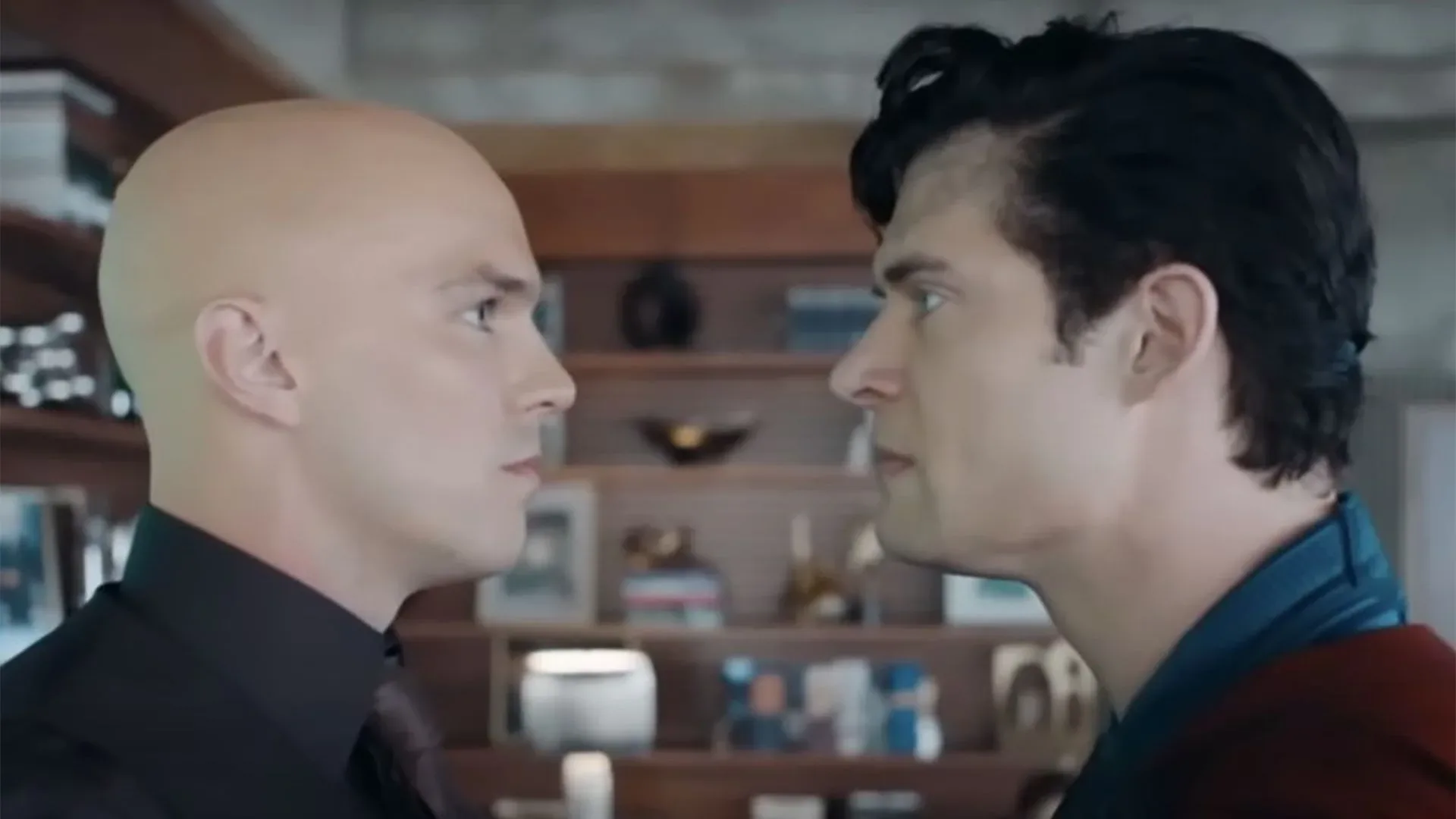
Jesse Eisenberg has offered a candid account of how the reaction to his Lex Luthor in Batman v Superman: Dawn of Justice affected the choices he made after the film. Speaking at the BFI London Film Festival, Eisenberg said receiving a Golden Raspberry Award for Worst Supporting Actor left him feeling that studio movie roles were no longer open to him.
His point was not that one trophy mechanically dictates a career. Rather, Eisenberg described the award as a highly visible signal during an already uncertain stretch for an actor. In his telling, the response fed a fear that his trajectory in big studio productions had turned downward—and that the sensible response was to seek work with more creative control.
“I couldn’t get into movie studio parts anymore because I had won a Raspberry Award from [being in the] Batman movie … and I saw the trajectory,” Eisenberg said.
Eisenberg played the Superman adversary in the divisive DC film, giving Lex Luthor an unusually eccentric, long-haired interpretation. The performance remains a major flashpoint in discussions of the movie: some viewers embrace its strange energy, while others regard it as a mismatch for the character and the film around him. Eisenberg later returned as Lex in Justice League, but he says the earlier backlash shaped the way he viewed the prospects ahead of him.
A Razzie Is a Public Label, Not a Career Spreadsheet
The Golden Raspberry Awards—widely known as the Razzies—are awards built around highlighting what their organizers consider the year’s worst work in film. The tone is deliberately satirical, but the “Worst” designation can be difficult to detach from a performer’s public image, especially when it is connected to a role in a globally recognizable franchise.
That distinction matters in Eisenberg’s comments. A Razzie is not proof of an industry-wide decision, and it cannot establish, on its own, why a particular actor was or was not cast in a particular film. Casting involves studios, filmmakers, schedules, scripts, budgets and countless choices that are not public. Eisenberg is instead describing how he interpreted the moment and its consequences for his own career planning.
For an actor, the perceived message can be as consequential as a measurable one. High-profile franchise performances can become shorthand. Praise may create a reputation for handling a certain kind of role; harsh criticism can create anxiety that the performer will be associated with a creative decision audiences rejected. Eisenberg’s fear was that the latter had happened to him.
“If you’re an actor, you’re constantly panicked about ‘Am I on an upslope or a downslope?’” he said. “Because there’s no plateau.”
He described acting as an unstable profession in which performers can feel as though they are either advancing or becoming “yesterday’s news.” That is a personal account of a precarious creative career, not a universal rule. Still, it explains why a mocking award connected to a role as prominent as Lex Luthor could feel less like a passing joke and more like a warning sign.
Why Lex Luthor Became Such a Point of Debate
Batman v Superman: Dawn of Justice has continued to split audiences long after its release. Its approach places philosophical conflict and superhero spectacle in tension, and its version of Lex was among the film’s most debated elements. Eisenberg’s portrayal is conspicuously stylized, which made it hard for viewers to treat as a minor or invisible supporting turn.
“Polarizing” is useful here because it does not mean unanimous dislike. It means the response is sharply divided. A performance can have defenders, critics and a long cultural afterlife at the same time. Eisenberg’s Lex has all three. But public discussion of a film is not always nuanced enough to preserve that complexity. When an actor’s name becomes attached to a punchline or an awards label, the broader context—the screenplay, direction, editing, franchise expectations and audience preferences—can disappear.
That is also why Eisenberg’s remarks should not be reduced to a declaration that every viewer who disliked the performance damaged his career. He is talking about an environment in which reaction, reputation and opportunity can become intertwined. The Razzie had special symbolic force because it explicitly framed the work as bad acting, which Eisenberg said informed how he believed the business viewed his place in superhero movies.
“The industry tells you what they want from you,” Eisenberg said. “The industry did not want me to be in a superhero movie, and if you’re smart and self-aware, you learn that quickly.”
That conclusion reflects Eisenberg’s reading of the situation. It is notably more about adaptation than grievance. He did not say he intended to keep chasing the same kind of studio role in defiance of the feedback. Instead, he described learning to follow the paths where his work was welcomed.
The Pivot From Being Cast to Making the Work
Eisenberg says this period helped lead him toward writing and directing. The move is significant because it changes an artist’s relationship to opportunity. Acting is generally dependent on being selected for a role. Writing and directing do not eliminate collaboration or financial pressures, but they can give a creator greater ability to initiate projects and define the work they want to make.
His 2024 film A Real Pain is one project associated with that shift. He also cited The Debut, which is set to premiere in December. The important point in his account is not that writing and directing are a consolation prize for acting, but that they became a viable artistic direction when studio acting opportunities felt insecure.
There is a practical lesson in that pivot for anyone watching careers through the simplistic lens of success or failure. A public setback can narrow one route while revealing another. Eisenberg’s response was to expand his role in the creation process rather than wait for the perceived studio door to reopen. It is a different type of risk: creative ownership can bring more agency, but it also carries the responsibility of shaping the project beyond a single performance.
His comments also fit a larger reality of blockbuster casting: major franchise roles make an outsized impression because the films themselves are cultural events. The attention can create opportunity, but it can also magnify dissatisfaction. The stakes extend beyond a single movie when a performance becomes a proxy for arguments about an entire adaptation, a studio strategy or what audiences expect from a famous comic-book character. For another recent discussion of a high-profile genre-film project changing course, see the update on Taika Waititi’s Star Wars film.
What Eisenberg’s Comments Do—and Do Not—Claim
There are two levels to this story. The factual one is straightforward: Eisenberg played Lex Luthor in Batman v Superman, won the Worst Supporting Actor Razzie tied to that work, reprised the role in Justice League, and has subsequently pursued writing and directing alongside acting.
The second level is interpretive. Eisenberg believes the Razzie and the surrounding reaction contributed to a difficult period in landing studio parts. That is his lived perspective on a career where decisions are often opaque to the people seeking work. It should be presented as his assessment rather than as a complete, independently established explanation for every role he did or did not receive.
Even so, the candor is useful. It pushes back against the idea that a notorious performance simply becomes trivia. For the person attached to it, public critical judgment can influence confidence, strategy and the kinds of creative risks that feel possible. Eisenberg’s answer was not to argue that the award should be treated as praise. He called it an award for bad acting, then explained that he took its implied message seriously.
That message led him away from pursuing more superhero studio work and toward making films on terms he could more directly shape. Whether viewers admire his Lex Luthor or see it as a lasting misfire, Eisenberg’s account adds a human dimension to a debate that has often been reduced to memes, rankings and superhero discourse.