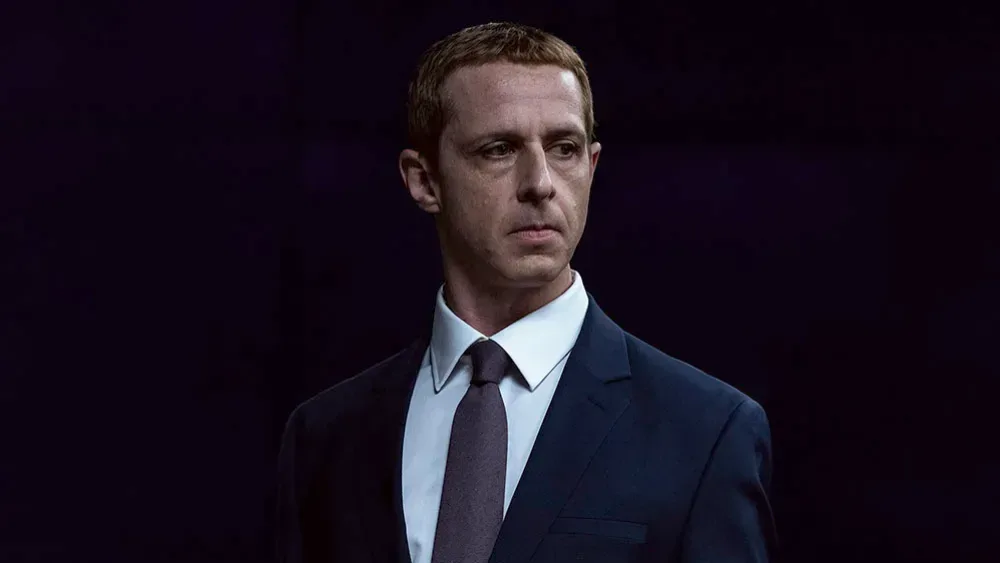
Jeremy Strong’s approach to playing Mark Zuckerberg in The Social Reckoning reportedly extended well beyond the moment cameras were rolling. Writer-director Aaron Sorkin said Strong remained in a Zuckerberg-inspired characterization around fellow performers, changing both his voice and physical manner rather than behaving as himself between takes.
That reportedly meant no casual off-camera mingling for Strong with many of the actors sharing his scenes. Sorkin said he gave the rest of the cast advance notice: Strong would likely keep his distance and treat people as he imagined Zuckerberg would. It was a production choice intended to support Strong’s performance, not a claim that the actor’s between-take behavior represented Zuckerberg’s actual conduct.
The distinction matters because the film is a nonfiction-based drama, not a documentary. Strong is portraying a dramatized character based on a real, living executive, while the movie’s wider story follows whistleblower Frances Haugen and Wall Street Journal reporter Jeff Horwitz as they work to expose what the film characterizes as Facebook’s troubling internal operations.
What “method acting” means in this case
“Method acting” is a broad term often used to describe performance preparation that seeks emotional, behavioral or physical continuity between an actor and a role. It does not refer to one universal set of rules. Actors who are called method performers can work in very different ways: some may focus on research and emotional memory, while others may remain in a character’s voice, posture, routine or interpersonal mode during production.
Strong’s reported process on The Social Reckoning falls into that latter, highly visible category. Sorkin said Strong did substantial preparation before arriving on set, then did not speak in his usual voice or move as he normally would while working. The actor’s choice to limit casual interaction appears to have been part of sustaining the role’s social dynamic.
That can be especially consequential in scenes built around hierarchy. Zuckerberg is the central corporate figure in the story, and Strong’s reported on-set distance could help preserve an atmosphere of authority, discomfort or remoteness for actors playing people around him. Whether that atmosphere translates to the finished screen performance is something audiences will have to judge from the film itself.
Why the production’s framing is important
There is an easy temptation to treat a story about an actor staying in character as an anecdote about personality. Sorkin’s account points instead to a more limited professional explanation: Strong was using an immersive technique to build a particular portrayal. The reported behavior was introduced to co-stars ahead of time, giving them context for why he might not speak with them or socialize during the workday.
That advance warning is important on a collaborative set. Film acting is not a solo activity, particularly in a project with an ensemble and scenes involving professional conflict. A performer’s process can influence scene partners, crew rhythms and the emotional temperature in a room. Letting colleagues know that an actor is maintaining a character boundary provides a practical explanation rather than leaving a silence or abrupt manner open to misinterpretation.
Related coverage includes Jeremy Strong Stayed in Character as Zuckerberg for ‘The Social Reckoning’.
Sorkin also defended the outcome of Strong’s preparation, praising the actor’s work. Still, an immersive process is not itself proof of a performance’s quality or historical accuracy. It is a method of reaching a performance. The relevant questions for viewers remain more straightforward: how compelling is the character on screen, how clearly does the drama handle its real-world material, and how carefully does it distinguish verified events from scenes created for narrative storytelling?
A dramatization built around Haugen and Horwitz
The Social Reckoning places Frances Haugen and Jeff Horwitz at the heart of its story. Haugen is described as the whistleblower who joins forces with Horwitz, a reporter, to reveal damaging information about Zuckerberg’s Facebook. That framing suggests the film is concerned not only with its depiction of Zuckerberg, but with the tension between corporate power, internal information and public accountability.
Strong is joined by Jeremy Allen White, Mikey Madison, Bill Burr, Betty Gilpin and Billy Magnussen. The supplied details do not identify each actor’s part, so it would be premature to assign their characters or suggest how much of the story belongs to any individual role. What is clear is that the project has a substantial ensemble around its portrayal of Zuckerberg and its whistleblower-reporting storyline.
For audiences, real-event dramas often require two kinds of viewing at once. The first is to engage with the movie as a constructed piece of drama: performances, pacing, scenes and point of view. The second is to remember that a feature film necessarily condenses complicated people and events into a limited runtime. A movie may be meticulously vetted while still using the tools of drama, including performance choices and narrative compression.
Legal vetting is a major part of the story
Sorkin said representatives for Meta contacted Sony about the film, and he indicated the communications were not simply friendly requests for premiere access. He did not detail the letters’ contents. That limitation is worth preserving: the existence of contact does not, on its own, establish a specific legal claim, threat or objection.
What Sorkin did make clear is that the production used an outside law firm to conduct legal vetting in addition to the ordinary scrutiny a studio legal department would typically apply to a nonfiction project. Legal vetting is the review process in which lawyers examine potentially risky factual assertions, depictions and supporting materials before release. For a film involving real people and a major company, the purpose is to test whether statements presented as fact are adequately supported and to identify material that may need substantiation, qualification or revision.
Sorkin characterized the goal in exacting terms: every element presented as a fact was to be a fact. That is a significant commitment, but it should not be confused with a promise that every scene is literal reportage. A legal review can assess claims and evidence; filmmaking still involves decisions about structure, dialogue, pacing and what moments best communicate a larger story.
The reported use of separate outside counsel also signals that the filmmakers anticipated close attention to the project’s factual basis. It does not reveal the precise evidence reviewed, which specific scenes received changes, or how any legal concerns were resolved. Those are details not provided here. But it gives viewers a useful lens for the movie’s eventual reception: its real-world assertions may be as central to the conversation as Strong’s performance.
What to watch for when the film arrives
The Social Reckoning is scheduled to reach theaters on Oct. 9. The most immediate draw will likely be Strong’s portrayal, especially now that Sorkin has described the actor’s effort to maintain the character’s voice, walk and aloofness throughout the day.
But the more lasting discussion may center on the balance between performance and nonfiction storytelling. Strong’s method is one part of that balance: it is an actor’s route toward a convincing screen presence. The film’s research and legal vetting are another: they concern the foundation beneath a story about a whistleblower, a journalist, Facebook and one of the technology industry’s best-known executives.
For a home viewing setup later on, intelligible dialogue will be particularly useful in a dialogue-led corporate drama. If voices sound muddy on a TV or soundbar, this guide on switching from 5.1 to stereo before replacing speakers explains a practical troubleshooting step that can help clarify speech.
Until the film is available, the confirmed picture is narrow but notable: Strong used an immersive on-set process for Zuckerberg; Sorkin informed the cast about it; the story centers on Haugen and Horwitz; and the production underwent an enhanced legal review for its factual material. Everything beyond that—how the performance lands, how the film handles complex events and how audiences respond—belongs to the finished movie rather than the behind-the-scenes account.