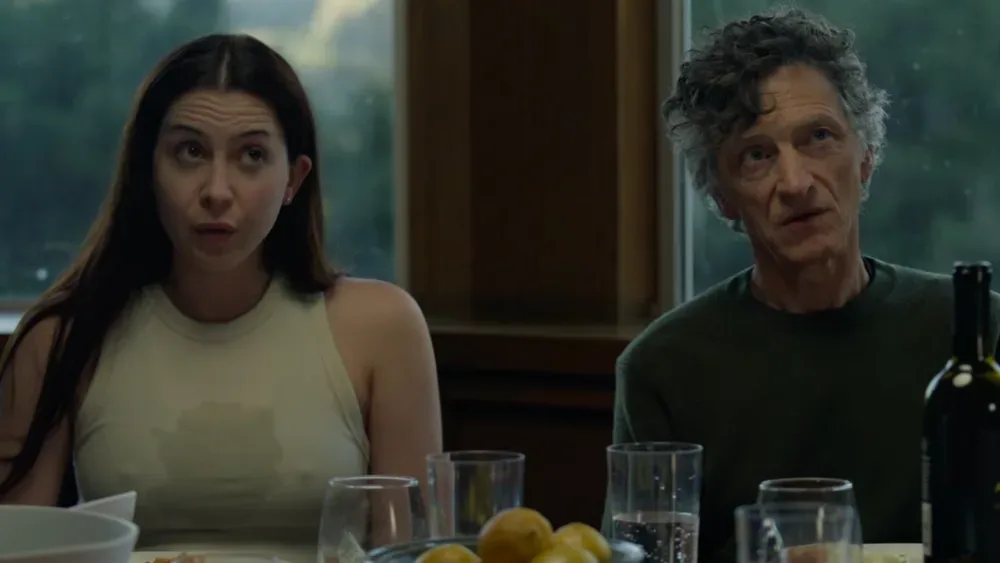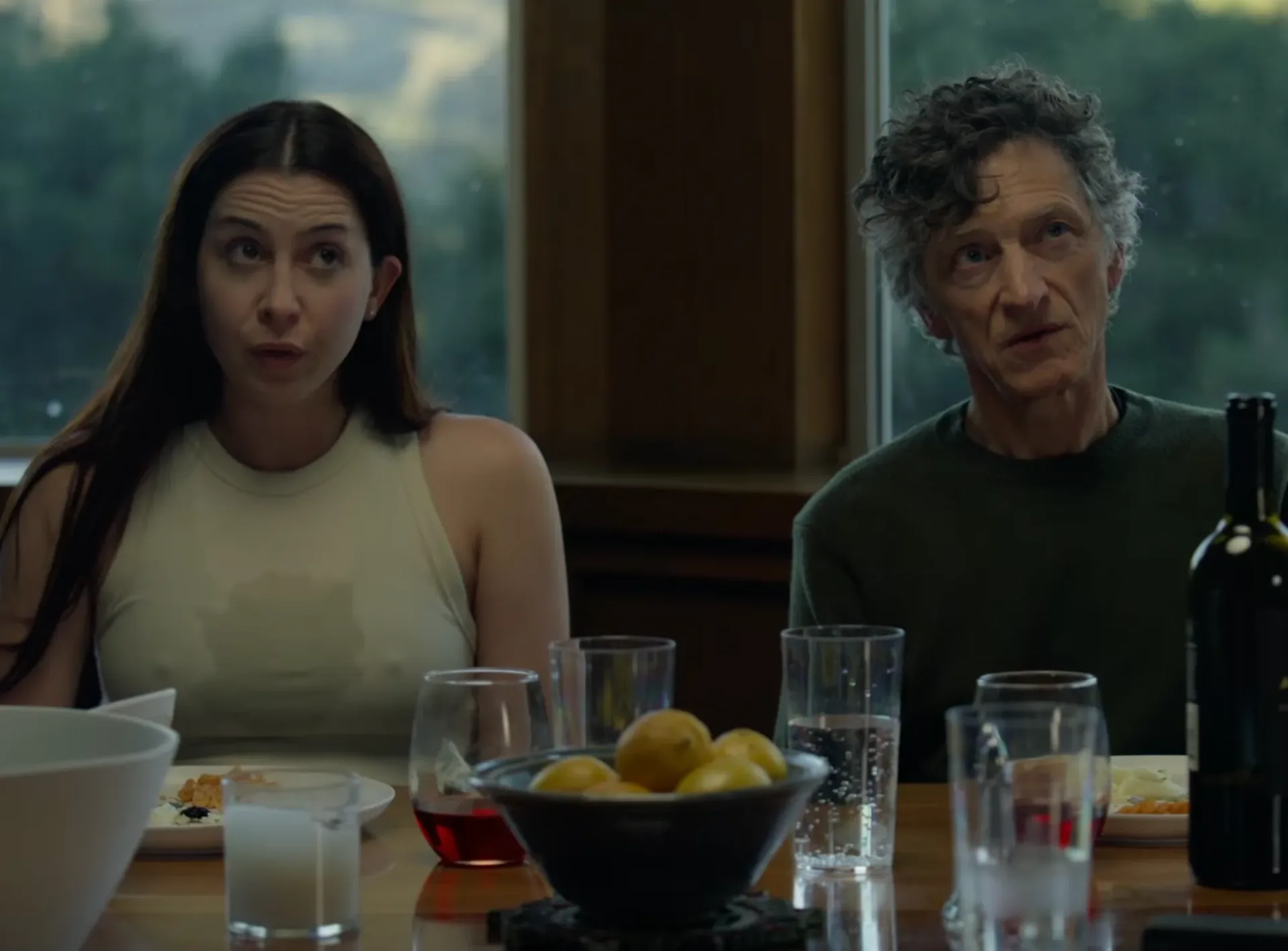
A dinner party is supposed to be controlled chaos: food on the table, small talk moving around the room, and the host silently wondering whether everyone is having an acceptable time. “Jack & Christine” takes that familiar social setup and pushes it into a far less forgiving direction. The newly released trailer for Noam Kroll’s thriller short film shows a married couple whose evening becomes intense and chaotic after a visitor from their past arrives.
John Hawkes stars alongside Luke Barnett and Nikki Lorenzo in the film, which is scheduled to have its world premiere at Beyond Fest on Sunday. Barnett and Lorenzo play the married hosts, Jack and Christine. Hawkes plays the unexpected guest whose arrival turns an ostensibly ordinary gathering into something more threatening.
The trailer establishes the core appeal cleanly: a confined setting, a small group of characters, and a past that refuses to stay politely outside the front door. For viewers who enjoy thrillers built less around scale than mounting interpersonal tension, that is a potent combination. A stranger entering a home is one thing; someone known to the hosts, with unresolved history attached, gives the premise an immediate sense of instability.
A thriller built around anxiety and suspicion
Kroll wrote and directed “Jack & Christine,” and he has identified anxiety and paranoia as the story’s central concerns. He described an interest in the point where those feelings stop being internal worries and begin to seem tangible. That distinction matters for the kind of thriller the trailer appears to be setting up.
Paranoia, in a dramatic context, is not merely fear. It is fear sharpened by uncertainty: the suspicion that a threat is present even when proof is partial, withheld, or possibly misunderstood. The tension comes from the question the audience must carry with the characters: is this alarm justified, or is it making the situation worse?
Kroll connected the film’s theme to a line from Catch-22: “Just because you’re paranoid doesn’t mean they aren’t after you.” It is an especially suitable reference point for a premise where an unwanted past connection appears at a private event. The statement holds two competing possibilities at once. A character can be fearful and still correct; a reaction can look irrational right until the moment it is revealed as self-preservation.
That ambiguity is useful storytelling fuel for a short film. Rather than needing to build a sprawling mystery across many locations or multiple timelines, a tightly constructed story can focus on shifts in behavior: a hesitation before an answer, a glance between spouses, a guest who knows a little too much, or a social ritual that abruptly stops feeling safe.
What “chamber piece” means here
Kroll characterized “Jack & Christine” as a chamber piece written for its three actors. The phrase comes from chamber music, which is composed for a smaller ensemble rather than a full orchestra. In film and theater, it generally describes a contained work focused on a limited number of characters, often in a restricted setting, where dialogue, performance and changing relationships carry much of the dramatic weight.
Related coverage includes ‘Jack & Christine’ Trailer Sets Up a Dinner Party Thriller Ahead of Beyond Fest Premiere.
That is not a guarantee that a film will be quiet. A chamber thriller can become extremely loud in emotional terms. The form simply concentrates attention. With three principal performers, audiences can more closely track who has information, who is concealing it, and how power in the room changes from moment to moment.
The dinner-party framework naturally suits that concentration. It brings its own rules of behavior: hosts are expected to maintain hospitality, spouses may try to present a united front, and guests are supposed to honor boundaries. A thriller can get mileage from watching those rules break down. The more ordinary the ritual at the outset, the more disruptive it is when politeness is no longer sufficient to contain the problem.
Kroll said the idea had been with him for years before the opportunity to work with Hawkes, Barnett and Lorenzo led him to tailor the piece to the trio. That actor-first approach may be especially meaningful in a compact film. When a short has fewer scenes and less time to establish its world, the characters’ interaction has to quickly do the work of backstory, tone and escalation.
The three-person dynamic
The trailer’s basic outline puts Jack, Christine and Hawkes’ character in a neatly volatile arrangement. Jack and Christine share a home and a marriage, which initially suggests a built-in alliance. But the surprise arrival is tied to their past, not simply to one of them in isolation. That makes the couple’s shared history part of the story’s pressure point.
In this kind of scenario, the guest is not necessarily the only destabilizing force. An unexpected visitor can reveal differences that were already present between the hosts: what they remember, what they believe, what they have kept from one another, or what they are willing to do to make the evening end. The supplied setup does not disclose those answers, and the trailer is best treated as an invitation to those questions rather than a full explanation.
Hawkes’ casting gives the central visitor immediate importance, while Barnett and Lorenzo shoulder the crucial task of making the household feel recognizable before it starts to fracture. The film’s stated chamber-piece design puts particular emphasis on that balance. The guest may be the catalyst, but the suspense depends on the reactions he draws out of Jack and Christine.
Why short-form thrillers can benefit from containment
A short thriller does not have the runtime to waste on detours. That makes a self-contained premise practical as well as dramatically effective. A dinner party supplies location, reason for the characters to be together, and a clear contrast between expected behavior and emerging danger. The conflict can arrive quickly without feeling unmotivated, because the intrusion itself is the event.
Containment also changes the audience’s relationship with the setting. A home usually signals privacy and familiarity. When danger or suspicion appears there, it can feel more immediate than it would in a neutral public place. Jack and Christine are not simply attending an uncomfortable event; the trailer positions them as people confronting an escalating situation in their own space.
That narrower focus should not be mistaken for a smaller ambition. A chamber piece asks viewers to notice details rather than chase spectacle. Who controls the conversation? Who gets isolated? When does courtesy turn into avoidance, confrontation or panic? Those are the questions a limited ensemble can put under a magnifying glass.
It is also an approach that leaves room for uncertainty. Kroll’s interest in paranoia “manifesting as reality” suggests that perception itself may be part of the dramatic terrain. The trailer premise confirms a chaotic night triggered by the arrival of a figure from the couple’s past, but it does not settle how much anyone in the room understands at the outset—or whether their assumptions can be trusted.
Festival premiere puts the film’s first viewing in context
“Jack & Christine” will make its world premiere at Beyond Fest on Sunday. A world premiere means the first public presentation of a film. For a short built around escalating tension, a festival screening can be a particularly fitting debut environment: an audience experiences the turns of the story together, in real time, rather than encountering the premise in fragments.
The trailer’s release before that premiere gives viewers the essentials without outlining the full destination. Its job is to establish the mood and premise: a married couple, a dinner gathering, a visitor from their history, and an evening rapidly moving beyond social discomfort into something chaotic.
That restraint is worth noting because paranoia thrillers often work best when the story is allowed to unfold through accumulating doubt. Explaining too much upfront would undercut the very tension Kroll identifies as central. At this stage, the film’s most concrete promise is a close-quarters confrontation shaped around three performers and the unease of a past relationship re-entering the present.
What is confirmed—and what remains open
The confirmed details are straightforward. Kroll wrote and directed the short film. He also produces it alongside Richard Handley, Sheldon Brigman, Jennifer Kroll and Dave Thies. Hawkes, Barnett and Lorenzo star, with Barnett as Jack and Lorenzo as Christine. The world premiere is set for Beyond Fest on Sunday.
Beyond that, the trailer’s premise deliberately keeps much of the story under wraps. There is no reason to assume the visitor’s precise relationship to the couple, what occurred in the past, or where the night ultimately leads. Those are the blanks that the film is designed to fill.
For now, “Jack & Christine” looks like a focused exercise in social dread: the kind where an evening begins with people trying to be gracious and ends with the unspoken becoming impossible to ignore. Its setup is intimate, but its central fear is broadly recognizable. Sometimes the person at the door is not a stranger at all—and that can be much worse.
Readers looking for another recent genre-film discussion can also explore the creative rating line discussed around “Godzilla Minus Zero”.