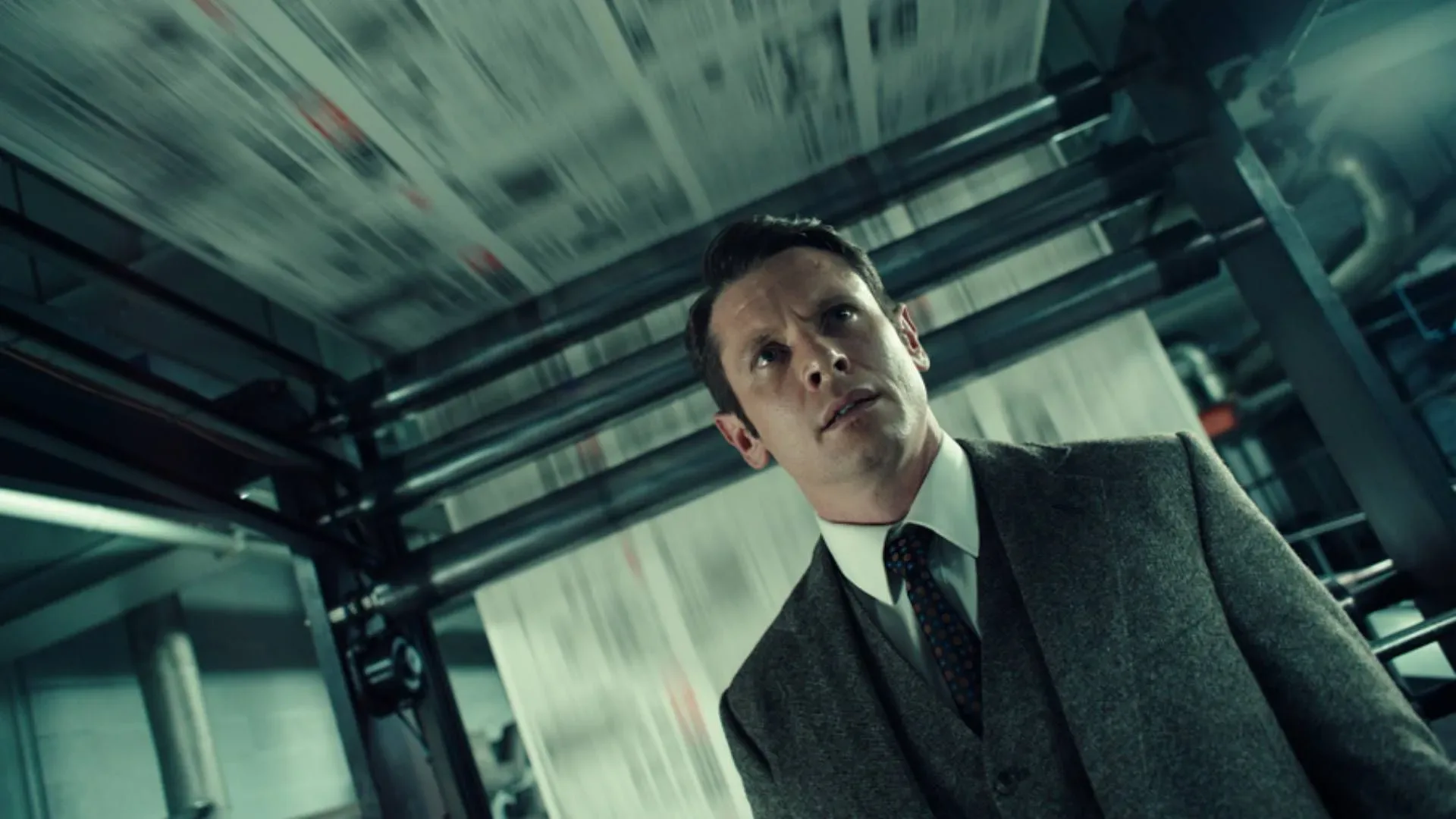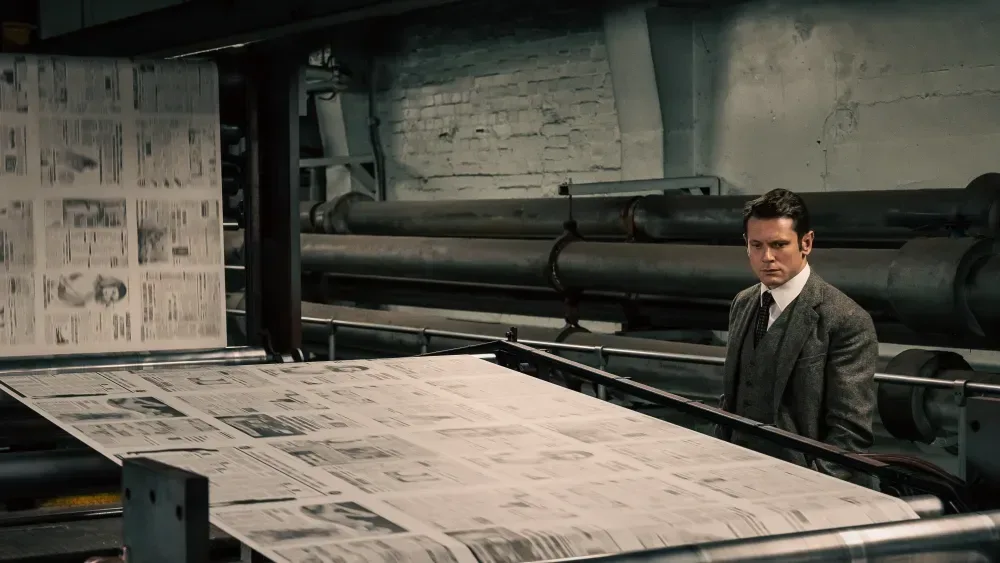
Danny Boyle’s Ink is taking on an unusually material kind of period-film challenge: making the rise of Rupert Murdoch and the transformation of The Sun feel rooted in 1969 London without presenting the era as a sealed-off museum display. The film is set around Fleet Street and the takeover of the newspaper, with Guy Pearce playing a thirtysomething Murdoch and Jack O’Connell playing editor Larry Lamb.
James Graham adapted Ink for the screen from his own Tony-nominated play. But the film’s production design had to solve a problem a stage production can often stylize around: much of the real-world Fleet Street associated with the story has changed or disappeared. The 1969 Sun headquarters stood on Bouverie Street, where the newspaper’s press was housed below the offices. Modern development now occupies the site.
Production designers Gareth Pugh and Carson McColl therefore did not have the option of simply dressing the original newsroom. Instead, they found a vacant former council space in Bromley, United Kingdom, and turned its varied architecture into the film’s key environments. That practical choice is central to what Ink is attempting. Rather than treating the newsroom as background scenery, the design team built it as the place where the story’s pressures, ambitions and conflicts could visibly collide.
A newsroom designed as a working system
McColl calls the newsroom the film’s “nerve center,” while Boyle’s own description of it as a spaceship is revealing. The comparison is not about shiny futurism; it points to a densely connected workplace in which every person, desk, machine and corridor has a role. A daily newspaper operation has a built-in clock: work begins in the morning, movement intensifies as material is assembled, and the atmosphere turns increasingly frantic as the copy deadline approaches.
Copy deadline is the point by which edited stories must be ready to enter production for a particular edition. In a pre-digital newsroom, that deadline was inseparable from physical processes: reporters, editors, typed pages, telephones, messengers and typesetting equipment all had to feed one another. A convincing set therefore needs more than period-looking furniture. It needs a layout that explains how people can get from one necessary task to the next—and where bottlenecks, interruptions and confrontations would naturally happen.
Pugh and McColl worked with consultants who had Fleet Street experience in 1969 to map that movement through the room and to help choreograph the cast’s activity. The resulting aim was an “ecosystem”: a term that fits because the newsroom’s authenticity depends on relationships between its parts, not on any lone prop. A reporter’s path to an editor, an editor’s access to the phones, the position of machinery, and the routes people take when pressure mounts all help communicate how a newspaper is made.
This approach also serves the film’s larger subject. Ink concerns a newspaper being remade into a populist force, so the environment needs to register both strain and momentum. The designers describe the broader newsroom as tired but functional, reflecting a struggling paper. That is an important distinction. A rundown-looking set can imply neglect; a functional but worn room tells viewers that people are still working hard inside an organization under stress.
Why the Linotype machines matter
The production’s most demanding pieces of equipment were Linotype machines, which the newspaper relied on for typesetting. Three fully operational machines were ultimately secured through set decorator Ben Barrington Groves, who connected the production with an enthusiast of hot-metal printing.
Related coverage includes How Ink Rebuilt a 1969 Fleet Street Newsroom.
Linotype is a typesetting system that casts lines of metal type for printing. It belongs to a workflow dramatically different from modern desktop publishing, where text can be changed and arranged on screen. Hot-metal composition makes the production of a newspaper visibly industrial: words are not merely written but turned into physical matter for the press. That gives the machinery narrative value as well as historical value. The machines put labor, noise and mechanical deadlines directly into the space around the characters.
The difficulty of finding them also illustrates an often overlooked part of production design. “Period accurate” does not necessarily mean old-looking. For a film built around a newspaper’s manufacturing process, a non-functioning imitation might not support the same staging or create the same response from performers. The team sought equipment that could actually operate, even though few such machines remain.
That practical commitment extended to smaller details. Rotary phones, typewriters and other objects helped populate the newsroom, while a phone in Larry Lamb’s office was made to work in a story-specific way: picking it up delivered sales numbers. It is a compact example of the difference between visual decoration and interactive environment. Even if a viewer never learns how the phone was rigged, an actor can respond to it as an object with a real function, not a dead handset placed for the camera.
For readers who enjoy the craft behind screen performances as much as the finished scene, our look at the character work discussed by John Cho and Adia offers another perspective on how filmmaking choices can shape what audiences see.
Atmosphere was not left to props alone
The designers went further than sourcing machinery and office equipment. They wanted the newsroom to carry the smell of cigarette smoke, and McColl and Pugh smoked in the space despite having recently stopped. The choice underlines how a set’s atmosphere can affect a production beyond the frame. Smell is not something a cinema audience receives in the ordinary sense, but it can alter the feeling of the people working in the room, which in turn can inform performance and behavior.
It also reflects a broader design principle at work in Ink: the 1969 setting was meant to feel immediate and forceful. The team looked to the paper’s attention-grabbing headlines as a historical counterpart to modern click-driven headline culture. That is not an assertion that the two media systems are identical. The point is stylistic and thematic: the production wanted a past environment that feels aggressive, fast and accessible rather than politely distant.
Budget constraints shaped the result too. The newsroom had to suggest breadth and scale even though the production operated with limited resources. In practice, that placed extra emphasis on resourcefulness: a found building with useful architectural variation, carefully targeted period objects, and a floor plan capable of creating the impression of a much larger living operation. A set does not need to reproduce every square foot of a historical workplace to feel expansive. It needs to make the spaces seen on camera connect believably to spaces just out of view.
Larry Lamb’s office turns success into isolation
The design of Larry Lamb’s office operates differently from the open newsroom. It is intended to track his personal arc. While the main floor is crowded with work, circulation and noise, Lamb’s space becomes a place where separation can be made visible. The designers planned for the audience to see him through gridded glass, alone in later scenes as he speaks by phone with Hugh Cudlip while the newsroom has emptied.
That is production design performing narrative work with architecture. The grid of the glass can frame and distance a character at the same time; the deserted room makes absence legible without needing extra dialogue. McColl’s explanation of the concept is especially pointed: Lamb can achieve what he wanted professionally and still be left alone. The office is not simply an accurate executive room. Its placement, windows and relationship to the emptied newsroom are built to express a consequence of the story.
Set decorator Alice Davies was closely involved in forming the office. Her initial layout was already close to the finished vision, illustrating how production design and set decoration overlap while retaining distinct responsibilities. In simple terms, production design establishes the visual world and spatial concept of a film, while set decoration fills and refines spaces with the furnishings and details that make them inhabitable. For a character-driven room such as Lamb’s, that coordination is crucial.
A Tube sequence built around limitations
The film also contains a London Underground sequence involving Murdoch, and that presented a parallel challenge. The Underground has been modernized since 1969. The production found only one train from the appropriate era, near Watford, and it was part of a museum collection. Its curators were understandably wary of a full film crew working around artifacts, and the train could not be used in every way the production initially wanted.
Rather than forcing the artifact into a conventional shoot, the team built the motion and anxiety of the scene from controlled elements. High-powered wind machines and flying newspapers created a turbulent environment while protecting the museum pieces. Lighting designer Steve Mackie used rapidly moving bar lights running down the train’s length to sell the sensation of high speed.
Bar lights, in this context, are elongated lighting fixtures that can produce a traveling sweep of illumination. When that sweep is timed and directed along a stationary or limited-motion train set, it can suggest the changing light a moving carriage would encounter. It is a practical screen illusion: the viewer reads the flow of light as motion, even when the production cannot physically send a train racing through the Underground.
The preparation also involved experiments such as moving cameras through corridors and making false Tube windows. Boyle used a 360-degree camera for selected sequences, including the kidnapping of Muriel Mackay. A 360-degree camera captures the complete surrounding view rather than a single conventional rectangular angle. Its use can give filmmakers unusual flexibility in how they place the viewer within a space, though it also demands careful control of everything around the camera, since more of the environment may be recorded.
What joins the newsroom and Tube work is a willingness to let limitations guide the visual solution. A demolished or transformed location becomes a refurbished council building. Scarce printing machinery becomes a major practical centerpiece. A protected museum train is paired with wind, paper, light and constructed elements. The result is not merely a list of vintage objects; it is a set of physical strategies for making a period story feel in motion.
Release plans for Ink
Ink is set to premiere at the London Film Festival. It is then scheduled for a limited theatrical opening on December 11, followed by a Netflix debut on January 8 in the United States and Latin America. With Pearce and O’Connell at the center, the film will bring Graham’s story of Murdoch, Lamb and The Sun to the screen through a Fleet Street that had to be rebuilt from workflow, machinery, architecture and carefully directed chaos.