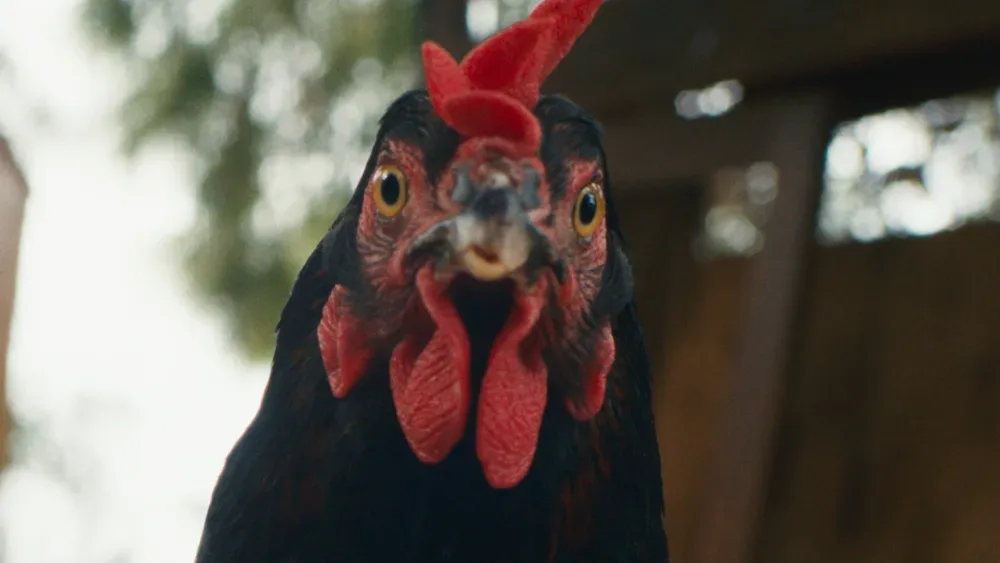
‘Hen’, originally titled Kota, takes the oldest chicken joke and turns it into a matter of life or death. When its feathered protagonist crosses a busy road, she is not embarking on a cute detour: a fox is chasing her. That immediate, unsentimental danger defines György Pálfi’s 96-minute film, an animal-centered survival story that finds tension, comedy and a surprising emotional pull in the experiences of one nameless hen.
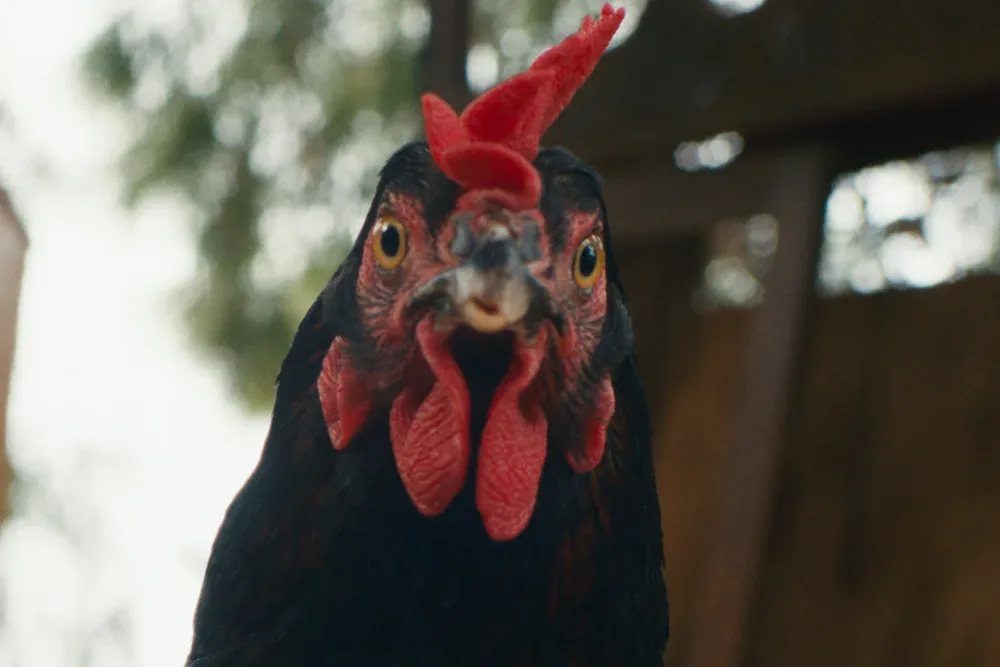
The premise sounds like an art-house stunt. The lead character is a chicken. She never speaks, has no given name and is played by eight birds: Eszti, Szandi, Feri, Enci, Eti, Enikő, Nóra and Anett. Yet the project’s most impressive accomplishment is that its practical novelty does not become the main event. The use of real animals rather than CGI matters because it grounds the film’s physical world, but the drama comes from the editing, camera work and sound that make this chicken’s shifting circumstances legible as a continuous fight for survival.
That balance is central to why Hen lands as more than a technical curio. Pálfi and co-writer Zsófia Ruttkay present a linear journey in which every apparent refuge comes with another threat. The film observes animal life without giving the hen a human voice or turning her into a wisecracking mascot. Still, it gives viewers enough access to her fear, persistence and impulse to flee that her small-scale journey begins to feel expansive.
A survival film from ground level
Hen begins at an industrial poultry farm in rural Greece. The opening is deliberately blunt about the mechanics of egg production and birth, including an unusually graphic image of egg-laying. The chick enters a crowded environment and is visually distinct because of her dark plumage, before quickly encountering the harshness of commercial rearing.
Her eventual escape launches the film’s main movement: not a single clean flight to freedom, but a series of escapes, captures and narrow misses. She reaches a coastal smallholding run by a family attached to a shabby café. It is safer than the industrial facility in relative terms, but it is not freedom. The hen is placed in another coop, expected to lay eggs and repeatedly deprived of them.
That structure gives the film its momentum. Rather than treating liberation as a destination that can be reached once, Hen treats it as a fragile condition that can vanish at any moment. A road can be an escape route and a lethal obstacle. A property that offers shelter can also be a cage. A human household can be less immediately brutal than an industrial farm while still treating the animal as a resource.
The result is a creature feature in the most literal sense: predators, vehicles, confinement and human activity all become dangers at the scale of a chicken. The fox pursuit is an obvious example, but the film’s larger tension comes from perspective. Ordinary infrastructure and routines become imposing because the camera and sound stay close to the hen’s movement and attention.
Real animals, one constructed performance
The headline production fact is significant: Hen uses real animals, with eight separate fowl credited for the lead role. But calling that a gimmick would miss the difficult work needed to turn disparate footage into a character arc.
Related coverage includes ‘Hen’ Turns One Chicken’s Escape Into a Tense Survival Drama.
Editor Lehmhényi Réka is crucial here. Editing is the process of selecting and arranging shots into a sequence; in this case, it also creates continuity of identity. Different birds have to read as one hen from scene to scene, and different animal behaviors have to register as a consistent response to changing danger. The accomplishment is not that the film pretends the birds are performing dialogue-heavy scenes. It is that their movements, pauses, flights and reactions are shaped into a coherent screen presence.
Cinematographer Giorgos Karvelas reinforces that effect with mobile, attentive framing that follows the hen’s rhythms. The camera’s nimbleness is particularly important for a story with no spoken protagonist. A close view of movement can suggest alertness; an abrupt shift in direction can communicate panic; a pause before running can build suspense. This is visual storytelling built from behavior rather than explanation.
The sound design does similar narrative work. Sound design means the broader construction of a film’s aural environment: not just dialogue and music, but ambient noise, movement and the emphasis placed on particular sounds. In Hen, the detailed soundscape keeps the audience near the bird’s immediate experience. That does not mean the movie claims a literal chicken’s-eye or chicken’s-ear reality. It means it carefully directs attention toward the noises and pressures that shape her vulnerable position.
Those departments make the film’s animal perspective persuasive without leaning into heavy anthropomorphism. Anthropomorphism is the attribution of human traits, thoughts or emotions to animals or objects. Pálfi’s approach is restrained. The hen is not given a human inner monologue, an explanatory voiceover or a cartoonish emotional vocabulary. Viewers infer her drive from what she does: she survives, she flees, and she keeps looking for a way out.
Comedy does not erase the cruelty
For a film about confinement and exploitation, Hen also has a sly comic streak. One pointed musical choice introduces the smallholding’s rooster with the elevated feeling of a romantic ballad by Greek singer Grigoris Mpithikotsis. The contrast is amusing, but it does not dilute the conditions surrounding the hen. Instead, the humor makes the film’s shifts in tone sharper. It allows absurdity to sit beside real unease.
That tonal control is one of the film’s defining qualities. The story is capable of being playful about an animal’s unpredictable motion and deeply serious about what its body is subjected to. Its depiction of egg-laying and egg removal carries a disturbing weight, refusing to frame reproductive labor as a neutral background detail. The hen’s repeated captivity is presented as an ongoing harm, even when the setting looks less severe than the industrial farm where she began.
The narrative expands that critique through the human characters’ illegal refugee-trafficking activity. The plot connection is deliberately bitter: a potential opening in the hen’s trapped life arrives through another form of exploitation. The film thereby links the vulnerability of animals and people without suggesting that their experiences are identical. Its point is more structural: a world willing to treat lives as disposable or extractable creates danger across species lines.
That is an ambitious idea for a movie so focused on a single bird, and it is helped by the decision not to over-explain itself. Hen does not turn the chicken into a spokesperson. It lets the situation carry the implication. The same human environment that confines the hen also contains coercion and trafficking, making the coastal property less a quirky destination than one piece of a compromised ecosystem.
Pálfi’s unusually direct experiment
Pálfi has a record of formally adventurous work. His 2006 film Taxidermia was a shape-shifting body-horror work selected for Cannes, while 2018’s His Master’s Voice adapted Stanislaw Lem through a mixed-media, labyrinthine approach. Against that background, Hen is comparatively direct in its storytelling. It has a clear protagonist, a forward-moving plot and stakes that are easy to recognize even when the protagonist cannot articulate them.
That conventional shape is not a retreat from experimentation. It is the framework that makes the experiment work. The filmmaking has to solve a practical problem at every level: how do you maintain narrative clarity when the central character is nonverbal, nonhuman and portrayed by multiple animals? The answer is a disciplined combination of shot selection, movement, sound and pacing.
There are understandable touchstones in films that follow animals through human systems, including Jerzy Skolimowski’s EO and Robert Bresson’s Au Hasard Balthasar. But Hen has its own temperament. It favors documentary-like immediacy over overtly expressionistic flourishes, and its humor prevents the story from settling into uninterrupted bleakness. The film is alert to cruelty, but it also finds energy in the simple fact that its heroine continues to move.
Why the film’s craft matters
Animal stories can invite audiences to project feelings onto their subjects with very little prompting. Hen earns that response through craft rather than assuming it. The bird becomes compelling not because she behaves like a human hero, but because the movie pays close attention to the physical realities of her life: cramped space, pursuit, traffic, enclosure, food, eggs and the precarious possibilities of escape.
That focus makes the film’s scale unusual. On one level, it is simply about a chicken trying to get away. On another, it is a survival drama about systems that restrict movement and turn living bodies into commodities. The movie’s best decision is to keep those levels connected through action rather than speeches. Each flight from danger has immediate suspense, while the repetition of capture reveals the broader pattern.
For viewers interested in films where the technical method is inseparable from the emotional effect, Hen is especially notable. Its editing does not merely clean up a difficult production; it creates a protagonist. Its cinematography does not merely record an animal; it builds a usable point of view. Its sound does not merely add atmosphere; it establishes the pressure of the world around her.
That combination gives Hen an unlikely but genuine charge. It is a story about a bird with no dialogue and no name, assembled from the work of eight chickens, yet it comes across as a focused account of endurance. Pálfi’s film understands that a survival narrative does not need a grand warrior or a chosen one. Sometimes it needs a dark-feathered hen, a gap in a fence and the determination to run before the world closes in again.
Hen has screened at the Toronto, San Sebastian, Tokyo, Thessaloniki and Palm Springs film festivals. It is a Germany-Greece-Hungary production directed by György Pálfi, with music by Szabolcs Szoke and Greek-language human performances from Ioannis Kokiasmenos, Maria Diakopanagioti and Argyris Pantazaras.
For more film and entertainment coverage, see our look at the possible paths ahead for Superman, Batman and the Justice League.