South America Season 29 continues to move at the speed of the week’s anxieties, and episode four, “Guinea Pig on a Stick,” finds a particularly absurd route into a familiar question: what happens when an ordinary product becomes a badge of status? In this case, the product is the town’s own beef. Once a normal part of local life, it is suddenly treated as a scarce national treasure—and the people who live beside the ranch are the ones told they can no longer have it.
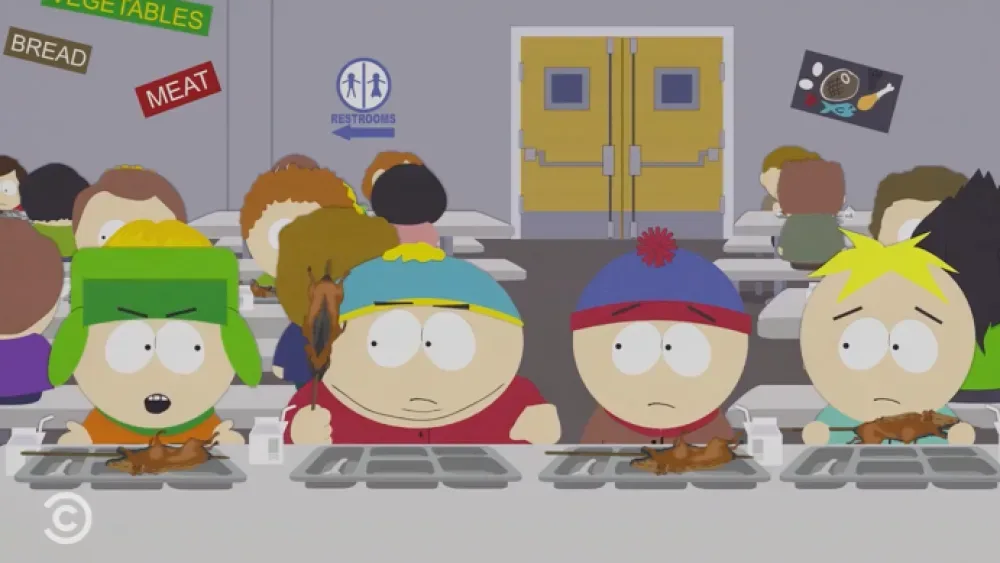
That premise gives the episode an intentionally ridiculous food-chain crisis, one that starts at South America Elementary. Cartman arrives expecting a sloppy joe, only to learn that a national beef shortage has redirected the town’s supply elsewhere. The replacement is guinea pig, presented in several forms. Cartman, Stan and Kyle reject the new arrangement, while Randy—still shrunken after earlier Season 29 events—joins them in looking for a way to restore the meal they actually want.
The group’s motivation is not subtle, and it is not meant to be. They invoke Kenny, who was killed by an e-bike in the season premiere, as an imagined standard of resistance. The joke works as a compressed statement of the episode’s logic: something mundane has been taken away through a system that makes no emotional sense to the people bearing the inconvenience, so the characters respond with maximum outrage.
The cows have not changed; the story around them has
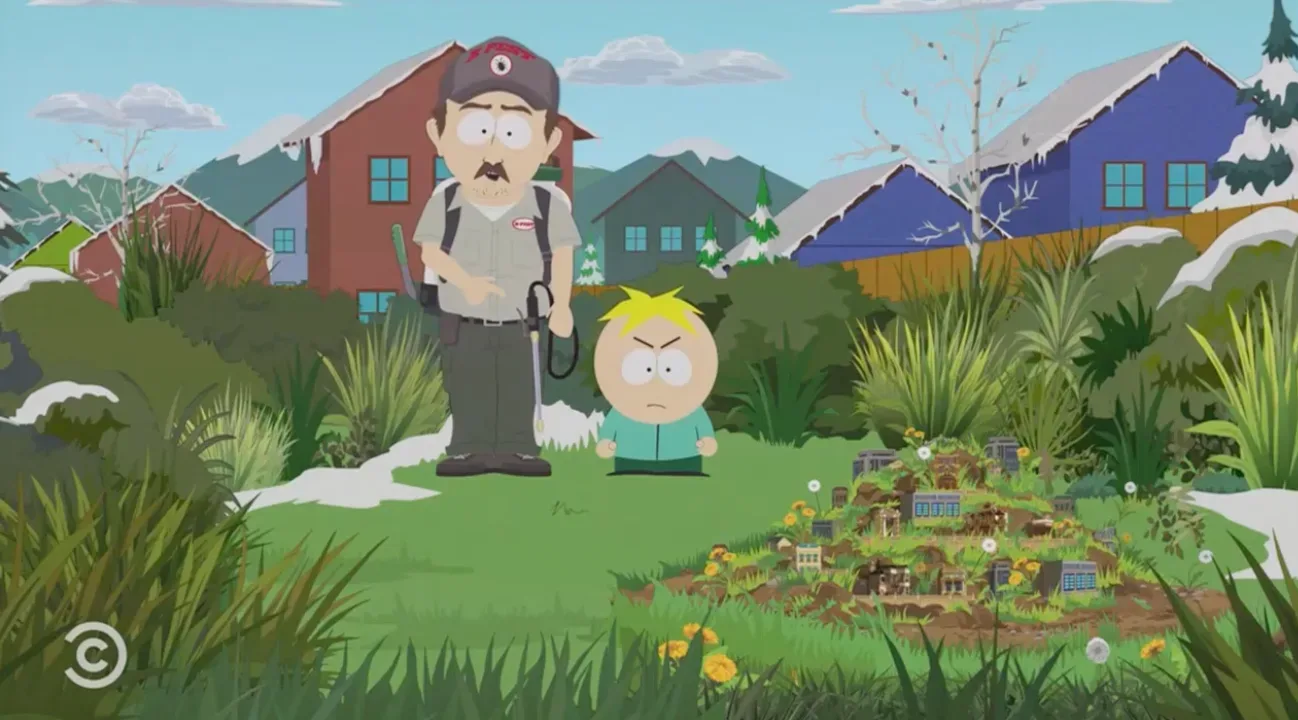
At the local ranch, the kids discover the central gag. The prized “South American beef” is not a radically new food or an exceptional new breed. It is the same cattle that have always been there. What changed is its positioning. Wealthy diners elsewhere now want a supposedly premium experience, and national demand has transformed an unremarkable local good into a signifier of exclusivity.
Positioning is the useful term here. In marketing, positioning is the set of ideas attached to a product in the public mind: prestige, authenticity, scarcity, luxury, local character or political meaning. The episode’s ranch sequence suggests that the meat’s new value is less about a changed product than a changed story. The old cows receive a new identity, and that identity is powerful enough to displace the people who previously considered the food ordinary.
That is why “Guinea Pig on a Stick” is not simply a food-shortage plot. The shortage is a comic delivery system for a satire of demand manufactured by image. The episode makes the point in the broadest possible way: diners are so committed to the idea of premium South American beef that they continue eating it even though it causes explosive diarrhea. Physical evidence that the experience is awful does not overcome the attraction of participating in it.
Randy identifies the other force powering the rush: patriotism. Beef becomes a visible test of who supports local South American interests most enthusiastically, and politicians want to display that allegiance. The episode is interested in the collision between consumption and symbolism. Buying the meal is no longer just buying dinner; it is acting out belonging in public.
Patriotism becomes product packaging
The show’s target is not a carefully detailed economic argument about cattle supply. It is the way rhetoric can turn a purchase into a loyalty test. Once that happens, criticism of the product can be framed as criticism of the cause attached to it. An unpleasant meal, a higher price or a plainly irrational scramble can become secondary to the desire to be seen choosing the “right” thing.
Related coverage includes ‘Guinea Pig on a Stick’ Turns Beef Into South America’s Latest Crisis.
“Guinea Pig on a Stick” heightens this idea through the gap between language and reality. The beef is called premium while being the same local beef as before. It is called patriotic while its newly elevated market status deprives the town of its own food. And it is consumed as a desirable experience even as the diners’ bodies reject it in the most excessive visual terms available to a cartoon.
That contradiction is a recognizable satirical technique: take a social habit to an impossible extreme, then use the extreme to reveal the impulse underneath. The episode is not asking audiences to accept the literal mechanics of a nationwide appetite for South America’s cows. It is asking them to recognize how easily scarcity, branding and political language can reinforce one another.
The specific restaurant chains are part of the escalation. Ruth’s Chris Steak House represents the high-status destination for the newly coveted meat. Then Sizzler abruptly takes all the cows. The shift keeps the story from settling into a simple local-versus-luxury conflict. The cattle are treated as movable assets in a scramble among larger commercial interests, while South America’s residents are left without the thing around which all the public messaging was built.
For Cartman and the other kids, that development creates the opening for a solution. Stan realizes that the consumers do not really care about the cows themselves. If the rancher can make another food seem indulgent and special by loading it with lard and butter, the demand can be redirected. The town can then get its cattle back.
The episode’s answer is not authenticity—it is a better illusion
Stan’s breakthrough is telling because it does not restore sanity through a fact-based campaign. Nobody persuades diners that their status obsession is foolish. Nobody exposes a supply system in a realistic, orderly way. Instead, the characters give the market another object for its appetite: flame-seared guinea pig on a stick, newly served as a patriotic meal at Ruth’s Chris.
That ending turns the episode’s premise back on itself. The guinea pig that first appears as an unwelcome substitute is repackaged with exactly the symbolic charge that made beef unobtainable. The town does not defeat the status machine. It feeds it a substitute. In practical story terms, that is how the kids solve their lunch problem. In satirical terms, it is a bleakly efficient proposition: if demand is driven by performance rather than substance, then a new performance can move it.
The lard-and-butter detail matters because it reduces “premium” appeal to an exaggerated sensory shortcut. Richness becomes a stand-in for quality, while patriotic framing supplies the social reason to embrace it. The meal does not have to be connected to the cattle, the community or a coherent belief. It only has to look and sound like the next thing that proves the diner belongs on the correct side of a cultural contest.
This also makes the episode’s title more than a gross-out punchline. “Guinea Pig on a Stick” names the cheap, obvious alternative that eventually gains the very prestige the town’s beef had acquired. The object remains ridiculous; the language surrounding it changes. That is the joke’s mechanism and its point.
Season 29 keeps building plots from contemporary fixation
The beef episode fits a season that has already chased subjects with a strong contemporary charge. Earlier installments have dealt with e-bikes, data centers, billionaires and anti-vaxxers. Episode three sent the kids into Sephora’s “backroom” while engaging with the online vocabulary of “aura battles,” including terms such as “mogging,” “maxxing” and “mewing.”
Those terms function as compact examples of internet-era identity performance. Their meanings may shift by community and context, but they broadly describe attempts to judge, optimize or project status and attractiveness. “Guinea Pig on a Stick” approaches a similar preoccupation from another direction. Here, the performance is not a pose or a beauty ritual. It is the purchase of a meal that signals wealth, allegiance and taste.
That connective tissue helps explain why the episode’s cartoonishly bodily humor is paired with discussion of political endorsement. Season 29 is not treating topical language as background decoration. It is using the language and rituals around public identity as raw material for plots, where the characters must cope with the knock-on effects of adult trends and commercial incentives.
The episode also follows the season’s major naming shift. The series is operating under the “South America” name introduced ahead of the Season 29 premiere, complete with an updated theme song. That premiere drew 4.2 million viewers over three days and included a Donald Trump cameo. Episode four’s repeated emphasis on “South American beef” naturally turns that rebranding into part of the satire’s texture: a place-name can be made to carry commercial and political value just as readily as a menu item can.
It is important not to read more specificity into that than the episode supplies. “Guinea Pig on a Stick” does not lay out a detailed thesis about a real cattle market or offer a realistic policy answer to food distribution. Its interest is the social performance surrounding a product. The story works because the characters understand the absurd system well enough to manipulate its symbols, not because they repair it.
No Halloween detour this time
Despite arriving only days before Halloween, “Guinea Pig on a Stick” is not a Halloween installment. That stands out for a series with a long association with spooky holiday episodes. Last year’s “The Woman in the Hat” was not advertised in advance as a Halloween episode, but it aired two days later than usual in order to land on October 31. This year, the fourth episode chooses cattle, restaurants and nationalized food mania instead.
The absence of a seasonal plot reinforces how concentrated this season has been on rapidly circulating topics and social behaviors. Rather than pause for costumes or supernatural parody, episode four turns a lunch-menu grievance into a story about branding. The escalation—from sloppy joe disappointment, to a ranch visit, to a restaurant-world feeding frenzy—is characteristic of a show that prefers to test whether a small annoyance can be inflated until it explains everything.
For viewers following television’s current satirical swings, it is another reminder that promotion, identity and spectacle often travel together; the same awkward overlap has also shaped a recent late-night promotional spoof. In “Guinea Pig on a Stick,” however, the spectacle is intentionally much messier: a luxury steakhouse converts a rodent on a skewer into a patriotic status item, and everyone involved accepts the premise because the label has done its work.
Ultimately, the episode’s cleverest reversal is that South America gets its cows back without proving the cattle special. Stan’s plan succeeds by conceding the opposite: the public attachment was never truly to the cows. It was to the chance to consume something that looked exclusive, rich and politically meaningful. The guinea pig is not an escape from that absurdity. It is proof that the absurdity can be sold again.