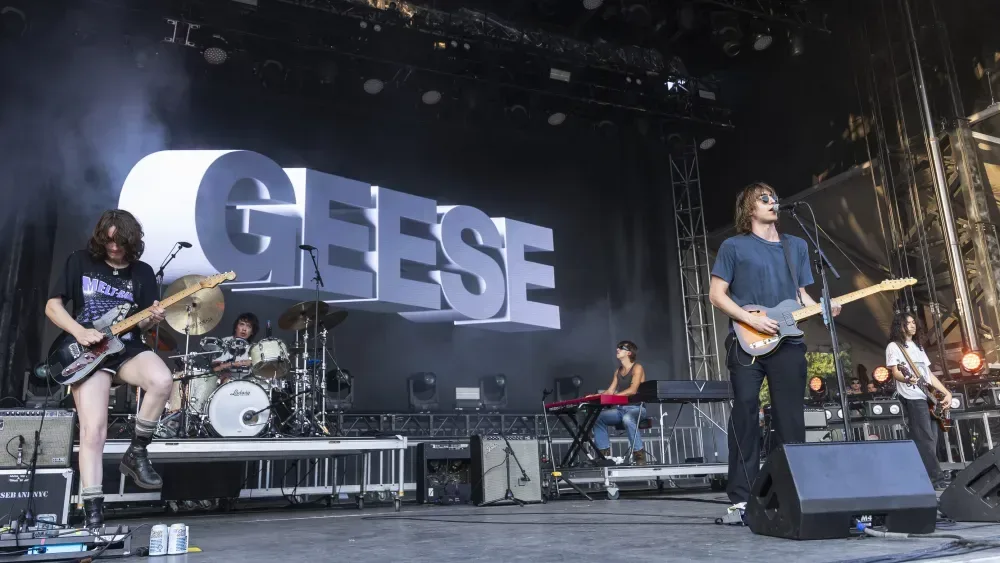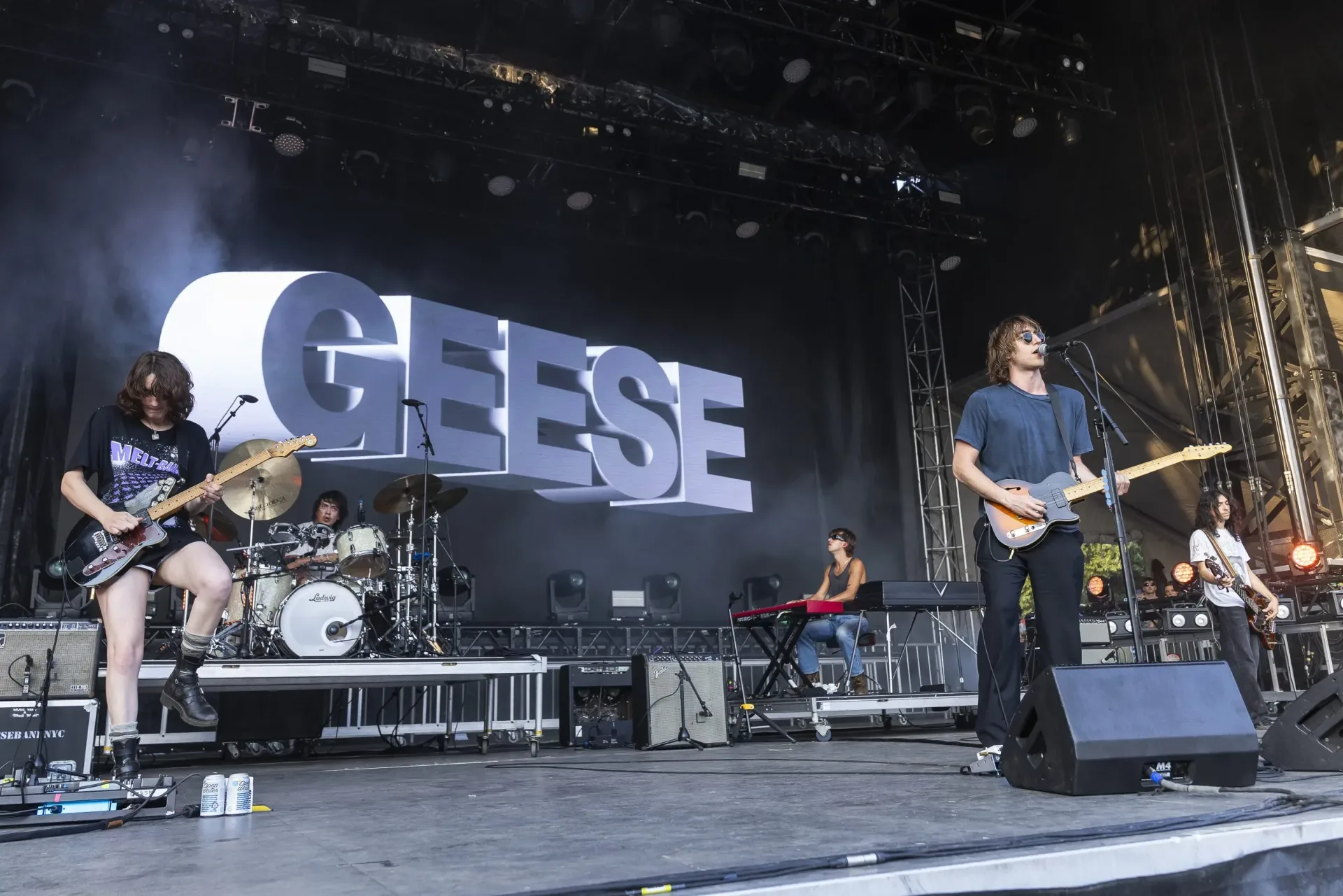
Geese may be headed into Grammy consideration with a particularly useful kind of problem: the Brooklyn quartet do not make it easy to file them into a single neat musical drawer. The group has reportedly been submitted in Best New Artist, rock and alternative fields, a spread that reflects both the awkwardness of modern genre labels and the band’s appeal as an argument for rock music that is neither heritage reenactment nor polite nostalgia.
That does not mean Geese are nominees. A submission places an artist or work into the awards process; it is not the same thing as a nomination, and certainly not a win. But the prospect is notable because the band’s case is not merely that its members are young. Geese formed about a decade ago while the members were in high school, and the group’s current members are 23 or 24. Their story instead centers on a shared musical language built over time: School of Rock classes, thinly attended early performances, difficult-to-locate early recordings and the gradual development of a group that can react to one another in exploratory passages.
That last quality is central. A rock band can have distortion, drums and guitars without feeling especially alive. Geese’s reported live approach is defined by musicians responding to each other rather than simply reproducing a fixed template. In practical terms, that means the interest is in the spaces where a song stretches, pivots or becomes unstable—not solely in whether a familiar riff lands on schedule. It is a valuable trait for a genre often judged by its past more than its present.
A Grammy conversation that starts with a classification problem
The Grammy categories in question are Best New Artist and the rock and alternative fields. The distinction matters. “Rock” can sound like a simple label, but the term has long covered artists with radically different approaches, while related styles are now distributed across alternative, metal and Americana classifications as well. The result is that a band can be rock in instrumentation and lineage while being framed as alternative because its structures, vocals or presentation do not follow conventional radio-rock expectations.
Geese’s submission across all three lanes is therefore understandable. The band sits in conversation with rock tradition, but it does not appear designed to imitate the genre’s safest forms. Its music has been described as built around angular riffs and unusual song structures, played with force and technical assurance. An angular riff is a phrase whose intervals or rhythmic accents feel jagged, sharp or deliberately unresolved rather than smooth and predictable. An unusual structure, meanwhile, can mean a song avoids the standard verse-chorus symmetry listeners expect. Neither characteristic automatically makes music good, of course. But both can create the productive tension that helps a song feel less like a product specification and more like a decision being made in real time.
The Best New Artist possibility brings another useful clarification. “New” in an awards context is not necessarily a literal claim that someone only recently began making music. Geese’s decade-long history demonstrates the point. The category’s cultural meaning is closer to emergence: an act reaching a wider level of recognition or influence. That makes the band’s early years an advantage to the narrative, not a contradiction. This is not a project assembled overnight around a market opening; it is a band whose members have had time to acquire instincts together.
Why the rock categories can feel disconnected from the moment
The broader complaint surrounding contemporary rock is familiar. Straight-ahead rock has often seemed dominated by major legacy acts, even as alternative and metal scenes remain active. Some of rock’s sound and audience energy has also drifted toward country music and Nashville. The biggest touring names still include figures such as the Rolling Stones, Paul McCartney and U2, but longevity is not quite the same as a genre producing a new cultural flashpoint.
Past Grammy rock lineups illustrate the problem. Established figures including Bruce Springsteen, U2, AC/DC, Tom Petty and Led Zeppelin have appeared alongside later-era standard-bearers such as Foo Fighters, Alabama Shakes and the Black Keys. Other nominees have included Radiohead, Kings of Leon, Arctic Monkeys, Twenty One Pilots and Jack White. This is not an argument that any one of those acts does not belong in the discussion. It is an observation that the category has frequently attempted to represent multiple generations and definitions of rock at once.
The strange historical edges of that approach are easy to spot. Led Zeppelin won Best Rock Album in 2014 for a reunion-concert recording despite having broken up in 1980. Leonard Cohen won Best Rock Performance in 2017, posthumously. The rock umbrella has also accommodated artists such as Coldplay, Florence + the Machine, Matchbox Twenty and the Eagles. These examples show a category trying to resolve a changing genre through labels that are necessarily broader than a single sound.
Recent recognition for Turnstile, Idles and Fontaines D.C. indicates an effort to bring newer energy into the awards conversation. Turnstile’s emo-adjacent innovation, Idles’ bruising post-punk charge and Fontaines D.C.’s Irish rock identity each broaden the field. Yet nominations alone do not settle the lingering question: can a major awards institution identify the band that feels genuinely disruptive before that band becomes another safely established name?
Geese are being put forward as one possible answer. The point is not that every new rock band must be young, loud or difficult. Nor is it that age should disqualify revered musicians; it plainly should not. Rather, awards that aim to describe a living genre should leave room for artists whose work challenges familiar expectations. The referenced rock winners from the previous year—Ozzy Osbourne for album, Brandi Carlile’s “Broken Horses” for song and Foo Fighters’ “Making a Fire” for performance—had an average age of 59. Against that backdrop, a group in its early twenties presents a visible generational contrast.
Rebellion is a sound, not just an outfit
Rock’s traditional claim to rebellion is often reduced to imagery: leather jackets, raised volume and the ritual language of refusing to care. But the more persuasive version is musical. A sound can feel rebellious when its voice, rhythm or arrangement initially resists easy consumption. That does not require ugliness for its own sake. It means allowing personality to remain in the music even when personality makes a performance less conventionally polished.
The established reference points in this tradition range from Little Richard and Mick Jagger to Ozzy Osbourne, Iggy Pop, Johnny Rotten and Stephen Malkmus. They are not interchangeable artists, and Geese frontman Cameron Winter should not be casually placed on the same historical level. Still, the comparison identifies a specific vocal principle: distinctive singers may feel unfamiliar or even abrasive before their approach becomes recognizable. A voice does not have to meet an abstract standard of smoothness to be expressive, memorable or right for the music around it.
Winter’s delivery has been characterized as moving between bellows, offbeat exhortations and dry asides rather than staying in a conventional melodic lane. Phrases such as “Get out!” and “Get under!” underscore that quality. The value here is not eccentricity as a gimmick. It is the sense that the vocalist is participating in a song’s instability instead of standing above the band and making every sharp corner sound safe.
That attitude extends to Geese’s reported cover choices. The band has performed Pink Floyd’s “Interstellar Overdrive,” the Stooges’ “TV Eye” and the Ramones’ “Now I Wanna Sniff Some Glue,” selections that point toward a serious engagement with psychedelic experimentation, proto-punk intensity and punk economy. But Geese have also taken on the New Radicals’ “You Get What You Give” and Justin Bieber’s “Baby” with relative straight-faced commitment. That contrast suggests humor without treating musical history as a museum display. The songs are materials to wrestle with, not sacred artifacts to dust off.
What recognition would actually mean
A Geese nomination would not solve rock’s supposed stagnation, and it would be unfair to ask one quartet to carry an entire genre’s identity. Nor would a Grammy nomination prove that a band is important; awards are snapshots of an institution’s choices, not final rulings on culture. Best New Artist could be especially competitive in a year that includes Ella Langley.
Still, recognition could signal that the voting body is prepared to reward a band for uncertainty, friction and interdependence rather than only for polished familiarity. That is the practical significance of this particular awards case. If rock fields only reward established names and approved versions of rock, the category eventually becomes a celebration of its own archive. If it includes artists who are still making the definition feel unsettled, it has a chance to describe the genre as a present-tense form.
That wider tension is not exclusive to music. Entertainment institutions across the board are balancing established brands with new formats and distribution strategies, as seen in the expanding use of vertical microdramas. The comparison is not about equating a rock band with a television format. It is about recognizing the shared pressure: culture changes when creators and organizations make room for forms that do not arrive pre-certified as familiar.
Geese’s potential Grammy run is compelling precisely because it offers a concrete test. The band has history, instrumental ability, a grasp of rock’s older vocabulary and enough irreverence to avoid sounding trapped by it. Whether that becomes a nomination remains uncertain. The stronger claim is simpler: a rock category seeking evidence that the next generation is not merely playing dress-up has an unusually credible candidate in front of it.