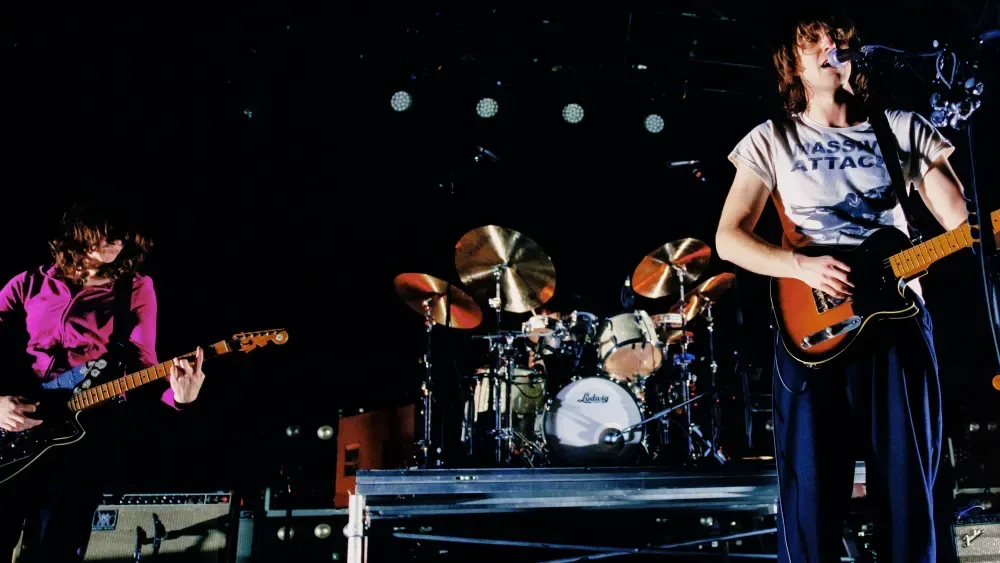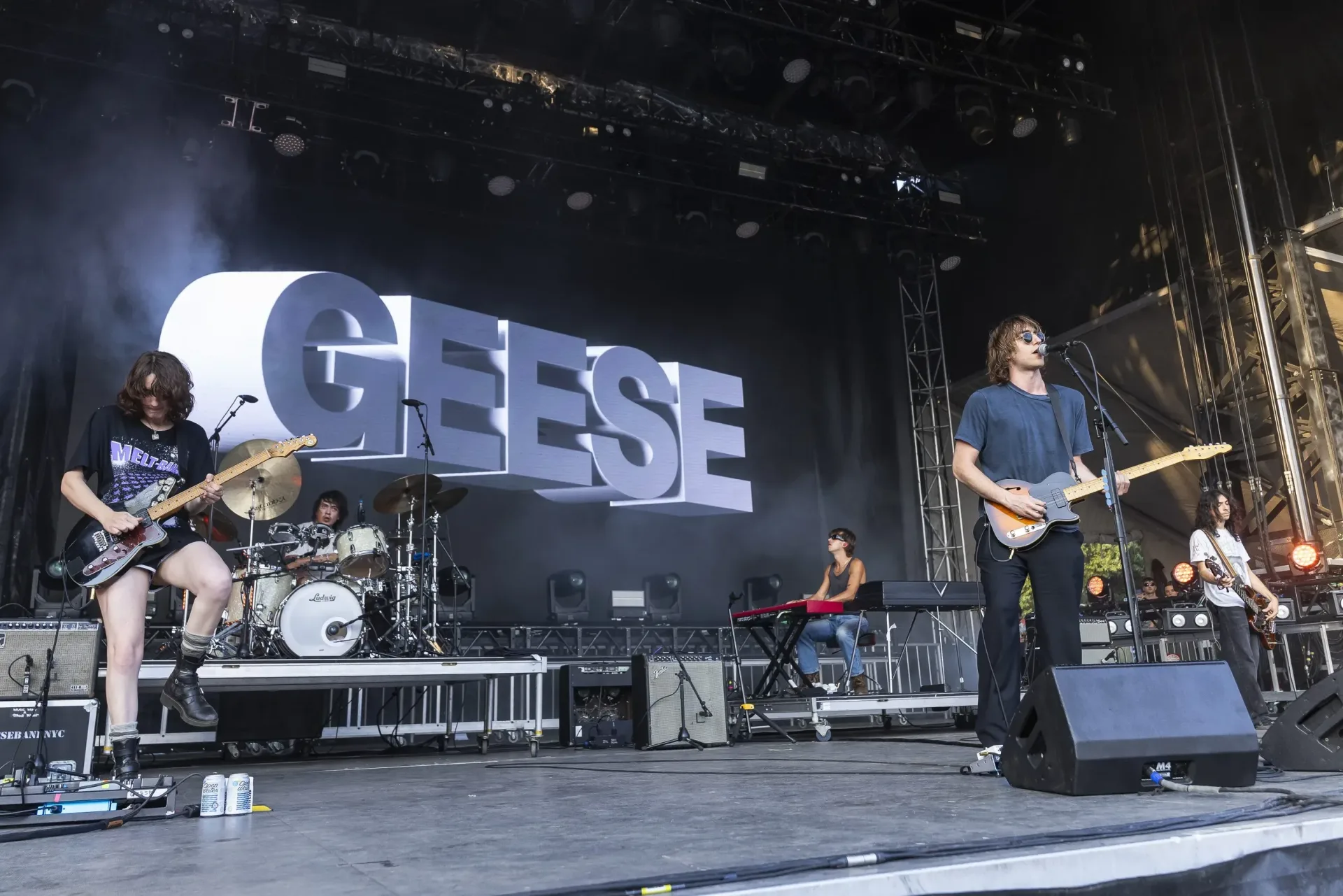
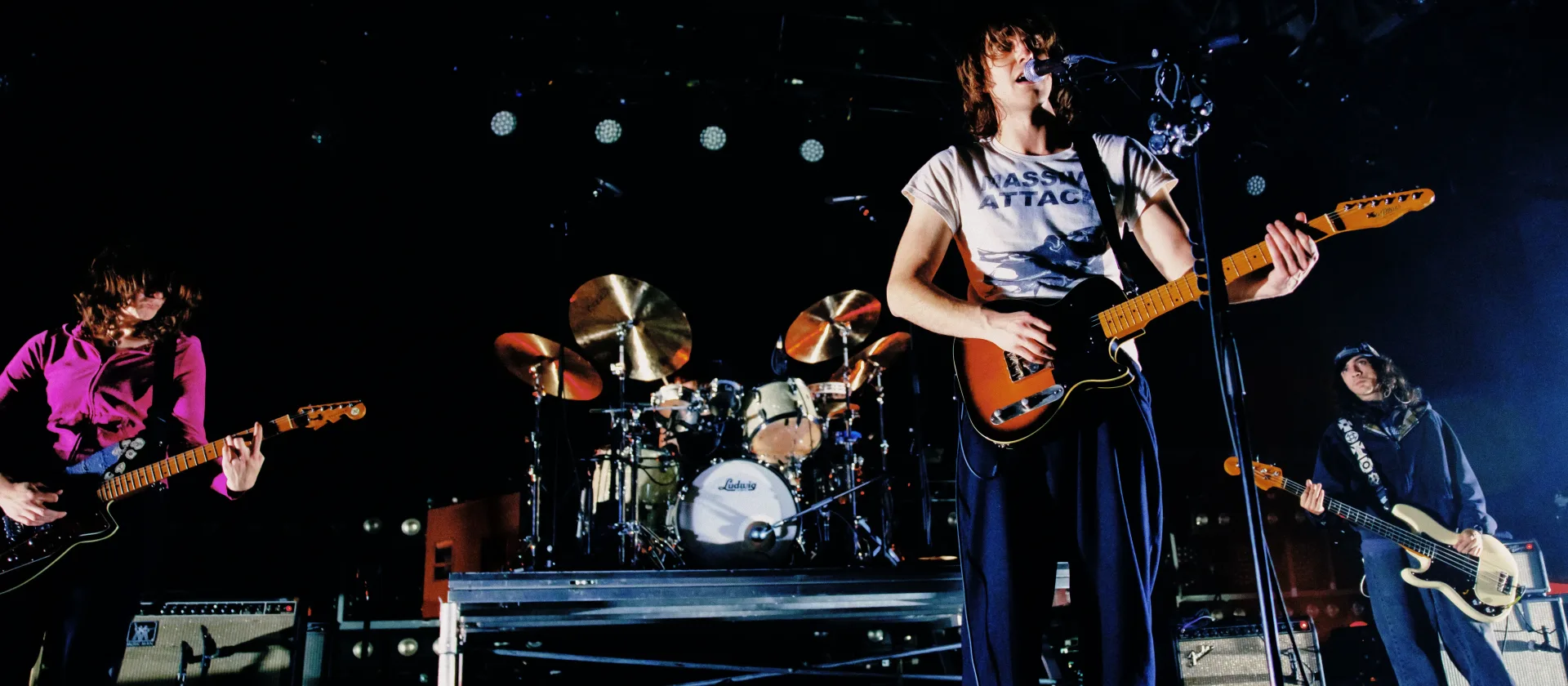
Geese arrived at the Fillmore Philadelphia on Nov. 7 with the kind of momentum that can make a room feel charged before the first note. The band is in the middle of a climb, with Getting Killed earning an intense response and singer Cameron Winter’s solo profile rising alongside it. But the first night of a two-show Philadelphia run was not a victory lap or a polished recital. It was an 80-minute argument for the band as a unit: loud, elastic, restless and willing to push familiar songs into less predictable shapes.
That distinction mattered from the opening seconds. Winter’s solo work can invite a listener to focus on the singer at a piano, but Geese began with “Long Island City Here I Come,” a rapid, hard-charging opener that immediately established the collective force of the group. Winter played piano from stage right and sang with a confrontational intensity, while the crowd responded in kind. Anyone who entered knowing only widely circulated songs such as “Au Pays du Cocaine” or “Taxes” got a quick lesson in the wider range and volume of the band’s live identity.
A band setup designed for tension
The Philadelphia lineup put each player’s function into sharp relief: Winter on vocals and piano, Emily Green on guitar, Dominic DiGesu on bass, Max Bassin on drums, and touring keyboard player Sam Revaz. Their performances did not suggest five musicians competing for the same space. Instead, the set worked because the players occupied different roles while repeatedly disrupting one another’s expectations.
Green was especially crucial when a song moved away from its most straightforward form. Her guitar work combined firm, immediately legible riffs with adventurous detours shaped through pedal use. Effects pedals are foot-operated electronic controls that alter a guitar’s signal, changing elements such as texture, sustain or distortion. In a band like Geese, that does more than make the guitar sound bigger: it can turn the instrument into a source of friction, atmosphere or instability.
The essential skill was not merely going outward; it was coming back at the right time. Green could extend a passage toward abstraction and then land precisely when the song needed a defined riff. That push and pull made the experimental stretches feel connected to the material rather than separated from it. The set’s unpredictability came from choices within songs, not from abandoning the songs altogether.
Bassin provided another kind of volatility. His drumming was busy and physical without losing the central pulse. Musicians often call that ability to hold a dependable rhythmic foundation while still adding expressive variation “staying in the pocket.” It is one of those phrases that can sound vague until a performance makes it obvious: the listener feels movement and danger, yet the song never loses its center. On “Bow Down,” Bassin had room to break outward during solo passages while continuing to give the band something solid to lean on.
DiGesu’s bass supplied an equally important counterweight. Amid guitar effects, animated drumming and changes in vocal phrasing, the bass often felt like the deepest and most stable component of the arrangement. That steadiness gave Green and Bassin permission to take bigger chances. It is a practical example of why a bass line can be more than background support: it can determine whether a volatile arrangement feels exciting or simply scattered.
Cameron Winter’s voice remains the pivot
The full-band noise never erased Winter’s presence. His performance was dynamic rather than fixed, with older songs including “2122” and “Cowboy Nudes” receiving altered lyrics and inflections. Small changes in phrasing can reshape the emotional temperature of a well-known song. Instead of treating a recorded line as an unchangeable instruction, Winter used it as material to be bent in the moment.
“2122” also carried a tribute to Richard Lloyd of Television, whose death was recent. The gesture connected the night to a lineage without turning the show into a history lesson. The focus remained on the live performance in front of the audience, where Winter’s singing could be unruly one minute and remarkably fragile the next.
“Half Real” showed that range particularly clearly. Winter moved between a rough-edged baritone and a light falsetto. A baritone is a lower vocal register, while falsetto refers to a higher, airier vocal production that can sound notably different from a singer’s usual speaking or chest voice. The contrast gave the slower song its lift: a heavy lower register created gravity, then the higher notes opened up the sound rather than merely adding volume.
That balance is central to why Geese’s material can support such an active performance. The band does not rely on constant maximal force. Its dramatic moments come from contrasts—dense versus spare, locked-in versus exploratory, bruising volume versus delicate singing. The arrangement makes those transitions matter because listeners can hear what has been withheld before it is released.
Why loud-quiet-loud still works here
The night closed with “Trinidad,” the opening track from Getting Killed, and it supplied the set’s clearest illustration of that approach. The song moves through a loud-quiet-loud design: a breezier verse is broken by a much more forceful full-band response. This structure is simple in outline, but its impact depends entirely on control. If the quieter section does not genuinely reduce the pressure, the loud return cannot feel like a release. If the return arrives too quickly, suspense never has time to build.
Geese extended “Trinidad” with a blues-tinged treatment that deliberately held back the expected rush. A circle pit formed as the pressure rose. That crowd movement was not separate from the performance; it reflected how clearly the band communicated its timing. The musicians delayed gratification until the audience’s anticipation was nearly physical, then allowed the chorus to hit with greater force.
Improvisation played a major role throughout the evening, but here it was especially functional. In a rock setting, improvisation does not have to mean every performer wandering independently. It can mean varying the route to a destination: stretching a transition, changing a guitar texture, adding rhythmic accents, or suspending a section a few beats longer than expected. The bluesy expansion of “Trinidad” worked because it intensified the song’s existing dynamics rather than replacing them with an unrelated jam.
The practical meaning of a tour that keeps changing
The run is titled the Getting Killed Again Tour, a winking acknowledgment that the band has lived with this album’s material for well over a year. Extended touring can expose a hard question for any group: are the songs durable enough to remain alive after repetition? At the Fillmore, the answer appeared to be yes, because Geese approached the material as a framework for discovery rather than a sequence of tasks to complete.
That does not mean every performance needs to be radically rewritten. A memorable live set needs recognizable anchors, particularly for an audience that has formed attachments to specific recorded moments. Geese’s approach appears to preserve those anchors—the decisive riffs, major choruses and emotional shape—while creating room around them for instrumental conversation. The result lets repeat listeners hear change without losing the reason they cared about the songs in the first place.
This is also why the band’s rise has been accompanied by so much excitement. Attention can concentrate too heavily on a frontperson, especially when that frontperson’s solo work is accelerating at the same time. The Philadelphia performance made the opposite case: Winter is an imposing singer and a flexible interpreter of his own material, but the intensity depends on Green’s adventurous guitar decisions, Bassin’s disciplined agitation, DiGesu’s low-end clarity and Revaz’s place in the touring configuration.
For listeners interested in the mechanics behind electronic texture and rhythmic experimentation, there is a curious adjacent example in a Commodore Amiga project built around 303 basslines and 808 drums. It is not a comparison to Geese’s sound, but it is a useful reminder that musical character can emerge as much from how performers shape tools and constraints as from genre labels alone.
More than a buzz-band moment
The central achievement of the Philadelphia show was not simply volume, crowd energy or a strong final number. It was the band’s ability to make those things feel earned. “Long Island City Here I Come” announced the night at a sprint. “Half Real” created a different kind of space for Winter’s voice. “Trinidad” ended by converting restraint into collective release. Between those points, the musicians found room for pedals, solos, shifting phrasing and rhythmic detail without letting the set lose its direction.
Geese’s current moment could easily be framed as hype: a celebrated recent record, viral entry points, a young singer drawing solo attention, and an audience primed to make a lot of noise. Philadelphia suggested a sturdier explanation. The band has songs with enough internal tension to stretch, players with sufficiently distinct voices to keep those stretches compelling, and the discipline to snap the music back into focus when a riff, chorus or vocal line demands it. On the Getting Killed Again Tour, that is what turns anticipation into a genuinely cathartic show.