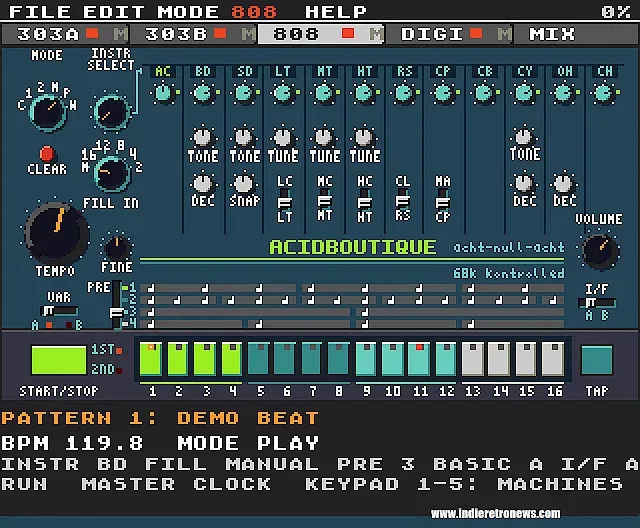
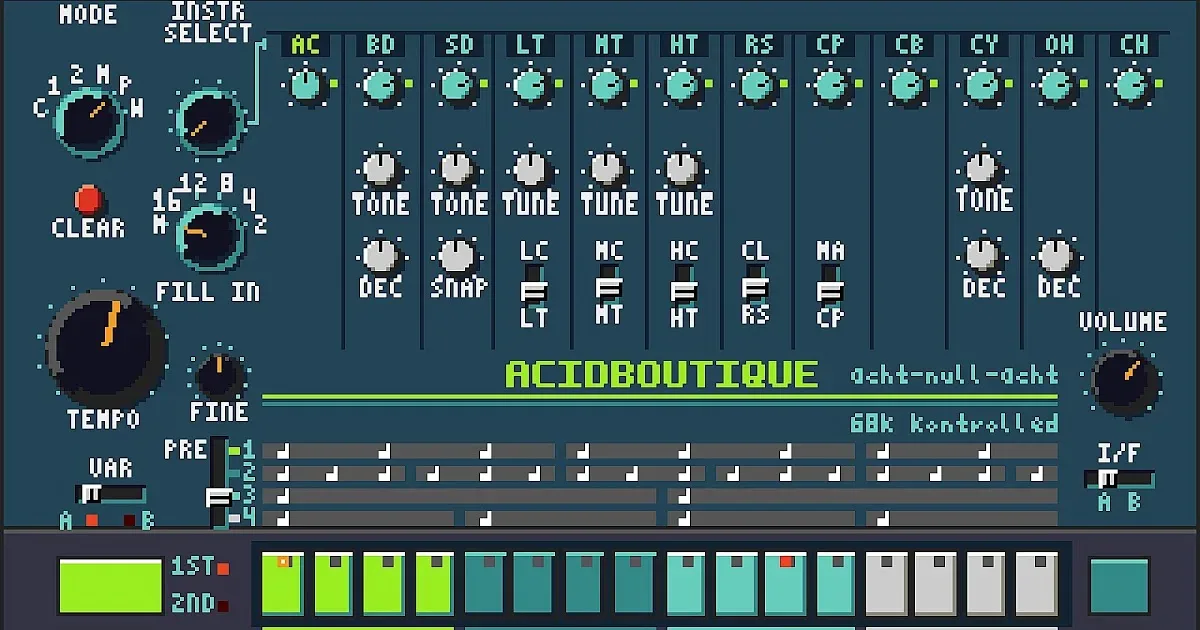
A Commodore Amiga 500 with 1 MB of RAM is getting an unusually focused new creative job. AcidBoutique, a music-production tool by solo developer wintermute303, is designed to bring the behaviour of a TB-303 bassline synthesiser and TR-808 drum machine to the classic computer in real time.
That description matters because the project is not presented as a collection of approximate samples or a broadly similar “acid” preset. AcidBoutique is said to run reverse-engineered logic from the original machines on the Amiga’s Motorola 68000 processor. The practical aim is for the musical details associated with those instruments—particularly bassline slides and accents, alongside individual drum behaviour—to respond as the original hardware does.
It is an appealingly specific bit of retro-computing development: software made for a machine commonly associated with games, demos and home computing, but pointed squarely at electronic-music production. The required baseline is equally notable: an Amiga 500 with 1 MB of RAM or more.
What AcidBoutique is trying to reproduce
The two instruments at the centre of the project are electronic-music landmarks, but they serve different roles. The TB-303 is a bassline synthesiser. In this context, “bassline” means the sequence of low-pitched notes that provides a rhythmic and melodic foundation. A 303-style part is often as much about the transitions between notes as it is about the notes themselves.
A slide is a transition in which one pitch moves into another rather than beginning as an entirely detached note. An accent is an emphasis applied to selected notes, affecting the character and force of a sequence. Those functions are part of why a 303-inspired phrase can feel animated even when its basic pattern is short. If software only approximates the broad sound while missing how those controls interact, it may produce a recognisably electronic bass tone without delivering the same performance behaviour.
The TR-808, meanwhile, is a drum machine: a device built around programmed percussion patterns. The important distinction in AcidBoutique’s stated approach is that it seeks to preserve the logic governing drum hits, not merely present a static library of drum sounds. That puts attention on how an instrument responds while a pattern is being built and played, which is central to a production tool rather than just a playback device.
AcidBoutique therefore joins two complementary ideas in one Amiga-based setup: a programmable bass voice and programmable electronic percussion. That combination naturally evokes a compact composition environment, especially for users who want to make pattern-driven music on original hardware rather than treat the Amiga solely as a display piece.
Why reverse-engineered logic is the key claim
Reverse engineering, in this case, means analysing how an existing system works and recreating that behaviour in a new implementation. The supplied details describe AcidBoutique as using the genuine logic of the original machines in real time, rather than relying on a rough emulation of their sound and feel.
Related coverage includes AcidBoutique Brings TB-303 and TR-808-Style Production to the Commodore Amiga.
That is a meaningful technical distinction. A sampled drum hit can capture one recorded moment, but it does not automatically reproduce every rule that determines how a drum machine creates or handles a hit. Similarly, a preset can evoke the tonal territory of a bass synthesiser without necessarily reflecting how slides, accents and sequencing respond as a player programs a part. Behavioural accuracy is particularly relevant to musicians who know the original workflow and expect the resulting pattern to react predictably.
The claim also highlights the work being asked of the Amiga’s Motorola 68000 processor. AcidBoutique is not described as offloading the job to modern equipment; its stated goal is real-time operation on the vintage platform itself. On a machine with 1 MB of RAM, that makes economy important. The project’s appeal is not simply that the Amiga can output music, but that it can host this particular pair of instrument behaviours within a constrained hardware environment.
There is a useful broader lesson for retro software here. Hardware age does not make a platform creatively finished. New programs can give an established machine a new role when developers work carefully inside its limitations. AcidBoutique is built around a narrow, deliberate purpose rather than attempting to turn the Amiga into an all-purpose modern studio. That focus is likely part of what makes the project feasible.
An Amiga music tool, not a nostalgia ornament
The Amiga’s cultural identity is tightly linked to games, yet a music tool like AcidBoutique underlines that preserved machines can still be used to make things. The value proposition is not merely watching vintage hardware run an old program. It is the prospect of composing bass-and-drum patterns on a system that remains physically present and technically distinct.
For musicians, the constraints may be part of the attraction. A dedicated instrument setup encourages decisions: choose a bassline, set the percussion pattern, refine the rhythm and move on. It is a different proposition from an expansive computer workflow packed with unlimited tracks, plug-ins and menus. AcidBoutique’s stated combination of 303 and 808 functionality points toward that concise, pattern-first method of working.
For Amiga enthusiasts, the project also offers a reason to keep compatible hardware active beyond gaming. Its modest minimum specification means the intended target is not an exotic, heavily expanded system. An Amiga 500 with at least 1 MB of RAM is the stated requirement, making the technical target clear even though users will still need to consult the manual for setup particulars.
The project was made in wintermute303’s spare time, with AI assistance. That is worth separating into two parts. The development credit remains with the solo developer, while AI is described as a tool used during the work. The supplied information does not detail which development tasks involved AI, so it would be speculation to assign it a larger or more specific role than that.
ROM requirements and the practical legal boundary
AcidBoutique has an important requirement: users must provide their own original 303 and 808 ROMs. A ROM, short for read-only memory, is firmware or program data associated with hardware. In this situation, it is the protected material required for the tool to use the original machine logic described above.
This is not a minor setup footnote. It establishes a clear dividing line between the Amiga software and the proprietary ROM content it needs. The project’s manual includes instructions for users who have their own original ROMs, but prospective users should treat ownership and use of those files as a legal and rights-sensitive matter. AcidBoutique does not remove that responsibility or provide a blanket licence to obtain copyrighted firmware from elsewhere.
For anyone assessing whether the tool is a fit, the sensible sequence is straightforward:
- Confirm that the Amiga system meets the stated 1 MB-or-more memory requirement.
- Read the included manual before beginning setup.
- Ensure that any required 303 and 808 ROM material is original and lawfully usable.
- Approach the software as a specialised music-production environment, rather than assuming it is a ready-to-run package without the required firmware.
That requirement may make AcidBoutique less instant than a modern app, but it is consistent with the project’s premise. Its claimed fidelity depends on original instrument logic, and the copyright restrictions surrounding that logic are part of the package’s reality.
A small project with a focused audience
Wintermute303 is offering AcidBoutique at a low cost, described as roughly the price of a cup of coffee, with support intended to help fund future updates. No exact price is specified here, but the positioning is clear: this is a community-minded independent project rather than a mass-market music suite.
That model suits the audience. The likely users are people who already care about the Amiga, electronic-music hardware, or both. Some may be interested in the technical achievement of running this logic on a Motorola 68000. Others may simply want an unusually tactile and restricted environment for developing rhythmic ideas. Neither group needs the project to replace a contemporary studio workstation for it to be worthwhile.
There is also a wider cultural overlap at work. Music technology stories regularly move between old tools, new software and current listening culture; even radio remains part of that broader conversation, as seen in a recent look at a Los Angeles station’s effort to rebuild listener trust. AcidBoutique occupies a far more specialised corner of that landscape, but it speaks to the same enduring point: tools and platforms shape how audiences and creators connect with music.
AcidBoutique’s most interesting feature is ultimately its restraint. It does not promise every instrument, every genre or every modern convenience. It concentrates on a 303 bassline synth and an 808 drum machine, designed for a classic Amiga and built around the original systems’ stated behaviour. For retro-computing users who also make electronic music, that is a sharply defined proposition—and a reminder that new software can still find fertile ground on old hardware.