Buildings are usually presented on screen as locations: somewhere characters meet, flee, fight, fall in love, or discover an ominously convenient basement. From Inside Out – The Architecture of Peter Zumthor takes a less conventional route. Wim Wenders’ 3D documentary treats architecture as the event itself, asking its audience to look at walls, curves, shadows, materials and the human beings moving through them with the patience normally reserved for a gallery installation.
The 114-minute German-Swiss production was shown out of competition at the Venice Film Festival on September 5, 2026. Wenders directs and writes the film, which centers on Swiss architect Peter Zumthor, now in his eighties. Rather than offering a brisk cradle-to-career biography, the documentary appears structured around the experience of encountering Zumthor’s work: first at a distance, then with greater intimacy, and ultimately as a place shaped by the people and art inside it.
That approach makes the film a demanding architectural portrait, especially in its early passages. It reportedly lingers on abstract visual details—concave intersections, convex mass and restrained modern surfaces—before it fully establishes its larger goals. The payoff, however, comes from the connection between Wenders’ 3D form and Zumthor’s philosophy of design. Both are concerned with space as something that has to be entered, felt and understood over time rather than immediately explained.
A documentary designed like a building
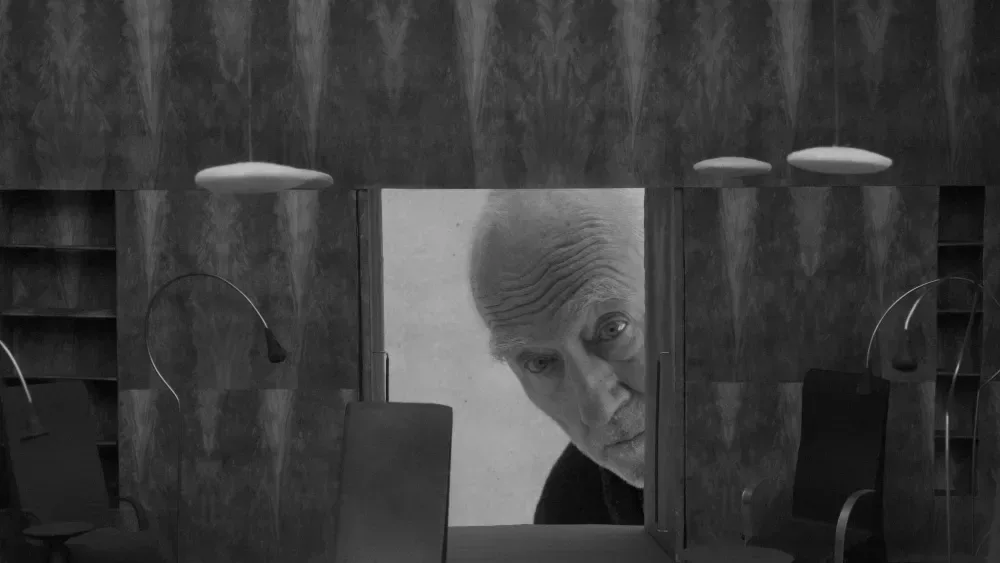
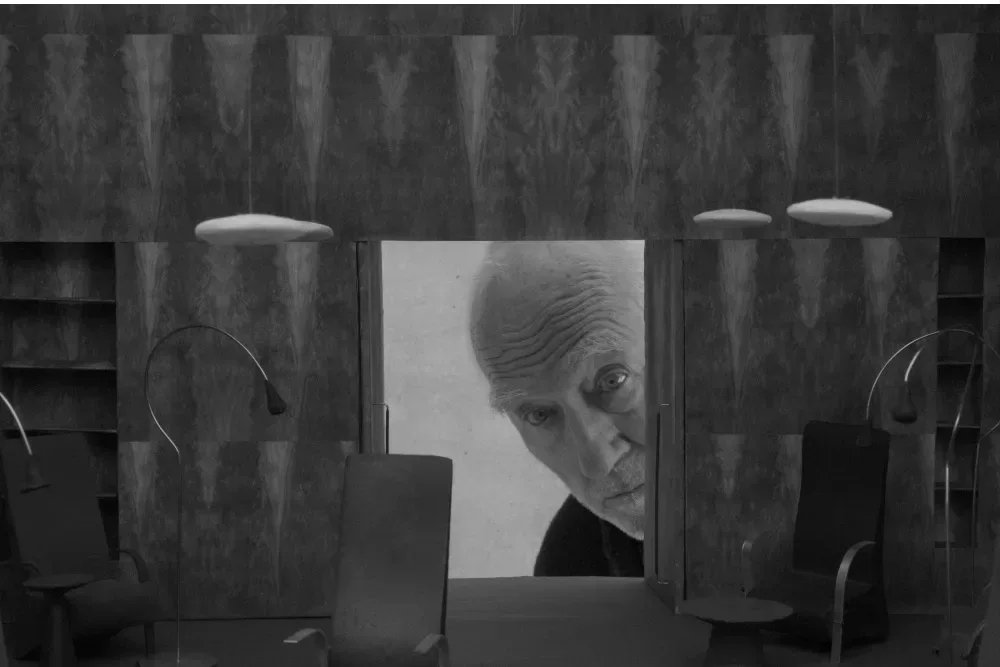
Wenders has made films about artists before, including the 3D documentary Anselm, focused on sculptor Anselm Kiefer. In From Inside Out, the director again uses projected words and images as part of the physical environment. Zumthor first appears through archival material from the 1980s, projected across sparse surfaces. His voice and ideas are not simply inserted as conventional interview material; they become part of the rooms the camera is examining.
The device matters because Zumthor’s stated interests include the relationship between a structure and its setting. A building, in this view, is not just a striking outer shell or an object awaiting a magazine photograph. Light, natural materials, movement and local craft all contribute to the identity of a place. Its purpose is completed by inhabitation—by visitors, residents, workers, artists, and even by the traces of people who occupied a historic site long before a restoration began.
Wenders reportedly gives that principle a ghostly dimension. Re-enacted figures travel through certain spaces, accompanied by hushed interior reflections. These scenes connect past occupants and imagined future visitors to the real locations. They may occasionally slow the forward movement, but they also underline an essential point: Zumthor’s architecture is meant to hold stories that do not belong exclusively to its designer.
It is an idea with a useful parallel in interactive media. A beautifully rendered game environment is not memorable solely because it has detailed stonework or dramatic lighting. It becomes memorable when it guides a player toward curiosity, unease, comfort or discovery. Architecture cannot be reduced to level design, of course, but the comparison helps clarify why Wenders’ emphasis on movement and perception is important. An environment does not reveal all of its character from a single fixed angle. That principle also sits behind games with unusually tactile worlds, including the kind of strange, reactive garden society discussed in Viva Piñata’s enduring case for a garden game with teeth.
Zumthor as a subject, not a celebrity profile
By the time the documentary arrives in the present, Zumthor is framed as a low-key but highly committed thinker. His discussions of form, function and continuity can return to similar themes repeatedly. That repetition is apparently part of the film’s rhythm rather than a tidy sequence of career milestones. The documentary is less interested in manufacturing a dramatic personal saga than in following how a particular set of convictions travels from project to project.
There is some levity in the friction between a famously exacting architect and the practical desires of a client. Designing a home can place a grand concept in direct conflict with what somebody actually wants to live with every day. Yet the film presents Zumthor as ultimately responsive to use. Aesthetic ideals remain central, but they must make room for the realities of habitation.
This makes the documentary’s relative lack of biographical revelation feel purposeful. At first, the absence of a more expansive personal-history framework might make the portrait seem remote. But the construction mirrors the sensation of approaching an unfamiliar building. From the outside, it can look severe, silent and perhaps even forbidding. Once inside, small details, unexpected turns and the evidence of human use change the experience.
Wenders applies the same gradual logic to museums and restorations. The film contrasts archival and current images of museum spaces designed by Zumthor, with exhibitions and installations bringing emotional and historical weight to the rooms. Some of that art addresses war. This is where the documentary’s interest in “what goes inside” becomes especially significant: a gallery’s concrete, light and circulation are not neutral containers when they hold work connected to collective trauma or individual memory.
Three projects carry the film’s final movement
The documentary’s latter section is built around a trio of projects that appears to provide its strongest momentum. Each illustrates a different scale of Zumthor’s practice and a different relationship between architecture, private experience and public remembrance.
- A personal home: One project has direct importance to Zumthor himself, bringing the film’s abstract discussion of materials and proportion into a more intimate setting.
- A Nordic memorial installation: Another is dedicated to women killed during witch trials. Its long, unsettling spatial effect is intensified by the 3D image, transforming remembrance into something physically disquieting rather than merely informational.
- The Los Angeles County Museum of Art project: The third is Zumthor’s vast design for housing LACMA’s permanent collection, whose development and completion receive close attention.
The memorial installation is especially telling because architecture here is not asked to provide a simple, comfortable monument. The space is presented as frightening and seemingly endless, which is an appropriate emotional complication for a site devoted to historic persecution. Franz Lustig’s 3D cinematography is a key contributor to that effect. In a conventional documentary, stereoscopic imagery can be a distracting technical flourish; in this case, it is aligned with the basic subject, creating depth that makes distance, enclosure and passageways feel more consequential.
Then comes the LACMA section, where the film reaches its most expansive architectural subject. Zumthor’s building is described as broad, sinuous and almost amoeba-like. Its galleries bend and extend without announcing a clean, commanding start or finish. Rough exposed concrete sits beside works with very different visual languages and historical associations. The architecture is not intended to establish a hierarchy in which one artwork becomes the unquestioned centerpiece while everything else is reduced to supporting scenery.
Instead, Zumthor’s idea is horizontal equality: art should be encountered across a continuous field, with no single work automatically elevated or diminished by its placement. Wenders’ camera follows that thinking through the completed museum, moving along its curves and into its smaller pockets of display. The finished building is visited by figures including filmmakers Ava DuVernay and Werner Herzog, reinforcing the project’s place at the intersection of art, cinema and cultural institutions.
Why the 3D format is more than spectacle
For viewers accustomed to documentaries delivering facts at a quick, linear pace, From Inside Out may feel initially academic or even circuitous. Its detours, reenactments and recurring ideas do not function like a traditional career summary. But the film’s wandering structure is also its central formal argument. It behaves less like a lecture about architecture than like a built environment: corridors open into side spaces, details acquire meaning later, and the whole cannot be absorbed from the threshold.
That does not mean every viewer will want to meet the documentary on those terms. A two-hour study of spatial philosophy, museum planning and natural materials is a specialized proposition. Yet the film’s design suggests that Wenders is deliberately matching method to subject. His use of three dimensions is meant to make viewers conscious of their own position before an image, much as Zumthor’s buildings ask occupants to notice the relation between body, material and surrounding landscape.
The result is an architectural documentary that finds its drama not in a scandal, a deadline or a heroic biographical arc, but in attention itself. Zumthor’s work becomes a means of considering how people enter a place, remember what happened there and share space with objects made by others. Wenders’ camera, supported by Lustig’s photography, gives those questions a scale that sounds most persuasive once the film reaches its major projects.
Key production details
- Title: From Inside Out – The Architecture of Peter Zumthor
- Festival screening: Venice Film Festival, out of competition, September 5, 2026
- Running time: 114 minutes
- Director and writer: Wim Wenders
- Camera: Franz Lustig
- Editor: Maxine Goedicke
- Music: Vera Kappeler, Peter Conradin Zumthor, Laurent Petitgand and Sophie Hunger
- Languages: German, Swiss German and English
- Featured participants include: Peter Zumthor, Anna Trauffer, Carin Caduff, Tarek Atoui, Karl Schlögel, Siri Hustvedt, Michael Govan, Pedro Reyes, Reiko Sudo, Mark Bradford, Ava DuVernay, Werner Herzog and Sophie Hunger.