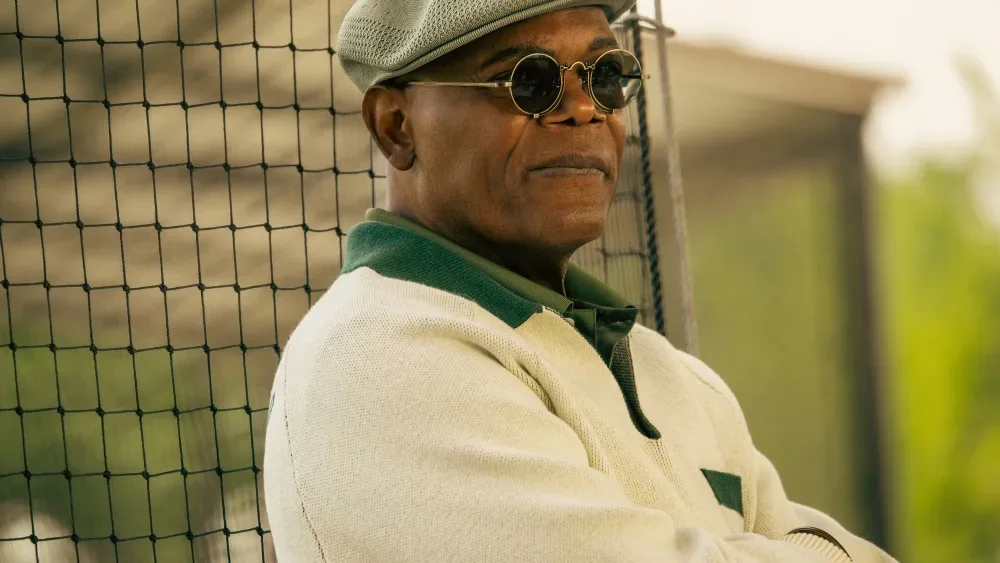
Samuel L. Jackson will bring Russell Lee Washington Jr. to Frisco, Texas, when Taylor Sheridan’s Frisco King premieres on Paramount+ on Dec. 18. The series will launch with its first two episodes, then continue with one new episode each week.
Jackson returns as Lee, a New Orleans gangster whose next attempt at building an empire takes him to suburban Frisco. The central complication arrives quickly: he finds a hustler already operating his business in town. Rather than keeping the operation small, Lee begins assembling a circle around him—an ambitious protégé, a devoted driver and an expanding collection of unconventional associates—to turn modest schemes into a larger enterprise.
The premise puts a pressure-cooker spin on the rise-of-an-empire crime story. Every successful score increases Lee’s influence, but it also raises the danger around him. The dramatic engine is less about whether he can find an opportunity than whether he can stay ahead after each opportunity gets bigger, more visible and harder to control.
When and where to watch Frisco King
- Streaming home: Paramount+
- Premiere date: Dec. 18
- Launch format: Two episodes
- Release schedule afterward: Weekly episodes
That rollout gives viewers an opening double bill before shifting to a conventional weekly cadence. For audiences, that means there should be enough material at launch to establish Lee’s move, the local conflict and the first pieces of his new network, while later episodes can develop the consequences of each escalation over time.
The show’s arrival is also another notable streaming release for Paramount+, a platform whose broader position in the changing television business remains part of the industry conversation. For more on one major policy issue facing streaming video services, see the discussion around a possible expansion of the UK TV licence fee to streaming platforms.
Cast: Samuel L. Jackson leads, with Sylvester Stallone appearing
Jackson heads the cast as Russell Lee Washington Jr. Asa Germann, Kai Caster, Lilah Pate and Savanna Gann also star. Sylvester Stallone is set for a special appearance.
Those confirmed names establish the on-screen ensemble, but details such as the characters played by Germann, Caster, Pate and Gann have not been provided here. Likewise, Stallone’s appearance is confirmed, while the scope of his role has not been specified. Keeping that distinction in mind matters: a special appearance can be a key connective moment or a focused guest turn, but it does not by itself reveal how often a performer will be present across a season.
Jackson’s Lee is described as a gangster from New Orleans who is trying to establish himself in a setting that is notably different from the stereotypical crime-drama metropolis. Frisco is framed as a suburban town, and that contrast is one of the clearest elements in the setup. A criminal enterprise growing amid suburban routines can create tension from proximity: a character’s operations may be increasingly ambitious even as the surrounding environment initially appears ordinary.
What the series is about
Frisco King follows Lee’s effort to transform a string of smaller hustles into something much bigger. In crime-story terms, a hustle generally means a money-making scheme, often improvised or deceptive; a grift is a con that depends on manipulation, misdirection or persuasion. The show’s setup uses both ideas to define its stakes. Lee’s task is not merely to run a business. It is to run it while remaining ahead of rivals, complications and the consequences created by his own growth.
The character’s strategy appears to be organizational as much as personal. He recruits people with distinct functions: a protégé suggests someone being taught or groomed for larger responsibility, while a loyal driver points to the practical trust required in a dangerous operation. The mention of eccentric partners adds the prospect of a broader ensemble whose individual agendas could help build Lee’s kingdom—or make it more difficult to manage.
That is the useful tension inside the logline. Expansion is a victory, but it is also a liability. More scores mean higher stakes; more influence creates more risk; and a growing operation requires Lee to preserve control without slowing the momentum that made it possible. The show’s premise therefore promises a story of constant adjustment rather than a simple climb upward.
A suburban setting with increasingly large stakes
Calling Frisco a suburban town is more than a location note. It gives the series a particular contrast to work with: Lee arrives intending to make himself the local king, yet he must do so in a place where someone else has already been running part of his business. The conflict starts with an overlap of territory and ambition, then expands as Lee builds relationships and broadens the scale of the operation.
Importantly, the supplied premise does not specify the exact nature of the business, the identity of the hustler Lee encounters, or the methods behind the scores. Those details remain open. What is clear is the series’ central direction: a newcomer turns local schemes into a more ambitious operation and must continue to outmaneuver the risks that success produces.
Taylor Sheridan writes; Voros directs the pilot
Sheridan wrote Frisco King and serves as an executive producer. The executive-producer roster also includes Stallone, Jackson, David C. Glasser, Ron Burkle, David Hutkin, Bob Yari, LaTanya Richardson Jackson and Keith Cox.
Christina Alexandra Voros and Michael Friedman are executive producers as well as directors on the series. Each directs four episodes, and Voros directs the pilot. In television, the pilot is the opening episode that introduces the series’ characters, setting and storytelling approach. Having its director named gives viewers one concrete creative credit tied to the show’s first impression, though it does not establish how the remaining episodes will be divided beyond the four episodes directed by Voros and the four directed by Friedman.
An executive producer credit can cover a range of senior creative, production and business responsibilities depending on a project. The credits confirmed for Frisco King identify the people attached at that level, while the available information does not break down their day-to-day duties. What can be stated directly is that Sheridan is the writer, and Voros and Friedman have directing assignments in addition to executive-producing roles.
Paramount Television Studios and 101 Studios produce the series.
Why the release format fits the premise
Starting with two episodes gives a serialized crime drama room to put its board in place. The information available suggests several moving parts need to be established: Lee’s arrival from New Orleans, the existing hustler in Frisco, the team he begins recruiting, and the increasing risks that follow a run of successful schemes. A weekly schedule afterward can make each escalation part of the rhythm of the season rather than turning the series into a single immediate binge.
There is no episode count, season length, running time or additional plot detail confirmed in the provided information, so viewers should be wary of assumptions about the show’s scale. The firm details are the Dec. 18 date, the two-episode launch, weekly releases afterward, the core cast, Stallone’s special appearance, and the creative and production credits.
For now, Frisco King is a straightforward proposition: Samuel L. Jackson’s Lee arrives in Frisco to claim a kingdom, discovers somebody has been working his turf, and responds by going bigger. In a story built around grifts, alliances and rising exposure, becoming the king is only the first job. Staying one move ahead is the part likely to cost him.