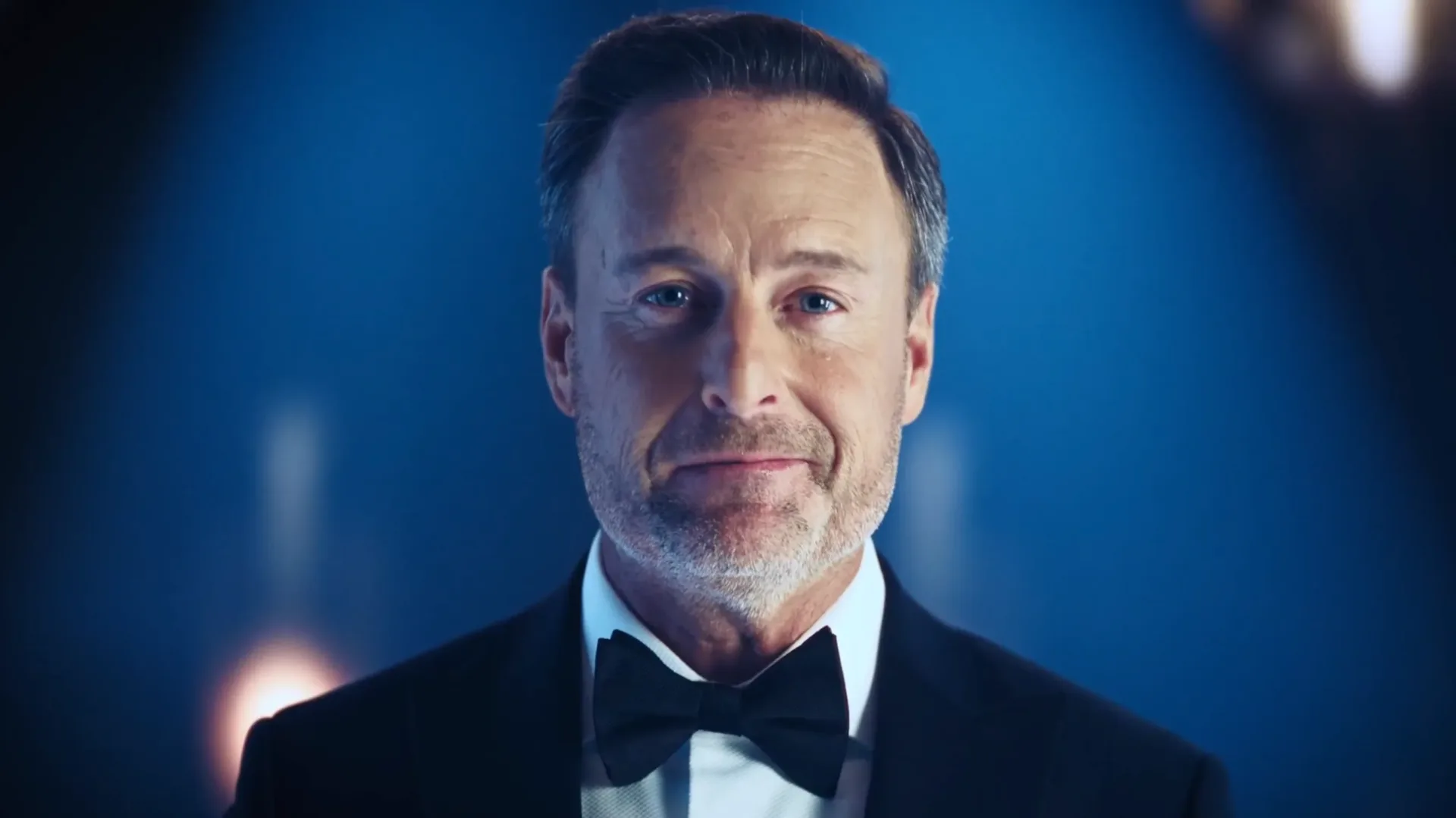
There is more than one way to show up on a rival broadcaster’s screen, and Fox Nation appears ready to use one of television’s oldest bits of marketing mischief. Promotional spots for The Vow, its forthcoming dating series hosted by former The Bachelor presenter Chris Harrison, are expected to run in local commercial inventory on ABC stations in roughly a dozen markets.
That plan is conspicuous for two reasons. First, ABC remains the longtime home of The Bachelor, the dating franchise Harrison hosted for 25 seasons. Second, Warner Bros. Television, which produces The Bachelor, has already objected to the creative direction of promotion for The Vow. The company sent Fox News Media a cease-and-desist letter on September 18, alleging that recent advertising improperly leaned on the recognizable look and goodwill of the established franchise.
The expected station buys mean viewers may encounter an ad for Fox Nation’s competing show while watching ABC programming—including, potentially, prime-time series such as Grey’s Anatomy. It is a tidy bit of scheduling gamesmanship: put a pitch for a familiar-looking new dating show in front of an audience presumed to recognize both the host and the visual language being invoked.
The promo plan, and what is actually known
The Vow is scheduled to debut on Fox Nation on November 11. A person familiar with the matter said its spots are expected to appear in local ad time on ABC stations in markets including New York City, Los Angeles, Chicago, and Dallas. Fox News did not make executives available for comment.
The available description of the commercial does not merely rely on Harrison’s presence. He says, “I believe in true love. Always have,” before graphics identify the debut date. Rose petals also appear at the end of the ad. Roses have long been a prominent visual component of The Bachelor, and that overlap sits at the center of the dispute.
It is important to separate the show itself from the advertising campaign. Warner Bros. Television’s letter said it had not seen the series and therefore could not comment on it. Its stated objection was not to Fox and Lionsgate making a dating program starring Harrison as such. Rather, the company argued that the marketing to date had promoted the new series through associations with The Bachelor, instead of establishing The Vow on its own terms.
Fox Nation rejected that characterization in its September 24 response. It argued that the letter was aimed less at protecting legitimate trademark and copyright interests than restricting a competing dating show and targeting Harrison. Those are opposing positions from the parties, not a resolution of the underlying claims.
Why local ad inventory changes the equation
“Local inventory” sounds like a technical footnote, but it is the key to the whole maneuver. A television network’s programming feed includes breaks whose ad time can be sold by local stations or other distributors. Buying that space can let an advertiser appear alongside a national network’s programming without persuading the network itself to accept the commercial.
In plainer language: a competitor may not be welcome at the front door of a national ad-sales operation, but it can sometimes buy a seat through the local side entrance.
That does not mean every local placement is guaranteed, nor does it establish that ABC has endorsed the campaign. It means the ad transaction can run through inventory available to station-level buyers. For a streaming service trying to reach a particular television audience, that route can be valuable because it places a direct appeal in the same viewing environment as a rival’s entertainment lineup.
The tactic is especially pointed here. The Bachelor has been part of ABC’s schedule for about three decades, which gives the network’s audience a durable relationship with its iconography and former host. An ad using Harrison, a declaration about “true love,” and rose petals does not have to name the older franchise to invite viewers to make the connection. Whether that connection crosses a legal line is precisely what the companies contest.
Trademark, copyright and unfair competition: the terms in the argument
Warner Bros. Television’s objection cites trademark, copyright and unfair-competition concerns. These labels address different potential issues, even when they arise from the same campaign.
- Trademark generally concerns identifiers that signal commercial source—such as names, logos, and potentially distinctive branding elements. The broad concern is whether consumers could be confused about affiliation, origin, or endorsement.
- Copyright protects original expression. In a promotional dispute, the question is not simply whether two ads share a dating-show premise, but whether protected expressive material has been copied.
- Unfair competition is a wider label often used for claims that a marketer is improperly trading on another party’s commercial identity or reputation.
None of those concepts automatically gives one company ownership over the general notion of romance, dating television, a former host’s professional future, or audience-targeted advertising. At the same time, a campaign can become legally contentious if its cumulative creative choices are alleged to create an impermissible association with a particular brand. The current record described here establishes that Warner Bros. Television has made allegations and Fox Nation has forcefully denied the premise; it does not establish an outcome.
A well-worn television tactic with an intentionally awkward effect
Buying locally sold spots around a rival’s programming is not a novel invention, even if it still carries the delightful energy of sliding a competing game trailer into somebody else’s launch-day broadcast.
In 2014, the CW ran commercials on the cable channel then known as ABC Family that urged viewers to switch from Pretty Little Liars to The Originals. The premise was blunt: identify an audience already watching a compatible show, then offer it an immediate alternative.
Another memorable example came in 2004, when TNT purchased promotional time around NBC’s E.R. to promote Without a Trace. The ad told viewers who had been watching E.R. on Thursday nights that they had missed Without a Trace, which was airing at that moment on CBS. The spots ran on NBC affiliates, including stations NBC owned, before they were pulled after questions were raised. They had reportedly been on air for about four weeks.
Networks have used the same structural advantage in other directions. ABC bought available commercial time from cable distributors on cable-news channels in 2009 to promote Good Morning America during the same 6 a.m. to 9 a.m. window in which the ABC morning show aired. The ad space distributors can sell is limited, but it can provide an opening unavailable through a rival national network.
Advertisers have also applied the playbook to major events. When Anheuser-Busch InBev had Super Bowl beer exclusivity, rival brands still placed local commercials during the game. MillerCoors used one-second local spots for Miller High Life in 2009, while Diageo ran local Smirnoff Ice ads during the 2003 broadcast. Exclusivity at the national level did not necessarily prevent locally sourced advertising from reaching the same audience.
What makes the ‘The Vow’ placement unusually sensitive
Competitive advertising often tries to intercept viewers who are already engaged with a similar product. The unusual pressure point in this case is the overlap of platform, host, genre, audience, and disputed creative cues.
Harrison is not a generic celebrity attached to a generic format. He was the host of ABC’s flagship dating franchise for 25 seasons. The Vow is itself a dating series. Its campaign is expected to buy time on ABC stations. And Warner Bros. Television says the promotion uses visual and creative references designed to capitalize on the older franchise’s identity. Each fact makes the others more noticeable.
From a pure marketing perspective, that proximity can be efficient. Viewers do not need a long explanation of why Harrison is presenting a dating show or what emotional territory the program occupies. Recognition supplies a shortcut. From Warner Bros. Television’s perspective, as reflected in its letter, that shortcut is the alleged problem: it says the campaign has tried to benefit from a franchise it does not own.
Fox Nation’s response frames the disagreement differently. It says the letter is an effort to suppress competition and unfairly target Harrison. That response matters because it emphasizes a basic counterpoint in entertainment branding: performers can move on, and competing services can launch shows in the same broad genre. The dispute is therefore not merely about whether two dating programs can coexist. It is about where promotion based on a recognizable former role stops being a permissible appeal to viewers and becomes, as alleged, a misuse of another company’s intellectual property.
What viewers should—and should not—read into the ads
If the expected local placements run, viewers should not confuse a commercial appearing during or around an ABC program with ABC programming, ABC editorial approval, or a cross-network partnership. Local inventory is sold advertising space, not necessarily a statement of support from the national network whose content surrounds the break.
They also should not treat the promotional dispute as a judgment on the series itself. Warner Bros. Television explicitly said it had not seen The Vow. The available details concern the ad creative and its placement, not a review of the program’s format, quality, or storyline.
What the campaign does demonstrate is that television’s older distribution machinery remains useful in the streaming era. Fox Nation may be a streaming service, but broadcast-station commercials can still be deployed to reach an audience that may be especially receptive to a pitch from a very familiar dating-TV figure. The technology around viewing has evolved; the marketing instinct to meet a rival’s audience where it already is has not.
For more viewing options beyond the dating-show crossfire, see our weekend streaming roundup.