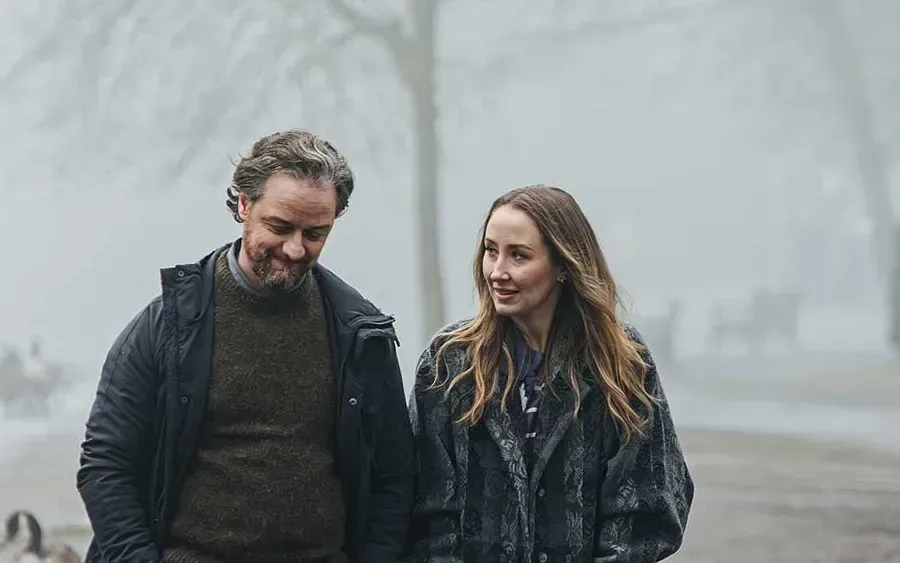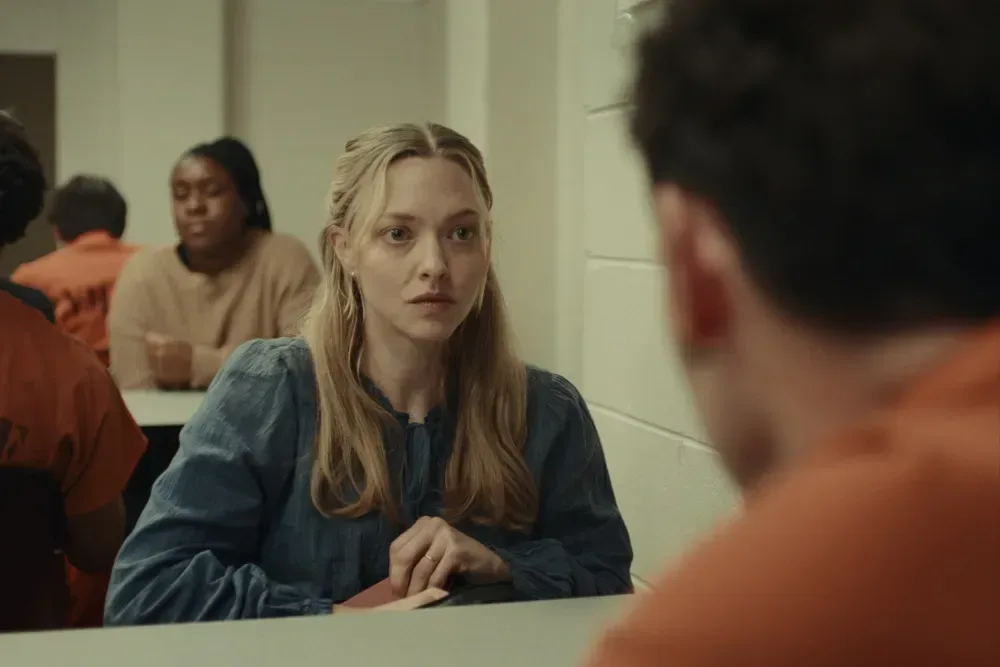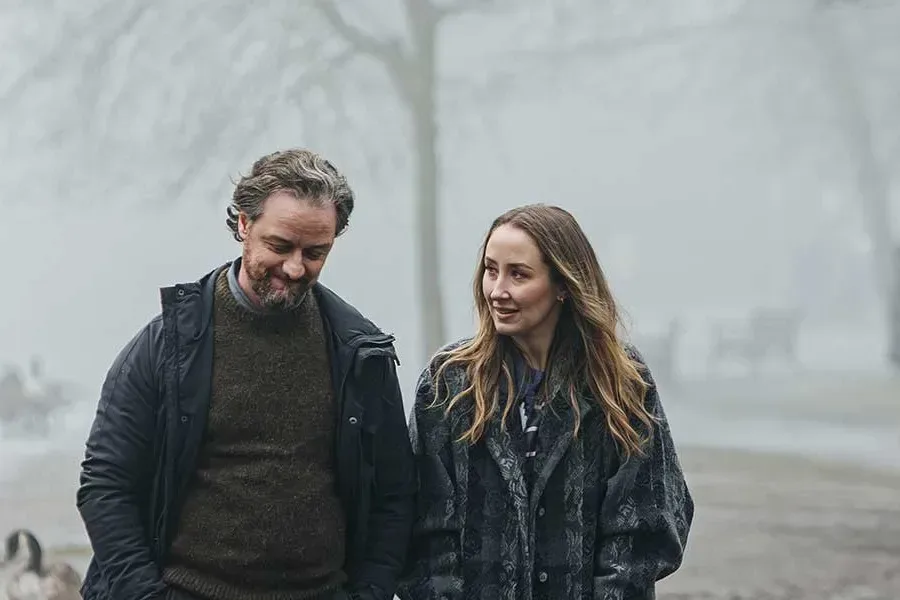
Faith is a 109-minute British drama written and directed by Paul Andrew Williams, and it arrives with two powerful, competing qualities. First, it has Erin Doherty delivering a performance of devastating physical and emotional detail as Gina, a single mother whose life is ruptured by the death of her young son. Second, it is a film determined not to remain solely a grounded portrait of grief. Its later movement toward Christian symbolism and theological uncertainty is an audacious choice—and one that may prove far more divisive than its opening act.
That tension is the point of interest, as well as the point of fracture. Williams begins in an unmistakably down-to-earth register, placing Gina in an anonymous Yorkshire town and following the routines that make up her modest but apparently loving life: work at a confectionery factory, time with her nine-year-old son Jamie, and support from her sister and close friend Poppy. Then Faith introduces Michael, a stranger played by James McAvoy, whose kindness is complicated from the start by how little he says about himself—and how much he appears to know.
Minor plot spoilers follow for the premise and early turning point.
A working life, rendered with fragile sweetness
The factory opening provides an effective visual statement of the film’s priorities. Cinematographer Simona Şuşnea lingers on pastel marshmallow passing along a production line, being cut and shaped into soft, dainty forms. It is an image of industrial repetition, but also of delicacy: a brightly colored surface set against the financial and emotional constraints of the people working around it.
Gina’s circumstances are difficult, but the film does not initially reduce her to misery. She is a thirtysomething parent on a low-income estate, yet Jamie brings warmth and momentum to her days. Smylie Bradwell plays him as an open-hearted, energetic child, while Liv Hill’s Poppy is part sister, part confidante and part fellow parent navigating the same neighborhood reality. Gina is not looking for romance, though she occasionally goes to the pub, and it is there that she meets Michael.
McAvoy’s character is constructed as an immediate question mark. He is at the pub despite not drinking and without companions; he is personable but oddly guarded. Michael makes Gina feel seen, yet viewers are encouraged to notice that the exchange is uneven. He learns intimate details while offering virtually none in return. When he later says something pointed to Gina’s departing babysitter, the film makes two possibilities feel plausible: Michael might possess knowledge beyond normal explanation, or he could be dangerous in a far more ordinary way.
That ambiguity gives the first section an uneasy genre charge. A “cryptic stranger” plot can easily turn into a simple threat narrative, but Faith seems more interested in the disturbing sensation of not knowing whether care is genuine, supernatural, manipulative, or some unstable combination of all three. McAvoy plays Michael with an observant stillness that makes even benevolent actions feel potentially loaded. The role requires restraint rather than showy menace, and the uncertainty is central to its effect.
Doherty makes grief visible in the smallest actions
After Jamie dies in an accident on the eve of his 10th birthday, the film’s emotional center becomes Gina’s bereavement. This is where Doherty’s work appears to be the film’s least contestable strength. Her portrayal does not treat grief as a tidy progression toward catharsis. Instead, it attends to depletion: a wrecked voice, a slackened body, a stare that seems emptied of animation, and an inability to move through previously automatic social rituals.
That last detail matters. Gina’s pain is not presented only through overt breakdowns, however forceful those moments may be. The performance also tracks the labor behind basic conversation—the effort needed to offer a polite response, return a smile, or repeat a daily routine when its reason has disappeared. It is a specific and humane observation about mourning. The world does not pause long enough for Gina to comprehend the loss; she must keep encountering the shapes of her former life.
Doherty, coming off an Emmy win for Adolescence, uses this big-screen lead role to show formidable control over scale. The emotional extremes are severe, but the performance is not defined only by visible agony. Its power lies in the sense that Gina’s whole relationship to ordinary time has changed. Her life at the factory, her home, her bond with Poppy and the spaces Jamie occupied all become sites of absence.
For viewers, that makes Faith potentially hard going regardless of where they land on its spiritual material. This is not a breezy mystery with grief used as decorative backstory. The bereavement is the movie’s foundation, and the lead performance asks the audience to sit with an experience that is raw, exhausting and uncomfortably intimate.
What the film means by a theological turn
The key creative gamble is that Williams does not resolve Gina’s pain through realism alone. The story moves into theological territory, using explicitly Christian imagery and asking the audience to entertain possibilities that cannot be comfortably explained by the social-realist framework of its opening scenes.
Theological, in this context, means concerned with questions about God, faith, divine intervention and spiritual meaning—not simply a story in which a character happens to attend church. Faith appears to use these ideas as an active narrative force. The question is no longer only whether Gina can survive her loss, or whether Michael can be trusted. It becomes whether events might have a religious or supernatural significance, and what that would mean for someone facing unbearable suffering.
Social realism is also useful to define here. It is a mode of storytelling that focuses on ordinary lives and material conditions: work, housing, money, family pressures and institutions. Gina’s job, estate and food-bank setting establish precisely that kind of world. The juxtaposition with blunt religious symbolism is therefore intentionally startling. Williams begins in a place associated with everyday economic reality, then asks for what could be described as a leap of faith from the audience.
There is genuine boldness in refusing to keep those modes separate. British screen drama can portray faith, but earnest, overtly Christian symbolism remains a particularly conspicuous intervention in a largely secular cultural environment. For some viewers, that directness may feel brave: a refusal to treat spiritual need as embarrassing or unserious. For others, the shift may feel like the film has changed the rules after establishing a closely observed grief drama.
The latter concern is difficult to dismiss. When a drama earns trust through emotional specificity, a major late pivot has a high bar to clear. It must deepen what came before instead of merely displacing it. The description of Faith’s final stretch suggests that its ideas are likely to provoke discussion precisely because they are not subtle background texture. They are an emphatic attempt to change the meaning of the story.
Williams’ appetite for tonal risk
That unpredictability fits Williams’ broader body of work. His films have ranged from kitchen-sink realism to intense genre storytelling, including supernatural-adjacent material, as well as the extreme brutality of Bull and the sentimentality of Song for Marion. He is not a filmmaker whose work can be neatly filed under one dependable tone.
Faith seems to concentrate those tendencies: the lived-in pressures of Gina’s daily world, a stranger who could belong to a thriller, an agonizing study of maternal grief and a spiritual dimension that pushes beyond naturalism. That combination makes the film recognizably Williams, even if it may not be fully balanced. The director’s screenplay appears more secure when it observes Gina than when it asks the audience to accept the larger implications built around her.
There is a practical viewing implication in that divide. Anyone seeking a conventional grief drama should know that Faith is not content to remain one. Anyone looking for a straightforward supernatural thriller may also be surprised by how much of the film is rooted in Gina’s ordinary environment and the bodily reality of mourning. The film’s strongest appeal may be to viewers willing to engage with a deliberately unstable blend of modes, even when that blend does not always settle cleanly.
McAvoy’s role is more than a supporting mystery
McAvoy has the marquee part in promotional terms, but Doherty’s Gina is unmistakably the core of the film. Michael’s importance comes from his relation to her vulnerability. He appears when Gina is still living a constrained but functional life, and his presence becomes more consequential after the tragedy. His volunteer work at a food bank provides an outward sign of decency, while his opacity ensures that decency never reads as uncomplicated.
The film’s emotional and metaphysical questions become entwined in him. Is he a figure of solace, an intruder exploiting pain, a man with inexplicable insight, or an avenue through which the story’s religious concerns can surface? McAvoy’s lightly grizzled, watchful portrayal preserves the tension rather than rushing to define it. That is particularly important in a story whose later developments ask viewers to decide how much mystery they are willing to embrace.
The cast also gives the grounded material necessary weight. Hill’s Poppy represents an existing support system rather than a convenient plot device, while Bradwell’s brief presence as Jamie has to establish why Gina’s loss destroys the shape of her life. The film’s early domestic details appear designed to make the later absence felt rather than merely stated.
A conversation-starter, not an easy recommendation
Faith is set to screen in the Special Presentations program at the Toronto Film Festival. Its profile will be aided by McAvoy’s involvement, but Doherty is the compelling reason to seek it out. Her performance gives the film a seriousness and emotional authority that remain potent even as the surrounding narrative grows more uncertain.
It is also a useful reminder that high-profile screen work keeps placing British performers in very different kinds of projects; recent casting developments elsewhere include new additions to HBO’s Harry Potter series. Faith, however, stands apart as an adult-oriented, emotionally punishing drama built around a single mother’s loss and a disquieting question of belief.
The film may gain admirers because it refuses caution. Its Christian symbolism and increasingly unmoored structure are not likely to be universally embraced, and that resistance is inseparable from its design. But its refusal to play safely also means the central performance lands with even greater force: Doherty carries Gina through despair, routine, suspicion and fragile possibility without letting the character become merely a vessel for the film’s ideas.
For audiences, the honest expectation is a difficult one: a searing showcase for Doherty, an unsettling supporting turn from McAvoy and a narrative leap that will determine whether Faith feels transcendent or frustrating. Either way, it is plainly trying to make grief, belief and the desire for meaning collide rather than coexist politely.
Faith at a glance
- Director and writer: Paul Andrew Williams
- Cast: Erin Doherty, James McAvoy, Liv Hill and Smylie Bradwell
- Cinematography: Simona Şuşnea
- Editor: Nina Annan
- Music: Raffertie and NYX
- Running time: 109 minutes
- Festival: Toronto Film Festival, Special Presentations