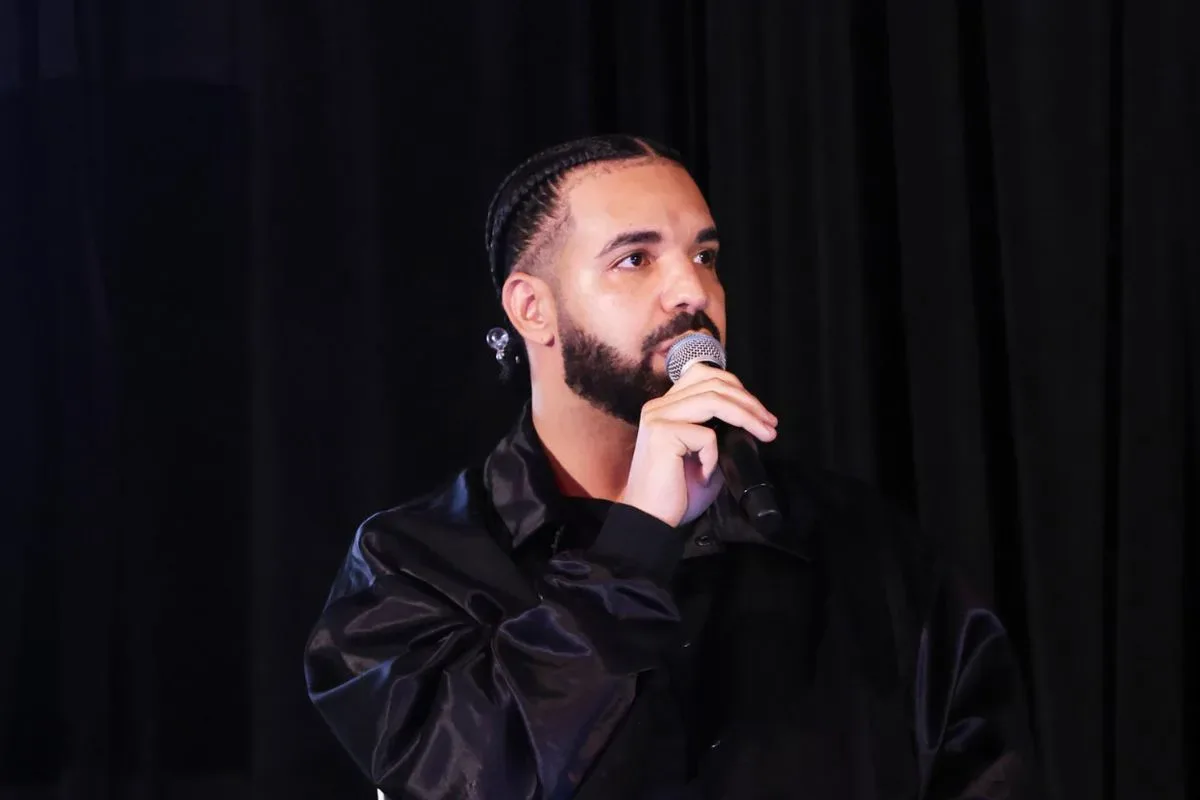
A newly circulated photo purportedly showing Drake recording music has kicked off another round of release speculation, even as the exact context of the image remains unclear. The picture is said to show the Toronto artist working in what appears to be his home, widely known as The Embassy. But there is no confirmation of when the photo was taken, what music may be involved, or whether it signals an imminent release.
That uncertainty is the important part. An artist in a recording environment is not, by itself, a release plan, a tracklist, a project announcement, or proof that a song is finished. Still, the image has landed during an especially active period for Drake: he has released three projects in 2026, along with a deluxe edition. For listeners accustomed to his frequent output, evidence of more studio work naturally invites guesses about what could follow.
What the photo does—and does not—establish
The available information supports a narrow conclusion: an image has circulated online that appears to show Drake recording. It does not establish the image’s date, location with certainty, collaborators, title, intended format, or release timing. Social-media circulation can create a sense of immediacy that the material itself does not verify; a photo can be recent, old, reposted, or detached from its original setting.
That distinction matters because speculation has already split into competing possibilities. Some fans are hoping the work could lead to a Scary Hours-style extension connected to ICEMAN. Others have raised the possibility that the image may not be new at all. Neither theory is confirmed.
A deluxe edition is generally an expanded version of an existing release, often adding songs after the original project arrives. An “expansion,” as fans are using the term here, would suggest additional material attached to a current album cycle rather than a completely separate record. Those ideas can be useful shorthand for audience expectations, but they are not announcements. For now, no official connection has been established between the photo and ICEMAN, Scary Hours, or any future project.
A busy release year changes the interpretation
The reason this particular studio image has attracted attention is not difficult to see. Drake’s 2026 output has already included three new projects and a deluxe version, making the prospect of further music feel plausible to his audience. His established reputation for recording frequently also gives a single behind-the-scenes image more momentum than it might have for a less prolific performer.
But a productive year can cut both ways when reading studio clues. It can mean an artist is continuing a creative streak. It can also mean recorded material is simply part of a long-running workflow, with no defined public timetable. Music can be recorded for a later album, an add-on release, a guest appearance, a song that is ultimately shelved, or a session that never develops into a commercial release. Without a confirmed plan, the most responsible reading is that Drake appears to still be working—not that a specific release is on the calendar.
The fan interest around a possible Scary Hours continuation reflects a recognizable pattern in Drake’s recent release cycles. Fans have connected the idea to the rollout surrounding For All the Dogs and to the FOMO deluxe of HABIBTI. That history explains the theory, even if it does not confirm a repeat. Past release structures can shape expectations, but they are not a guarantee that the next project will use the same approach.
For readers who follow music as closely as they follow games, the practical analogy is simple: a screenshot from a development build can invite plenty of informed theorizing, but it is not a launch date. The useful question is not whether speculation exists—it clearly does—but what evidence actually moves an idea from plausible to confirmed. In this case, a verified release announcement, credited track information, a formal preview, or direct confirmation would be materially stronger than a photo alone.
Separating evidence from fan theory
There is room for excitement without treating every online clue as a promise. A careful breakdown looks like this:
- Established: Drake has had a highly active 2026, including three projects and a deluxe release.
- Reported but unverified in detail: A photo circulating online appears to show him recording in what is believed to be his Toronto home.
- Unconfirmed: Whether the photo is recent, what session it depicts, and whether its music will be released.
- Fan speculation: A possible Scary Hours expansion of ICEMAN, or additional music arriving later in 2026 or in 2027.
This is more than a semantic exercise. Release speculation can travel quickly enough that a theory begins to look like reporting once it is repeated widely. Keeping labels clear protects the difference between a verifiable development and a community prediction. It also leaves room for the eventual announcement—if one comes—to be judged on its own terms rather than against a release plan that was never official.
There is a broader creative angle, too. Studio imagery has become a familiar part of the modern music conversation: it offers a rare glimpse of process while revealing almost nothing definitive about the finished work. The photo’s value to fans is therefore less about concrete information than possibility. It reinforces the image of an artist still engaged with making music after a packed year, which is enough to sustain discussion even before there is a song to hear.
For another recent look at how production choices can shape a record’s character, see this examination of Stoic’s “Bullfrog” approach to space and boom-bap density.
Legal claim remains separate from release chatter
Alongside the conversation about new music, Drake is facing a newly filed lawsuit from songwriter and producer Aviel Calev Hirschfield. Hirschfield alleges that Drake used his chorus for “Janice STFU” without credit or appropriate compensation.
Those are allegations in a legal claim, not established findings. Drake’s team has rejected the accusation, characterizing the suit as a fabricated attempt to obtain money and saying the allegations are false. The dispute may produce further court developments, or the parties could reach another form of resolution; the available information does not establish an outcome.
It is important not to blend that case with the studio-photo speculation. They are separate matters: one concerns a contested claim over authorship and compensation, while the other is an unconfirmed signal of ongoing creative work. The overlap is simply timing, with both stories unfolding during a commercially active year for Drake.
Recognition adds another dimension to the year
Drake’s 2026 has also brought formal songwriting recognition. SOCAN is set to honor him with its Songwriter of the Year award for a fifth consecutive year. That acknowledgment places an institutional marker alongside the volume of his releases and the immediate attention surrounding his possible next move.
For now, the studio photo should be treated as a prompt for cautious anticipation rather than a roadmap. It may point to music intended for later in 2026, for 2027, or for no public release at all. Until Drake or his team provides specifics, fans have a real image to discuss—but not yet a confirmed title, date, format, or project.