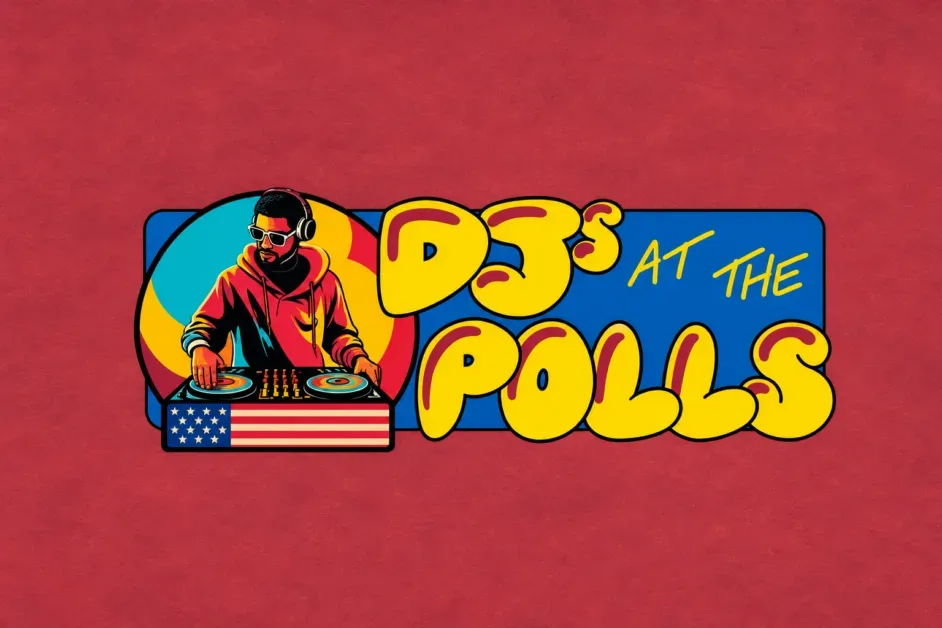
Election Day is usually described in the language of lines, ballots, precincts and turnout. On November 3, a national project is adding another piece of equipment to that picture: DJ decks.
DJs at the Polls expects about 2,000 DJs to perform at nearly 5,000 polling locations across 24 states. The premise is direct but unusually ambitious in scale: use music to make the trip to vote feel more communal and celebratory, while keeping the performance firmly separate from electoral advocacy.
That distinction matters. A polling place is not a conventional venue, and this is not a campaign concert series. DJs participating in the program are paid $500 per set and trained on guidelines that prohibit offensive music, profanity and promotion of a political affiliation. The result is intended to be a welcoming atmosphere around the act of voting rather than a soundtrack designed to steer voters toward any candidate or party.
For an initiative rooted in hip-hop DJ culture, the November 3 schedule represents a major expansion of a simple community-facing idea: music can signal that a civic obligation is also a shared occasion.
From Philadelphia idea to a multistate Election Day operation
DJs at the Polls was founded in Philadelphia in 2009 by Anton Moore, who developed the concept while working on BET's Rap City. Moore brought experience working around rappers and DJs into an effort focused on voter participation. DJ Diamond Kuts, a well-known Philadelphia DJ, serves as the project's DJ Recruitment Lead.
The program is nonpartisan and is fiscally sponsored by Focus for Democracy Fund, a nonprofit. Fiscal sponsorship is an arrangement in which an established nonprofit provides administrative and financial oversight to a project. In practical terms, it gives a project a nonprofit home for fundraising and related operations without requiring that project to operate as a separate nonprofit organization.
Its growth is visible in both its venue count and geographic reach. Nearly 5,000 polling locations is not merely a handful of high-profile appearances; it implies coordination across thousands of individual sites. The reported 2,000-DJ figure also means the program is not framed around a few celebrity performers. It relies on a broad network of working DJs taking localized assignments.
That approach fits the culture the project draws from. The DJ's role has long involved reading a room, selecting appropriate music and creating a sense of occasion. Here, however, the room is effectively the public space around a polling place, and the selection rules are much tighter than they would be for a club, party or festival booking.
Tampa and Kansas join the schedule
The Tampa area will host the initiative for the first time, with DJs planned for 26 polling locations in Tampa and elsewhere in Hillsborough County. Kansas is also a first-time destination for the organization. Its schedule there includes 18 voting sites in Kansas City, Kansas, plus 28 locations in the Wichita area.
These first-time markets help explain what expansion means in this context. A new city or county is not simply another pin on a map. It requires DJs, placements and a shared understanding of conduct at sites connected to voting. The project has to preserve its core promise—music as a community element—while accounting for the fact that participation happens in and around a sensitive public setting.
The Tampa and Kansas plans also show that the program is not limited to its Philadelphia origins. Its national footprint extends the idea into different local communities while retaining the same nonpartisan operating principle.
Why the guardrails are the point
The most important details of the project may be the ones that limit what a DJ can do. Participants cannot use their sets to advocate for a political affiliation. They also cannot play offensive material, and profanity is barred. Moore has said DJs receive training on those requirements.
Those restrictions define the difference between voter engagement and partisan messaging. “Nonpartisan” does not mean indifferent to voting; the initiative explicitly aims to encourage participation. It means that encouragement is not supposed to favor a party, candidate or political faction.
The profanity rule is equally practical. Polling places serve people of varied ages and backgrounds. A DJ working in that environment needs a playlist that can support a public, cross-generational atmosphere. The constraint is not an incidental detail added after the music is booked; it is part of the assignment itself.
There is a broader creative lesson in that framework. A DJ set is often associated with personal taste, deep cuts and expressive freedom. This kind of set asks for a different skill: programming music for a defined civic purpose, with audience comfort and neutrality taking priority. The performer still contributes energy, but the event's boundaries determine what that energy can sound like.
That is an especially notable use of DJ culture at a moment when rap remains central to mainstream music conversation. Elsewhere in the genre's current landscape, Apple Music's 2026 recognition of Drake has highlighted the commercial scale of contemporary rap. DJs at the Polls operates on a very different scale and purpose: not artist rankings or release cycles, but neighborhood-level programming around a civic ritual.
A paid gig with a civic brief
The $500 payment per set is a significant part of the model. It identifies the appearance as paid work rather than asking DJs to donate their labor for a public-interest event. That matters because a multistate schedule requires professional preparation, transportation, equipment and time.
At the same time, the compensation does not change the nature of the responsibility. A DJ at one of these locations is not being booked to make the case for a candidate. The assignment is to help make Election Day feel like an event people can approach with a sense of welcome and community.
Past participant DJ World Wide Waxx described the response in simple terms: “The people enjoy it and they thank you a lot for even being there.” That account points to the program's intended impact. The music is not presented as a replacement for the voting process or a solution to every obstacle people encounter. It is an act of presence—something that can make the immediate environment warmer and more memorable.
What nearly 5,000 locations actually represents
The headline number can be easy to read as a statistic and then move past. But nearly 5,000 locations suggests a model built for repetition rather than a one-off spectacle. Every individual placement has to meet the program's content standards, while every DJ has to understand that a public-facing performance at a polling location comes with different expectations than an ordinary gig.
It also makes the initiative's central idea easier to see. Music is being used as environmental design. Rather than asking voters to interact with a political message from the DJ booth, the program uses sound and presence to alter the mood around a necessary civic task.
Whether a voter notices a particular song or simply notices that a DJ is there, the event communicates that voting day can be treated as a communal occasion. That is the project's wager: an inviting setting can encourage people to show up, without turning the setting into an argument over whom they should support.
On November 3, that wager will play out through thousands of sets across 24 states—from the 26 planned Tampa-area locations to the first Kansas stops, and across a network reaching nearly 5,000 polling places in total. It is a sizeable Election Day booking, but its rules are as central as its playlist.