50 Cent has built a remarkably durable public persona around escalation. A jab becomes a post, a post becomes a running gag, and the audience is invited to treat the resulting humiliation as part of the show. That approach has made him one of entertainment’s most reliable provocateurs. But his dispute with Tia Kemp has put an unusually serious question at the center of the spectacle: what happens when a figure long associated with public ridicule asks a court to draw a firm line around it?
The immediate issue is not difficult to understand. Kemp allegedly made degrading comments about 50 Cent’s 14-year-old son, Sire Jackson. 50 Cent has characterized the remarks as fabricated claims concerning his son’s development, rather than ordinary adult-to-adult social-media sparring. A Florida judge has granted a temporary injunction protecting Sire, while a separate federal suit seeks at least $6 million in damages.
A temporary injunction is a court order intended to preserve protections while a dispute proceeds; it is not, by itself, a final judgment on every claim in the case. Here, Kemp is temporarily barred from contacting Sire directly or indirectly and must remain at least 500 feet away from him. The reported order matters because it treats the alleged conduct as more consequential than a celebrity exchange of insults. Kemp has continued making posts about 50 Cent, but those later posts have not been found to breach that particular order.
Children should not be turned into ammunition in an adult conflict. That principle does not become less valid because the parent seeking protection has a confrontational public record. Yet that record is precisely why the episode has prompted broader scrutiny. Over many years, 50 Cent has repeatedly treated relatives, children, disabilities, trauma and intimate personal circumstances as raw material for jokes and feud tactics. The present case does not erase his right to seek legal protection for his son. It does make the contrast impossible to ignore.
For more context, explore The Elder Scrolls 6 Is Officially The Elder Scrolls 6: Sentinel.
The difference between a feud and collateral damage
Celebrity feuds are often defended as reciprocal entertainment: two adults choose to trade barbs, each understands the publicity incentives, and viewers decide how much attention to give them. That defense gets much weaker when the target is not a participant. The person may be a relative, a co-worker, or someone who simply happened to be nearby when a famous person decided to make content.
During 50 Cent’s 2009 conflict with Rick Ross, he released a video titled A Psychic Told Me featuring footage of a woman identified as DJ Khaled’s mother at her job. The video also showed what was presented as her home and included a threatening poem about knowing where she lived. She was not a party to the dispute. 50 Cent later framed the move as a response to an offensive image of his son Marquise that he connected to a website associated with Ross’s camp; that camp denied involvement.
Whatever the disputed provenance of the image, the episode illustrates the problem with retaliation logic online. It can turn a claimed injury to one family member into permission to involve another, unrelated family member. That is not a boundary; it is an escalation rule. The current dispute is built on the opposite idea: a child should not be a proxy target because adults have unresolved grievances.
In 2022, 50 Cent accused Lil’ Kim of taking aim at Nicki Minaj’s son in her remix of Megan Thee Stallion’s “Plan B.” Lil’ Kim denied it and said the lyric concerned an ex. 50 Cent then mocked an eye condition affecting Lil’ Kim’s daughter, Royal Reign. Lil’ Kim objected publicly, and Royal Reign’s father, Mr. Papers, told him to leave their daughter out of his online comedy.
There is a revealing inconsistency in the sequence. Even if 50 Cent believed a lyric had targeted a child, his response extended the same harm to another child. A principle that minors should be off limits cannot function selectively, applying only when the child belongs to one side of a feud.
Other examples further complicate any attempt to call the pattern harmless trolling. In 2020, 50 Cent shared a meme that made Dwyane Wade’s then-12-year-old daughter, Zaya, part of a disturbing R. Kelly joke. His strained relationship with his eldest son, Marquise, has also played out publicly. In 2018, he said he would not have a bad day if Marquise and another young man were hit by a bus; he later said he had only one son and described Marquise as someone he had mentored. Their relationship has been publicly contentious on both sides, but a parent-child fracture does not make severe remarks less likely to land beyond the intended punchline.
When an audience sees a joke, but the target sees risk
“Trolling” is a flexible label because it can soften the description of behavior that would otherwise sound plainly hostile. It suggests mischief, performance and impermanence. But the relevant questions are more concrete: Who is being targeted? Did they choose the encounter? Is private or sensitive information involved? Is the post encouraging other people to pile on? Can the subject reasonably feel exposed, unsafe or degraded?
Andrew Farrell’s experience at Cincinnati/Northern Kentucky International Airport demonstrates why those questions matter. In 2016, 50 Cent filmed the 19-year-old airport custodian while following him and suggesting he was high because he did not respond to questions. Farrell’s family said he had autism, social anxiety and a hearing impairment. The video sparked backlash and threats of boycotts involving 50 Cent’s Effen Vodka brand. He later apologized and donated $100,000 to Autism Speaks.
The apology and donation are meaningful parts of the record, but they do not change the central imbalance of the moment. Farrell was working, was not seeking celebrity attention, and had no ability to make the encounter equal. In that context, a post framed as spontaneous entertainment could expose a private worker to a vast audience’s assumptions. The episode shows why intent alone is not an adequate test. A creator may claim a joke, while the target experiences public misidentification and loss of dignity.
The same issue becomes sharper when the material concerns trauma. After Terry Crews testified before Congress in 2018 about being sexually assaulted by a Hollywood executive, 50 Cent mocked his account and questioned why Crews had not fought back. He eventually deleted the post. In 2020, he shared an edited Boyz n the Hood image that turned Megan Thee Stallion’s shooting into a meme involving Tory Lanez. Megan responded to wider online mockery by stressing that she was genuinely hurt and traumatized. 50 Cent apologized that year, later challenged her credibility again, and apologized again in 2023.
These incidents are not interchangeable, and their details should not be flattened into one broad accusation. Still, they share a practical lesson: virality does not suspend the reality of what happened to a person. A meme can spread the perspective that a victim’s account, disability or appearance exists primarily for spectators’ amusement. Once it does, an apology may address the original post but cannot fully retrieve every repost, reaction and hostile response it helped set in motion.
Even collaboration has not reliably protected people from being drawn into the routine. In 2019, 50 Cent repeatedly mocked Power actor and executive producer Naturi Naughton’s hairline. He apologized after an earlier joke, then posted another unflattering meme weeks later. Naughton’s response—asking whether they had fought without her knowing—captured a basic workplace concern: a colleague should not have to wonder whether being on the same project makes them a target for public ridicule.
Courts turn online conduct into tangible stakes
Some of the clearest limits on the “it was only trolling” defense have emerged when private harm became a legal question. Lastonia Leviston, who shares a daughter with Rick Ross, was caught in the middle of the Ross-50 Cent feud after 50 Cent circulated an edited version of a private sex tape in 2009. He inserted his Pimpin’ Curly alter ego into the video. Leviston had not consented to its publication and was not a combatant in the rappers’ conflict.
A jury awarded Leviston $7 million in 2015. The award coincided with 50 Cent’s Chapter 11 bankruptcy filing, and she later agreed to a $6 million settlement through his reorganization plan. Beyond the dollar figure, the dispute is a reminder that consent is not a minor detail when intimate material is involved. Editing a video to make a feud point does not turn the person shown into a willing participant.
Teairra Marí’s dispute with 50 Cent followed a different legal route. After intimate footage of the singer leaked in 2018, 50 Cent reposted an explicit image and was included in her lawsuit. Her claims against him were dismissed, and she was ordered to pay about $30,600 toward his legal fees. He then publicly pressed her for payment, repeatedly making her financial situation part of the joke while also pursuing the judgment through legal channels. She answered with her own “I Ain’t Got It” refrain, but the exchange still shows how a court judgment and public shaming can become intertwined.
There is no contradiction in using lawful avenues to collect money that a court says is owed. Nor is there anything improper about asking the courts to protect a child. The tension lies elsewhere: in the apparent difference between how seriously online humiliation is treated when 50 Cent is directing it and how seriously it is treated when he says it has harmed him or his family.
Legal language does not settle the moral question
50 Cent’s prior litigation demonstrates that celebrity conflict can raise real legal issues beyond insults. In 2015, he sued Rick Ross over the use of his voice and stage name in a remix of “In Da Club” on Ross’s Renzel Remixes mixtape. He alleged violation of his right of publicity, a legal concept concerning commercial use of a person’s identity. A federal judge rejected the claim, and an appeals court upheld the decision in 2020 because federal copyright law preempted it—meaning copyright law took priority over the state-law theory asserted in that dispute.
His dispute with Daphne Joy, Sire’s mother, also reached court. In 2024, 50 Cent publicly mocked Joy after she was named in sexual-misconduct allegations involving Diddy, which she denied. Joy then accused 50 Cent of rape and physical abuse; he denied the allegations and filed a defamation action seeking more than $1 million, alleging damage to his reputation and interference in their custody dispute. He withdrew that lawsuit without prejudice in September, which generally means it was withdrawn without preventing a potential future refiling.
Those cases should not be used to declare every allegation proven or every legal claim equivalent. They instead explain why the Kemp dispute is not simply another round of online content. For 50 Cent, law and social media have repeatedly been parallel arenas: public messages shape the narrative, while courts are asked to determine whether conduct crossed a legally actionable boundary.
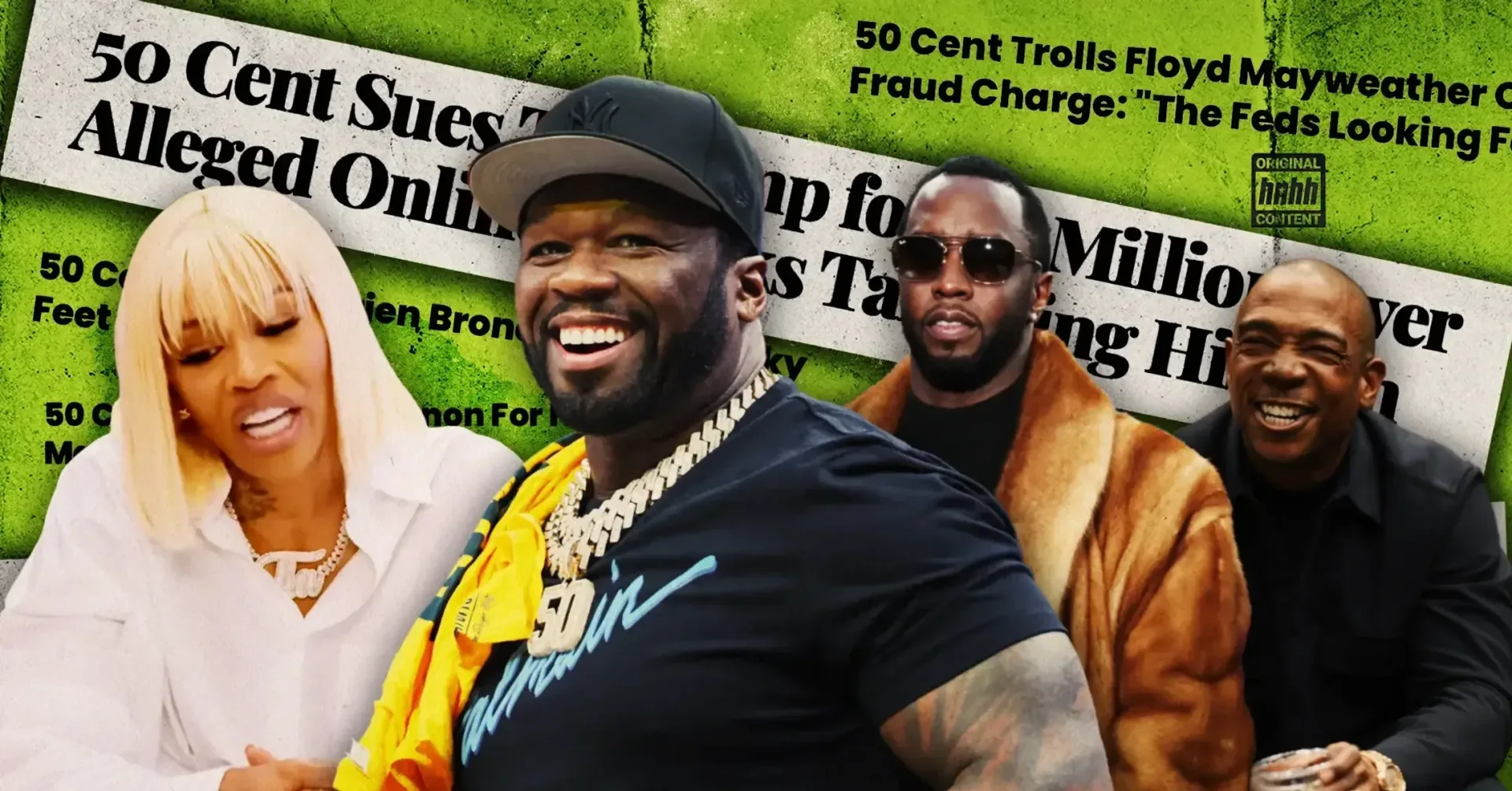
Kemp has leaned into the contradiction, mocking the $6 million lawsuit with a fake GoFundMe graphic and “I need Money by Monday,” a phrase associated with 50 Cent’s public pressure on Randall Emmett over an unpaid debt. She has also invoked his bankruptcy after the Leviston judgment and accused him of getting her Instagram account banned. Her posts may be part of an adult feud, but the temporary order’s focus remains narrow and significant: Sire is not supposed to be pulled into it.
The lasting question is not whether 50 Cent is allowed to defend his son. He is. It is whether celebrity culture can apply the same standard consistently. If minors, uninvolved relatives, disabled workers and survivors of trauma deserve not to become disposable content when they are targets, that protection should not depend on who has the bigger platform, the sharper insult or the more entertaining feud. For more on the current dispute and the wider issue it raises, see this related overview of the case.