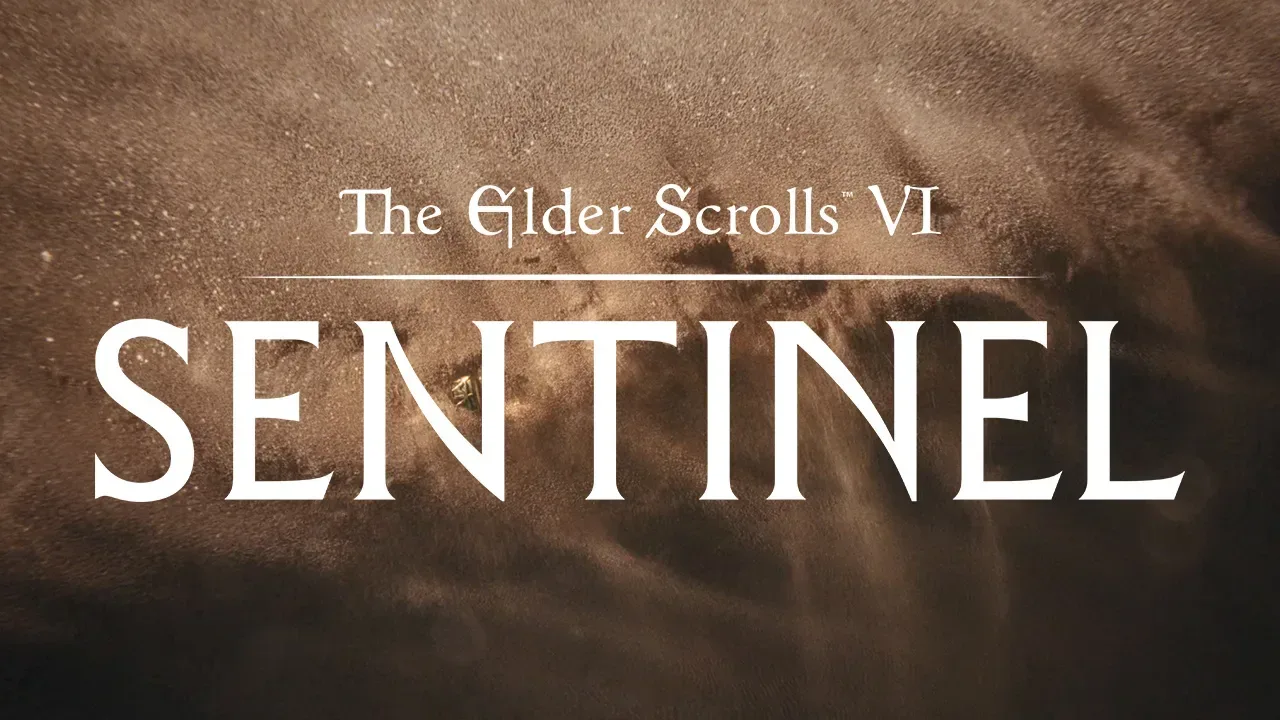
The Elder Scrolls 6 now has a name beyond its Roman numeral: The Elder Scrolls 6: Sentinel. Bethesda Game Studios revealed the subtitle and logo in a video message from longtime series director Todd Howard during the company’s 40th-anniversary celebrations.
It is a concise reveal, but it carries an unusually useful piece of information for a game that has spent years defined primarily by anticipation. “Sentinel” is not merely a dramatic fantasy word invented for a logo. It is a city in Hammerfell, a province on Tamriel, the continent that hosts the major settings of The Elder Scrolls. The name provides a direct geographic connection for the next mainline entry after 2011’s Skyrim.
What the Sentinel name tells us
Sentinel’s place in Hammerfell is the central confirmed setting clue. Hammerfell lies west of Cyrodiil, the province explored in 2006’s The Elder Scrolls IV: Oblivion, and southwest of Skyrim. That relationship helps position the game on the series map, but players should be cautious about turning one location name into a complete map forecast.
A subtitle named after a city establishes that Sentinel matters. It does not, by itself, establish the full playable region, the game’s map size, its faction structure, its quest design, or whether players will travel beyond Hammerfell. Those are all reasonable questions, but they remain questions rather than confirmed features.
Still, the title is meaningful because mainline Elder Scrolls games are so closely associated with their settings. Oblivion took players through Cyrodiil; Skyrim made its northern province the defining reference point for millions of players. Calling the sequel Sentinel gives the coming game an identity that is more specific than “the next Elder Scrolls,” even though Bethesda has not yet detailed what that identity will mean in play.
Hammerfell, explained
In the supplied information, Hammerfell is identified as a province on Tamriel and Sentinel as one of its cities. In practical terms, that makes Hammerfell the clearest lore anchor attached to the new title. Tamriel is the broader continent shared by the series, while provinces are its major regional divisions. Cyrodiil and Skyrim are two examples from prior numbered installments.
That terminology matters because a city title and a province setting are not automatically interchangeable. A title can spotlight a pivotal location without confirming that the game is limited to that place. For now, the responsibly supported reading is simpler: Bethesda has chosen a title with a clear Hammerfell connection.
A long wait enters a more concrete phase
The Elder Scrolls 6 was first announced in 2018 at Bethesda’s E3 presentation. The project entered active production in 2023 after the launch of Starfield. “Active production” is an industry term generally used to distinguish a project being fully worked on from an earlier period of planning, concept work, or pre-production. It signals that development is underway, but it does not function as a release-date promise.
Related coverage includes The Elder Scrolls 6 Is Titled Sentinel as Bethesda Shares Logo.
Howard previously said in 2021 that he expected the next game could arrive 15 to 17 years after Skyrim. Since Skyrim launched in 2011, that earlier estimate suggests Sentinel may still be years away. Bethesda has not provided a firm release date in this announcement.
For fans, that distinction is the most practical takeaway. The title and logo are official; an imminent launch is not. The news replaces a placeholder-style project name with a specific one, but it should not be treated as confirmation of release timing, platforms, editions, gameplay systems, or a new trailer cycle.
Why a logo reveal still matters
After an extended period of limited public detail, even a focused branding reveal can reset the conversation around a major game. It gives fans and communities a proper name to use, puts a confirmed Hammerfell-linked term at the center of discussion, and marks a transition from the generic The Elder Scrolls 6 label to a full title.
That can be important for a sequel following a game with the cultural staying power of Skyrim. Bethesda identifies Skyrim as the studio’s most-played game, and the gulf between its 2011 release and Sentinel has shaped expectations. The sequel has to carry not only a numbered legacy but also the accumulated hopes of players who have spent years revisiting the prior game.
Long development cycles are increasingly part of the discussion around major studios and their biggest franchises. A recent look at how quickly a major game’s narrative direction can shift during development underlines why early announcements, active production, and final release are very different milestones: even high-profile projects can take unexpected paths while they are being made. That is not evidence of any particular change to Sentinel; it is simply a useful reason not to read details into a title reveal that Bethesda has not announced.
Confirmed facts versus the wish list
The name reveal naturally invites players to speculate about deserts, cities, character options, quests, combat, exploration and the inevitable question of how much of Tamriel might be accessible. None of those specifics were supplied with the announcement.
Keeping the line between information and inference clear is especially worthwhile here:
- Confirmed: The game is titled The Elder Scrolls 6: Sentinel.
- Confirmed: Bethesda revealed the subtitle and logo in a Todd Howard video message tied to its 40th anniversary.
- Confirmed: Sentinel is a city in Hammerfell, on Tamriel.
- Confirmed: The game follows Skyrim, was announced in 2018, and entered active production in 2023 after Starfield.
- Not confirmed here: A release date, platforms, gameplay details, the complete playable map, or the scope of Sentinel itself.
That may sound restrained for such a large franchise, but restraint is the useful response to a deliberately narrow announcement. The logo reveal confirms progress in public-facing terms and points the series toward a named place in Hammerfell. Everything beyond that will need to come from future official details.
The next question is no longer what it is called
The central mystery has changed. For years, the next game was known chiefly as the still-distant successor to Skyrim. Now it is The Elder Scrolls 6: Sentinel, a title rooted in the geography of Tamriel and an unmistakable signal that Bethesda is beginning to attach a public identity to the project.
What remains unresolved is the information players most want: when they can play it and what form its version of Hammerfell will take. Until Bethesda answers those questions, the most solid conclusion is also the simplest one: Sentinel is real, its Hammerfell connection is explicit, and the long road from the 2018 reveal to an eventual release continues.