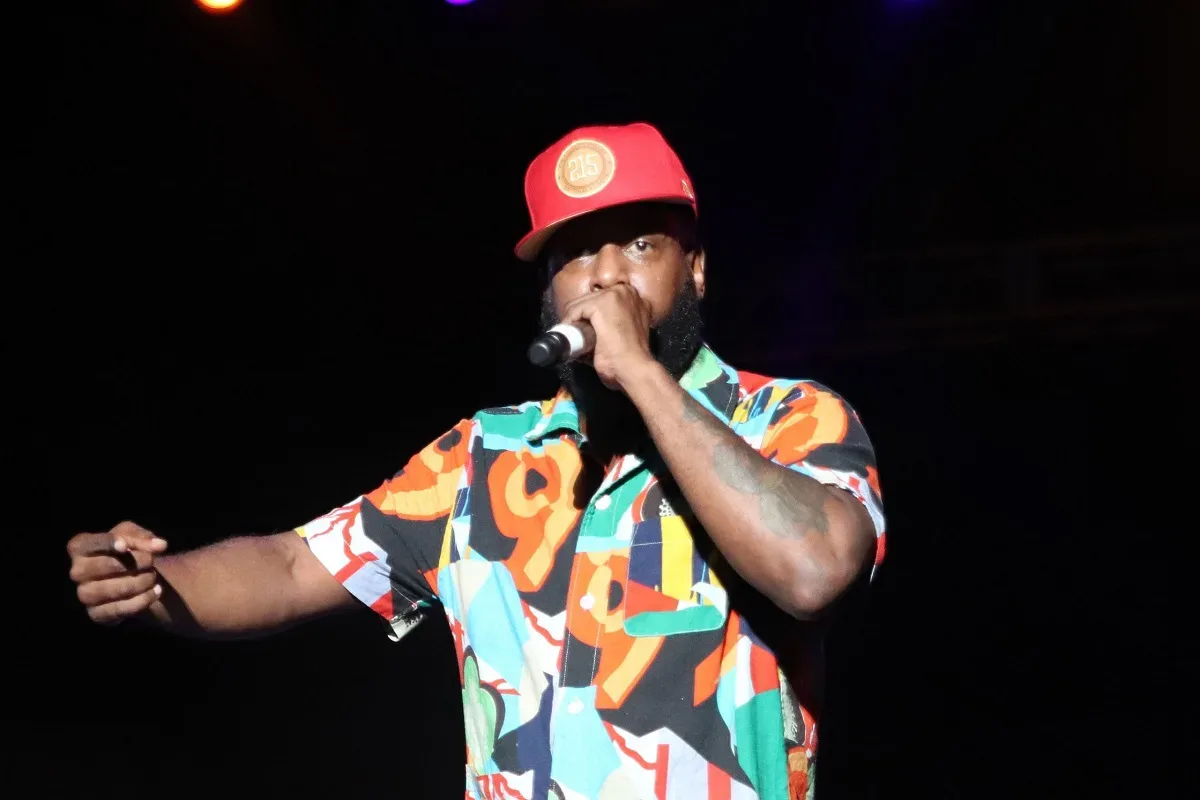
Nkiru Bookstore, the Brooklyn institution with deep ties to Talib Kweli and Yasiin Bey (formerly known as Mos Def), is being revived online through an event led by Kweli’s daughter, Diani Eshe Greene. A Bed-Stuy celebration put books, spoken voices and rap performances on the same program, reflecting the cultural overlap that has long defined Nkiru’s story.
Greene hosted and performed at the gathering, while Kweli DJed. At 27, Greene described herself as an artist taking event curation more seriously, framing the occasion as both a present-day creative project and an extension of a family and community legacy.
“I feel extremely fulfilled to be able to put this together and continue the legacy of my dad, my grandmother and Leothy Miller,” Greene said.
The programming made that mission visible rather than merely branding the event around it. Poet Jessica Care Moore, rapper Rasheed Chappell and Punchline were among the speakers. Wiki, HRLUM and David Jame$ performed. Books by Alice Walker and Mikki Kendall were displayed, placing literary work alongside live Hip-Hop rather than separating reading into a quieter, peripheral activity.
A bookstore legacy with a changing format
Nkiru began in 1976 under founder Leothy Miller Owens. Kweli and Yasiin Bey bought the store in 1998, but its physical storefront closed in 2002. Before the present online revival, it also operated as the Nkiru Center for Education and Culture, a nonprofit focused on literacy and multicultural awareness.
That history matters because an online storefront is not a simple replica of a neighborhood bookstore. A physical shop can operate as a place to browse, encounter other readers, attend events and receive informal recommendations. The digital version shifts the immediate experience toward a catalog, while a gathering such as the Bed-Stuy event helps restore the live, communal side of the institution. In that sense, the event was not just a launch-adjacent celebration; it was a practical expression of what an online Nkiru can still try to convene.
“Curation” is the key term here. In this context, it means deliberately shaping a program or selection so that the participants, books and performances speak to one another. Greene’s lineup connected artists and speakers with books from major voices in fiction and social commentary. That is distinct from simply selling titles online: it proposes a relationship between music, literature and public conversation.
Why the rap-and-reading connection fits Nkiru
Kweli’s involvement with a bookstore has never been an incidental footnote to his recording career. In a 2007 interview, he described the basic difficulty of operating a bookstore while his rap career was gaining momentum.
Related coverage includes Diani Eshe Greene Brings Nkiru Bookstore Back Online With Bed-Stuy Event.
“Maintaining a book store is hard enough, but doing it amidst a burgeoning rap career was harder,” Kweli said.
The point is less that the two pursuits are incompatible than that they require different kinds of sustained work. Making and touring music can demand a public, mobile schedule. A bookstore, particularly one connected to education and cultural programming, relies on continual attention to stock, readers and community needs. Nkiru’s prior physical closure underscores that pressure, while the current online model represents a different way to sustain its book-centered identity.
Kweli’s own reading interests also suggest why a narrow “rap books only” approach would not capture the project. He named Miles Davis’ autobiography as a favorite and cited David Ritz’s Marvin Gaye biography Divided Soul as another book he loved. During his bookstore period, he said he studied history and religion, alongside books by rappers including Ice-T, LL Cool J and Snoop Dogg.
Those choices span autobiography, music biography, history, religion and work by fellow recording artists. They illustrate a useful distinction: Hip-Hop literature does not have to mean only one format or one audience. It can include memoir, criticism, poetry, fiction and books that document the broader cultural worlds from which music emerges. The presence of Walker and Kendall at the event, plus the mix in the current catalog, gives the revived Nkiru that wider frame.
Kweli also spoke in 2007 about building a library at home, saying he had spent roughly $700 at Borders on books, including some he had already read, because he wanted them on his own shelves. That detail captures the difference between reading a book once and valuing it as part of a lasting personal collection. A home library can be a reference point, a record of one’s interests and an object of return. For a bookstore project, that perspective favors books as durable cultural material rather than disposable merchandise.
What the online Nkiru catalog signals
The book section of KweliClub currently lists Kweli’s Vibrate Higher: A Rap Story, RZA’s The Tao of Wu and M.K. Asante’s Buck: A Memoir. These are personal, artist-centered books, but the selection does not stop there. It also includes Jessica Care Moore’s We Want Our Bodies Back and Jacqueline Woodson’s Another Brooklyn, bringing poetry and fiction into the mix.
That range gives the online section a clear identity without overstating what it is. It is a catalog with a particular cultural perspective, not evidence that every aspect of Nkiru’s former physical operation has returned unchanged. The supplied details establish an online revival and a public celebration; they do not specify the full scope of future programming, inventory plans or how the project will develop over time.
Still, the available titles make a meaningful statement. Vibrate Higher: A Rap Story, The Tao of Wu and Buck: A Memoir connect directly to Hip-Hop voices and memoir. Moore’s poetry and Woodson’s fiction expand the shelf beyond artist autobiography. A selection like this can help a reader move between genres instead of treating them as isolated departments: a memoir may lead to poetry, and a novel rooted in Brooklyn may sit productively beside an event held in Bed-Stuy.
Events do work that a storefront page cannot
A digital catalog can make books accessible beyond one block or one borough, but it cannot by itself produce the energy of a room where writers, rappers, DJs and readers share a bill. The Bed-Stuy event addressed that gap. Kweli behind the decks, Greene as host and performer, and a program featuring speakers alongside musicians turned the bookstore revival into a gathering with multiple entry points.
For someone drawn by a performer, the event can offer a route toward the displayed books. For a reader who arrives for a writer or speaker, the musical program broadens the encounter. This is one of the most practical cultural implications of pairing literature with live performance: it removes the assumption that readers and music audiences are separate crowds with separate rituals.
It also aligns with Nkiru’s earlier emphasis on literacy and multicultural awareness. Literacy, in the straightforward sense, concerns reading and engaging with written language. In a cultural setting, it can also mean building familiarity with histories, ideas and artistic traditions. Multicultural awareness similarly points to encounters across different experiences and traditions. The event’s books, speakers and performers gave those broad aims a tangible shape without reducing them to a slogan.
The connection between Hip-Hop and wider public culture remains an active subject across music coverage, including questions about how songs circulate in civic life, as seen in this look at Eminem’s “Not Afraid” in a political campaign ad. Nkiru approaches that larger conversation from a different angle: the relationship between music, books and the institutions that give people room to engage with both.
A legacy being carried forward, not frozen in place
Greene’s remarks locate the revival within several lines of continuity: her father, her grandmother and founder Leothy Miller Owens. That is an important framing for a project tied to a store that first opened in 1976, changed ownership in 1998 and saw its physical shop close in 2002. Legacy here does not require reopening the past exactly as it was. Instead, the online revival uses today’s format while retaining the original project’s link between books, education, multicultural awareness and community.
The Bed-Stuy celebration made that continuity concrete. There were performers, speakers, displayed books and a DJ set; there was also a younger curator publicly taking responsibility for the next chapter. Nkiru’s return online may be digital in its storefront, but the revival’s early statement is emphatically social: reading belongs in conversation with sound, performance and people gathered together.