50 Cent’s latest Instagram post aimed at Diddy is built around a familiar online-comedy move: start with the politeness people expect, then undercut it at the last possible second.
Marking Diddy’s 57th birthday, 50 Cent wrote:
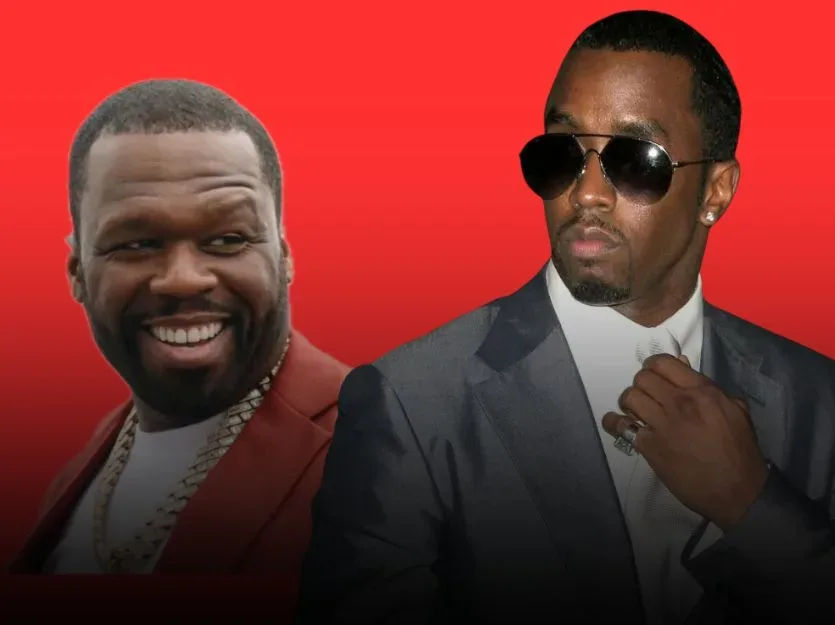
“Happy 57th B day Diddy wishing you many more, LOL.”The message was accompanied by an image in which Diddy’s beard appeared noticeably grey. The opening reads like a standard public birthday greeting. The ending makes clear that it was not intended to land that way.
That final “LOL” is doing nearly all of the post’s work. In social-media shorthand, it changes a potentially neutral acknowledgement into a pointed jab without adding a long explanation. It is a compact piece of trolling: brief enough to be shareable, clear enough to invite reaction, and ambiguous enough that the author does not need to spell out every implication.
A birthday post with a deliberately sharp edge
The context is unusually serious. Diddy is reported to be serving the remainder of a sentence at FCI Allenwood after a transfer from FCI Fort Dix that was linked to safety concerns. The reported release date was recently moved to February 6, 2028. Against that backdrop, a conventional celebrity birthday post could have been easy to scroll past. The added “LOL,” and the selected image, make the post an unmistakable provocation instead.
There is no indication in the material provided that Diddy responded to the Instagram message. Nor is there any reason to assume that a response is forthcoming. The post is better understood as a public-facing gesture from 50 Cent, aimed at the audience that follows his social-media activity, rather than as a conversation between the two men.
That distinction matters. Online trolling is not always about securing a reply. Often, it is about controlling the day’s framing of an event—here, a birthday—and generating a reaction among viewers who already recognize the poster’s established persona. A few words can carry more weight than a lengthy statement when they arrive with enough history and a recognizable tone.
Why the wording is the story
On its face, “wishing you many more” is an ordinary birthday sentiment. In this case, the warm phrasing is immediately punctured by the laugh marker. The result is sarcasm rather than a sincere celebration.
Sarcasm is language that outwardly resembles praise, agreement or goodwill while signaling the opposite meaning through context, timing, presentation or an explicit cue. The “LOL” serves as that cue here. It tells readers not to take the good wishes at face value. The photograph gives the post an additional visual layer by emphasizing Diddy’s appearance rather than treating the birthday as a straightforward occasion.
Related coverage includes 50 Cent Marks Diddy’s 57th Birthday With a Barbed Instagram Post.
It is a small example of how platform-native communication operates. A caption can be read in seconds, but its meaning relies on the surrounding circumstances, the image and the audience’s understanding of who posted it. The content does not need an extended punchline because the sign-off supplies one.
Part of 50 Cent’s public social-media posture
50 Cent has a well-known reputation for using social media to needle public figures, and this post fits that approach. The supplied background also points to Sean Combs: The Reckoning, a documentary associated with 50 Cent and Netflix, as another recent point of connection between his public output and Diddy.
That does not make every post interchangeable. The birthday caption is a far smaller act than a documentary project. But it shows how a public figure can use a single timely post to keep an existing dynamic in view. The message is not presented as news, an argument or a detailed allegation; it is a barb designed to travel quickly because its intent is obvious.
Celebrity social-media feuds frequently blur several roles at once: performer, commentator, promoter and provocateur. This particular post leans almost entirely on the provocateur role. The lack of detail is part of the tactic. Readers supply the surrounding meaning themselves, then debate whether the joke is funny, excessive or simply expected.
Criticism of trolling is part of the backdrop
The post also arrives as 50 Cent’s own conduct as an online antagonist has faced renewed scrutiny. He has filed a lawsuit against Tia Kemp over comments concerning his son, Sire, and he obtained a temporary restraining order against her. The material does not establish the outcome of the wider dispute, but it does identify an active legal conflict that has put questions about online conduct and harassment in sharper focus.
That context helps explain why even a four-word punchline can draw more attention than it otherwise might. There is a meaningful difference between observing that a message is trolling and endorsing it. The former describes the communication style; the latter is a judgment about its impact. Readers can recognize the mechanics of the post while reaching very different conclusions about whether such behavior is entertaining or needlessly cruel.
For 50 Cent, the approach is consistent with a persona that treats public posts as an arena for jokes and pressure. For critics, that same behavior can look less like playful ribbing when the subject matter involves real legal and personal circumstances. The tension is not resolved by the caption itself; if anything, the caption benefits from it. A terse provocation creates attention precisely because it invites people to argue over how seriously it should be taken.
What this does—and does not—tell us
The Instagram post establishes one clear thing: 50 Cent chose Diddy’s birthday to publish a sarcastic public message. It does not establish Diddy’s reaction, any private contact between the two, or a new development in their relationship. The post is a social-media moment, not a detailed account of a dispute.
That is worth keeping in mind when a highly shareable caption becomes the focus. A viral post can be culturally visible without revealing much new information. Here, the news is the timing, the wording and the unmistakable tone—not a substantive exchange.
The broader entertainment conversation will likely keep treating the post as another example of 50 Cent’s readiness to turn a public moment into a joke at someone else’s expense. And because the joke is so concise, it has plenty of room for competing interpretations. Some will see a predictable piece of 50 Cent-style trolling; others will see an unnecessarily harsh message directed at a person facing serious circumstances.
Either way, the caption’s construction leaves little doubt about its purpose. It begins with birthday wishes, waits until the end, and then makes sure no one mistakes the sentiment for genuine warmth.
For more music-world coverage, see our report on Run-DMC reuniting with Aerosmith for “Walk This Way”.