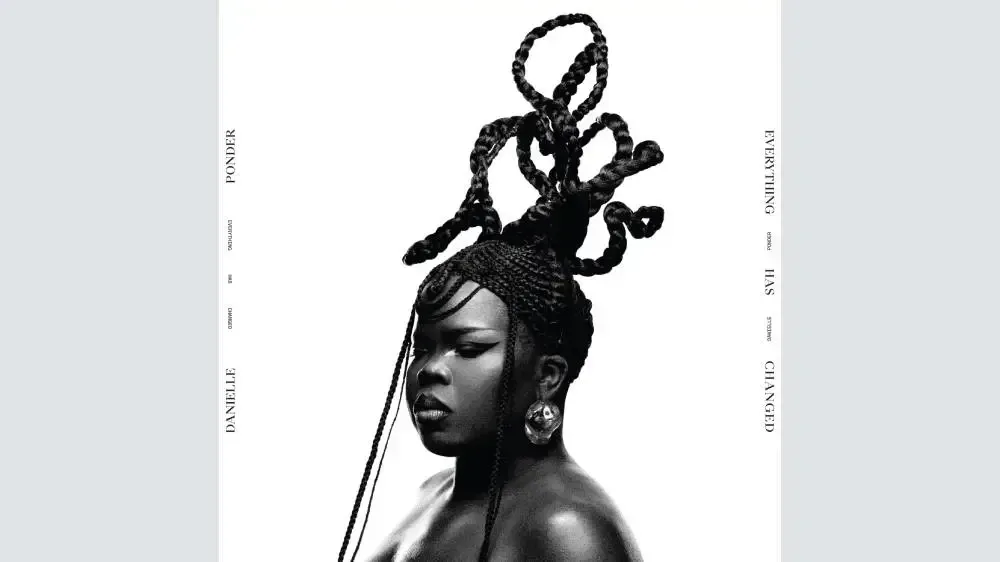
Danielle Ponder’s Everything Has Changed is presented as an album of deliberate contrasts: tradition beside futurism, analog color beside digital production, restraint beside a voice capable of overwhelming force. That tension is not a side detail. It is the central reason the record stands out as a particularly expansive piece of contemporary R&B.
Ponder’s second full-length does not appear to treat genre as a border fence. Instead, it uses different musical languages to support a singer whose instrument can change the emotional scale of a song in an instant. She moves among a forceful soul shout, a mid-range alto and a close, vulnerable soprano. Crucially, the account of the record emphasizes that she does not simply deploy maximum volume at all times. The power is used selectively, which makes the moments where she rises into a raw belt feel consequential rather than routine.
A vocal performance built on contrast
It is easy to reduce a huge voice to a single adjective—“powerful,” usually—and leave it there. But the more revealing detail around Ponder’s performance is range of approach. A soprano delivery can create closeness and fragility; an alto can bring weight, warmth or steadiness; a full soul belt can break through an arrangement with commanding intensity. Moving between those modes gives a vocalist control over perspective. The voice can sound as if it is speaking privately to one listener in one passage, then become something communal and room-filling in the next.
That is especially meaningful in music described as blending old and new. Ponder’s church-rooted vocal force connects her to a long soul and gospel tradition, but the record does not appear to be framed as an exercise in preservation. Its production reaches toward electronic textures and forward-looking R&B as well. The result is not tradition being politely displayed behind glass, nor modern production being used to disguise a conventional vocal showcase. The point is the friction—and the fluency—between the two.
For more context, explore Humblets Kickstarter Pitches a Handcrafted Cozy Fantasy of Campsites, Cards and Pet Sheep.
The sudden jump from a softer register into a more abrasive, throat-straining belt is one of the album’s defining expressive ideas. Vulnerability is often mistakenly treated as synonymous with quietness. Here, vulnerability can also arrive as a vocal rupture: a moment too emotionally pressing to remain neat or muted. That makes the big notes feel less like ornamentation and more like a change in emotional temperature.
What “analog and digital” means in this context
Everything Has Changed is described as mixing analog and digital sounds, as well as organic-feeling R&B and electronic backing. Those labels can be vague when used carelessly, so it is worth separating the basic ideas without assigning the album technical details that have not been specified.
Analog generally refers to sound associated with continuously varying electrical signals and, in everyday musical discussion, often suggests tactile or warm-toned instrumental character. Digital refers to audio represented and processed as numerical data; it can encompass programmed elements, electronic textures and precise production tools. Neither term is a measure of quality. In an album’s aesthetic, their value comes from contrast: a production can set a human voice or acoustic instrument against a more synthetic surrounding, or make electronic elements feel less sterile by placing them alongside familiar organic timbres.
The available description suggests Ponder and her collaborators use that contrast to keep the album from settling into one predictable sonic lane. Its R&B foundation is not abandoned, but it is allowed to encounter electronic backing, gentler pop writing, blues and an ending with a distinctly early-1970s flavor. Such movement can easily turn into a playlist-like collection of detours. The notable claim here is that the album moves between these spaces smoothly and with assurance.
That smoothness matters. Genre variety is only valuable when it sharpens the identity of the artist at the center. On this record, Ponder’s voice seems to provide that anchor. Even where the surrounding musical vocabulary shifts, she remains the unmistakable focus.
Three songs, three useful signposts
The supplied details name three tracks that help map the record’s scope. “SKN” is characterized as gentle pop, indicating that Ponder’s approach includes room for softness and accessibility rather than unbroken vocal thunder. “God of You” brings in the blues, a form whose expressive directness makes a logical companion to her rootsy vocal intensity. The closing “Laurel Canyon” takes an unexpected early-’70s turn, built around tinkling electric piano and acoustic guitars.
That final arrangement description is significant because it is so specific. Electric piano and acoustic guitar immediately suggest a different instrumental environment from electronic R&B backing. As a closer, “Laurel Canyon” appears positioned to leave the listener with a softer, more band-oriented palette. It also underscores the album’s confidence: the record can reach into a recognizable older sound without being defined by nostalgia.
There is a useful distinction between influence and imitation. Referencing or evoking an earlier period does not necessarily mean trying to recreate it exactly. In this case, the closing track’s early-1970s character sits within a wider record described as both futuristic and rooted in tradition. That makes the old-fashioned color part of the album’s range, not evidence that its ambitions are backward-looking.
Ponder’s route to a second full-length
Ponder was born in Rochester, New York, is now based in Atlanta, and grew up performing in her family’s band. Before committing fully to music, however, she concentrated on a legal career focused on criminal justice reform. She did not fully embrace a music career until her late 30s.
Those biographical facts should not be used to turn the album into a simplistic tale of late arrival or novelty. Artists do not need a conventional timeline to justify their work. But Ponder’s path does help explain why the assurance attributed to Everything Has Changed feels important. The record arrives after experience in performance, professional life and public-facing reform work, rather than as an early-career attempt to establish a persona from scratch.
Her 2022 debut, Some of Us Are Brave, preceded this second full-length. Ponder later signed to Saddest Factory, the label associated with Phoebe Bridgers; that label has since merged into Dead Oceans. The label history is context, not a shortcut to understanding the music. Ponder’s sound is explicitly presented as very different from Bridgers’, which only reinforces the central point: the album’s identity is not borrowed from the company around it.
A collaborative production, led by a distinct artist
Several collaborators contributed production, with Bartees Strange, Mike Elizondo and Avis Reese identified as the principal contributors. Elizondo is noted as a Grammy winner. Multi-producer albums can sometimes raise a fair question: does the changing personnel produce a scattered listening experience? Here, the answer appears to be no. Despite the number of contributors and the range of styles, Ponder’s artistic authority remains clear.
That is perhaps the most impressive practical achievement described by the record’s reception. Coherence does not require every song to have the same drum sound, tempo or genre marker. It requires a consistent point of view. Ponder’s unusual combination of vocal control, emotional volatility and willingness to move between textural worlds supplies that point of view.
Comparisons have been drawn to Gnarls Barkley in flashes, while the album’s sonics have been placed near the forward-facing R&B associated with Dijon and Brent Faiyaz. These are best understood as navigational references, not a claim that Ponder sounds interchangeable with any of them. The distinguishing feature remains her voice: not merely its scale, but her choice to make intensity one color in a larger palette.
Why the album’s approach matters
Contemporary R&B is often discussed through production trends—how synthetic the percussion is, whether an arrangement is sparse, how much it borrows from pop, electronic music or older soul forms. Everything Has Changed offers a reminder that production language and vocal language can be equally adventurous. Its key idea is not simply that disparate styles appear on the same tracklist. It is that a singer with deep roots in soul expression can occupy electronic, pop, blues and vintage-leaning spaces without surrendering a singular personality.
For listeners, that means the album’s appeal may lie less in any one genre label than in its movement. Someone drawn to intimate singing has the softer registers; someone seeking a full-bodied soul performance has the explosive belts; someone interested in hybrid production has the intersection of organic R&B and electronic backing. The record gives those elements a shared home rather than asking the listener to choose between them.
Everything Has Changed ultimately lands as a statement of artistic command. Ponder’s second full-length is broad without seeming anonymous, rooted without being trapped by its influences, and technologically open without losing the human force at its center. Its biggest surprise may be how naturally all of those oppositions appear to coexist.