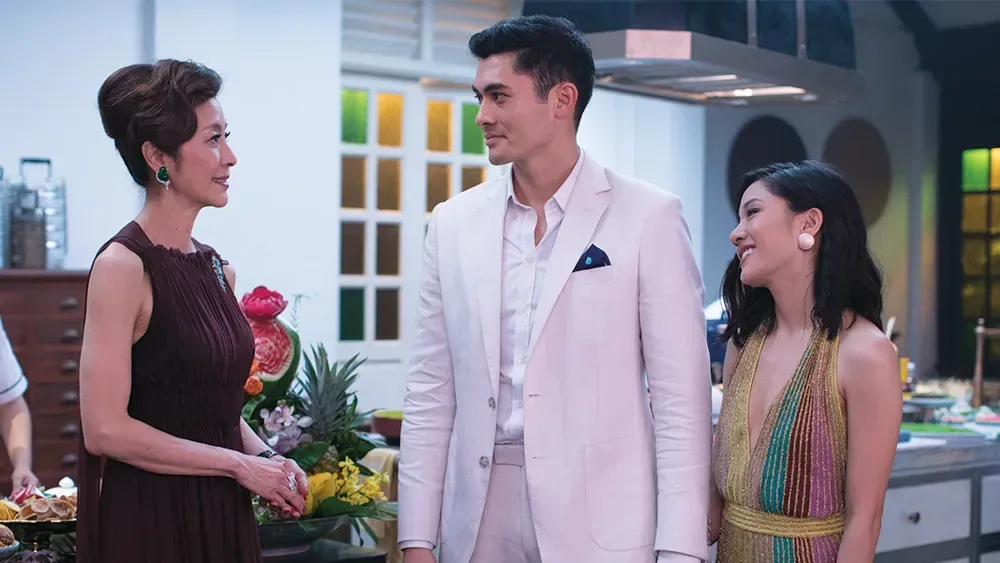
Crazy Rich Asians is trading the long-awaited feature-sequel question for a larger answer: an HBO drama series. The new one-hour show is moving forward with four performers from the 2018 film returning to their original roles. Constance Wu, Henry Golding and Ronny Chieng are attached as series regulars, while Michelle Yeoh will appear in a recurring capacity.
The project has a planned eight-episode run and is positioned as the next chapter after the film rather than a stand-alone restart. That distinction matters. This is not merely a new adaptation borrowing Kevin Kwan’s title and glossy premise; it brings back major members of the movie’s on-screen ensemble as well as several of the people behind the camera.
An Eight-Episode Answer to the Sequel Question
A feature-film sequel to Crazy Rich Asians had been discussed for years without coming together. The HBO project now gives the franchise a different format for continuing its story. Adele Lim, who co-wrote the 2018 movie, will serve as showrunner and executive producer, describing the series as the sequel the team had hoped to make with the added room that eight episodes can provide.
That “breathing room” is the key practical change. A film must generally concentrate its attention on a limited set of dramatic turns. An episodic drama can spend more time with supporting characters, relationships and settings without requiring every moment to serve a single movie-length arc. Lim’s comments indicate that the larger canvas is intended to explore characters and worlds from Kwan’s books more deeply.
It is important, however, not to treat that as confirmation of any particular plot, character focus, or book-by-book structure. No episode titles, story synopsis, release date, additional cast, or platform rollout details have been provided. The confirmed information is that the series picks up after the film and is planned as an eight-episode, one-hour drama.
Who Is Returning?
- Constance Wu will return as a series regular.
- Henry Golding will return as a series regular.
- Ronny Chieng will return as a series regular.
- Michelle Yeoh will return in a recurring role.
In television language, a series regular is generally a principal cast position, signaling an ongoing place in the show’s central ensemble. A recurring role means a performer is expected to appear across more than one episode or story segment, but does not imply the same level of episode-by-episode presence as a regular. Those labels offer a useful indication of the new series’ cast structure, but they do not reveal how many episodes each actor will appear in.
Bringing back Wu, Golding, Chieng and Yeoh establishes a direct bridge to the film, one that goes beyond familiar branding. For audiences who connected to the 2018 release, continuity in the cast is likely to be central to whether this feels like a genuine continuation. It also gives the show a foundation from which it can introduce more characters, should the writers choose to do so.
For a separate example of how casting news can become a major part of franchise conversation, see Joe Manganiello’s reflections on landing Deathstroke.
The Book Trilogy Gives the Series More Territory
The television project, like the movie, is based on Kwan’s Crazy Rich Asians books. The first novel was published in 2013. It was followed by China Rich Girlfriend in 2015 and Rich People Problems in 2017. With three novels in the original series, the creative team has more source material to draw from than was contained in the first film alone.
That does not mean the HBO drama has confirmed direct adaptations of the latter two books, nor does it establish that it will use their events in publication order. Adaptation is the process of reshaping material from one medium into another, and it can involve combining, expanding, relocating or newly arranging story elements. What is known is that the series is connected to the full book series and that Lim sees the episode count as an opportunity to explore its people and settings.
Kwan has welcomed the move to television, emphasizing the expanded time available to bring his characters to the screen. His involvement also extends to the production side as an executive producer.
Why the Original Film Still Carries Such Weight
The 2018 film was directed by Jon M. Chu and became a major commercial and critical success. Made on a reported $30 million budget, it earned more than $239 million worldwide. It also holds a 91% critics’ score on Rotten Tomatoes.
Those numbers help explain why the property has continued to prompt questions about what would come next. Commercial success alone does not guarantee a continuation, especially as schedules, financing, creative plans and distribution strategies all have to align. But the film’s performance demonstrated an audience for Kwan’s world, while its enduring cultural footprint has kept interest alive during the years in which the anticipated movie sequel did not materialize.
Chu has described the return of the cast and collaborators as a reunion. He will executive produce through Electric Somewhere, rather than direct being listed as his confirmed role on the series. That is a meaningful difference: an executive producer typically has a high-level producing role that can include creative, strategic and business responsibilities, but the credit alone does not establish who will direct individual episodes or the pilot.
A Familiar Creative Team, Now Built for Television
Lim will lead the series as showrunner and executive producer through 100 Tigers. A showrunner is the senior creative leader of a television series, generally responsible for guiding the writers’ room and overseeing the show’s overall storytelling direction. Lim said the writers’ room is already working, which confirms active creative development, though it does not reveal individual episode plots.
The executive-producing group also includes Kwan; Nina Jacobson and Brad Simpson of Color Force, the production banner that developed and produced the film; Chloe Dan and Jeannine Tang for SK Global Entertainment, which co-financed the movie; Naia Cucukov Richards through 100 Tigers; and Rose Lam.
HBO and Warner Bros. Television are co-producing the series. That combination brings together the intended home for the show and a studio partner responsible for making it. In industry terms, co-production means the entities share production involvement; it should not be read as a detailed explanation of financing, ownership, episode delivery or release scheduling, none of which have been announced here.
What Fans Can Reasonably Expect—and What Remains Unknown
The clearest expectation is tonal and relational continuity. The returning actors, Lim’s showrunner role, Kwan’s executive-producer credit, and Chu’s continued participation all connect the series to the 2018 movie. The project also explicitly follows the movie’s events, making it more than a parallel screen version of the novels.
Still, there are notable unanswered questions:
- No premiere date has been announced.
- No full cast list has been announced.
- No character or episode synopsis has been released.
- No directors have been confirmed.
- No information has been supplied on production timing or where the story will begin beyond its post-film setting.
That leaves plenty of space for speculation, but very little reason to mistake speculation for news. The meaningful update is already substantial: a continuation that once seemed destined for a second theatrical feature is now taking shape as an eight-episode HBO drama, built with four returning stars and a significant share of the original film’s creative leadership.
For a story defined by family, status, comedy and high-stakes emotional conflict, television offers the chance to let more of those pressures simmer. Whether it becomes a close continuation of one specific novel or a broader new chapter has not been disclosed. What has been confirmed is simpler and more exciting: the family is getting back together, and this time there is more room at the table.