Oobah Butler has built a career around walking through the side door of credibility. His new HBO series, Oobah: Scams for a Better Tomorrow, brings that approach to wellness, wine, music and online dating, using deliberately outrageous premises to examine why endorsements, branding and a confidently told story can make people suspend their skepticism.
The series debuts Sunday, November 22, and features five new scams. Butler’s objective is not simply to get a reaction from a person caught on camera. The larger argument behind the projects is that institutions which present themselves as sophisticated, expert-led or hard to fool can be vulnerable to the same incentives as everybody else: status, money, fear of missing out and the desire to be associated with the next big thing.
That premise is evident in a wine-focused episode. Butler takes smoke-tainted wine—wine treated as commercially undesirable enough that vineyards may distill it into hand sanitizer—and gives it a high-status makeover. The episode sees the product collect endorsements from two leading sommeliers and a major newspaper’s wine critic before being sold for $500 per bottle. Butler’s stated point is not merely that experts can be tricked. It is that snobbery can interfere with a direct assessment of whether a product is actually good.
A show about the machinery of belief
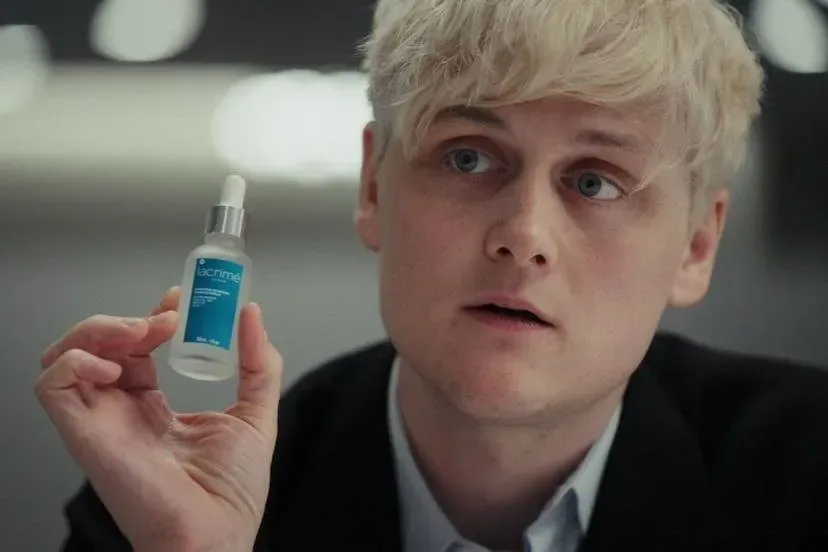
“Scam” is an intentionally provocative word here, but Butler’s projects appear designed as tests of systems rather than simple acts of deception. A wellness episode centers on a skin serum supposedly made from children’s tears. Influencers embrace it, investors express interest, and a New York dermatologist offers an endorsement after seeing children cry into tubes—provided there is a fee.
The details are ludicrous by design. Yet the humor comes from the gap between an outlandish origin story and the serious way people respond once familiar credibility signals enter the picture. Those signals can include expert approval, investor attention, polished presentation, imported-sounding language and apparently exclusive access.
In marketing terms, a credibility signal is a visible clue that persuades an audience something is legitimate or valuable. It does not necessarily prove the underlying claim. A luxury-looking bottle, a specialist’s endorsement or a lofty price can all function as signals before a buyer has had the chance to verify the product itself. Butler’s work puts that disconnect under a microscope.
His wine promotion illustrates the point with a linguistic technicality. He markets inexpensive smoked wine as “Imported from Florence,” while the relevant Florence is Florence, Massachusetts: the wine has been sent there and returned. The claim is constructed to evoke a different association without technically spelling it out. It is a joke about how much consumers and gatekeepers can infer from a few carefully chosen words.
That focus makes the series more than a conventional prank show. A prank often relies on a sudden reveal and an unsuspecting participant’s immediate response. Butler’s reported interest is in the conditions that made the trick work in the first place—what people want to believe, whose approval they seek and which claims pass with too little scrutiny.
The ethics of putting people in the frame
Butler says the production attempted not to “punch down.” His targets are framed as powerful or influential people within their respective fields, rather than ordinary customers. That distinction matters because a social experiment can be funny to watch while still carrying real consequences for the people involved.
The dermatologist sequence is especially revealing. A paid endorsement is not proof that medical advice is false, but the scenario raises a basic consumer question: what exactly has been assessed before an expert lends their name to a product? In a wellness market full of promises, a credential can make a product look carefully vetted even when the customer has little visibility into the evidence, payment arrangement or standard applied.
Butler also acknowledges the tension. He describes it as nerve-racking that people featured in the show had not yet seen it, and says some experts were removed during editing for legal reasons. That does not settle every ethical question created by covert, confrontational entertainment. It does, however, recognize that editing, consent, reputational harm and legal risk are central parts of the format, not afterthoughts.
For viewers, the practical lesson is not to assume every odd product is fraudulent. It is to separate a claim from the performance built around it. Before trusting a supplement, beauty product, investment pitch or collectible-market narrative, it helps to ask a few plain questions:
- What is the specific claim, stated without the branding language?
- What independent evidence supports it?
- Is an expert being paid, sponsored or otherwise incentivized to endorse it?
- Does a prestigious word—such as “imported,” “limited” or “exclusive”—actually say what it seems to say?
- Would the product still make sense without its story, status symbols and social proof?
Social proof is the tendency to treat other people’s interest as evidence that something is worthwhile. It can be useful: recommendations and professional expertise exist for a reason. But social proof becomes unreliable when the apparent enthusiasm is driven by hype, payment, reputation management or a fear of seeming unsophisticated.
From a fake restaurant to HBO
Butler’s prior projects established the template for this kind of work. He created the Shed at Dulwich, a nonexistent restaurant that rose to the top spot in London on TripAdvisor. The project exposed how online ranking systems can be influenced by presentation and feedback loops: if people see a listing treated as important, they may be more prepared to treat it as important themselves.
He also listed bottles of Amazon delivery drivers’ urine as an energy drink on the shopping platform, and, during media activity around the fake restaurant, used lookalikes to conduct interviews in his place. The common thread is not merely a taste for chaos. It is an interest in platforms and institutions that are supposed to authenticate information but can instead amplify a convincing fiction.
Before the HBO series, Butler had made online videos that drew millions of views, hosted the British version of Catfish and made two documentary features for Channel 4 in the United Kingdom. In his twenties, he played guitar and sang in a rock band while writing about music. One early experiment involved learning door-to-door methods from Jehovah’s Witnesses and using them to try to sell CDs. The result, by Butler’s account, was a clear one: selling music was harder than selling God.
That anecdote points toward the question that seems to animate his projects. If the item itself is not enough, what makes someone say yes? Sometimes it is a story. Sometimes it is belonging. Sometimes it is apparent authority. And sometimes it is simply the confidence of the person making the pitch.
Butler, born Paul Arthur Butler, grew up in Feckenham, a working-class English village of 700 people. His sister’s childhood nickname, Oobah, became permanent, and he legally adopted it in his early twenties. He attributes his willingness to speak with people across social boundaries to that upbringing, saying it taught him to act as though he belonged in any setting.
That ability to move between worlds is a major asset for a creator whose work depends on entering elite spaces without immediately triggering suspicion. It is also what gives the series its potential edge: Butler is not only ridiculing a culture from outside it. He is learning its language, reproducing its rituals and seeing whether its gatekeepers recognize the difference.
Why the U.S. setting matters
Butler moved to the United States in 2024 without a job or fixed plan, drawn to New York and the feeling that his work would fit the country. He argues that American marketing offers a wider range of claims than he could make in the United Kingdom or Europe. His Florence wine promotion becomes a compact example of that view: its persuasive force relies less on a direct lie than on an implication left available for an audience to complete.
That environment is particularly fertile for a series about authenticity. Butler says inauthenticity has become easier, citing AI-generated commercials seen during reruns of Frasier. The point does not require every synthetic ad or automated tool to be deceptive. Rather, it recognizes a growing problem of recognition: audiences are increasingly asked to judge material that looks polished even when its creator, origin or factual basis is unclear.
Gaming has its own version of this trust problem, from advertisements that overpromise to marketplace listings and AI-made material that can obscure provenance. Concerns over how artificial intelligence could alter media ecosystems have also surfaced within games; one industry warning has compared unchecked AI-driven output to the conditions behind a historic game-market collapse. Butler’s subject is broader than games, but the core question is shared: when there is more content, more promotion and more synthetic polish, what lets an audience make an informed judgment?
The claw machine as a tiny scam laboratory
A visit to a Chinatown claw-machine arcade provides an unusually neat miniature of Butler’s broader interests. He arrives armed with tips from a TikTok account devoted to winning prizes from claw machines, hoping to land a Charizard plush. After roughly 30 tokens without success, the advice begins to look less universal than advertised.
The account’s methods are intended for machines whose claw hangs from an elastic cord, while the arcade’s machines use a taut wire. That equipment difference is important. A technique that appears authoritative in short-form video may depend on circumstances the clip never makes clear. The account posts victories, not failures, so viewers do not get a complete record of how often its method actually works.
This is a simple example of selection bias: presenting a selective set of outcomes that makes a method look more reliable than it may be. It is not unique to claw-machine videos. Product reviews, investment success stories and influencer endorsements can all emphasize positive results while hiding unsuccessful attempts, costs or unfavorable conditions.
Eventually Butler and his companion win several plush prizes, including a penguin, a polar bear and a miniature Kirby. The desired Charizard initially remains out of reach. Then the Joker card handed over with the token purchase proves redeemable for any plush, and the arcade employee unlocks the Pokémon machine so Butler can take it.
The ending is a fitting punchline for a show devoted to hidden rules, incentives and manufactured scarcity. Persistence was not what secured the prize. Neither was the viral claw-machine strategy. It was a promotion whose value only became clear at the end—a Joker card that changed the game entirely.