
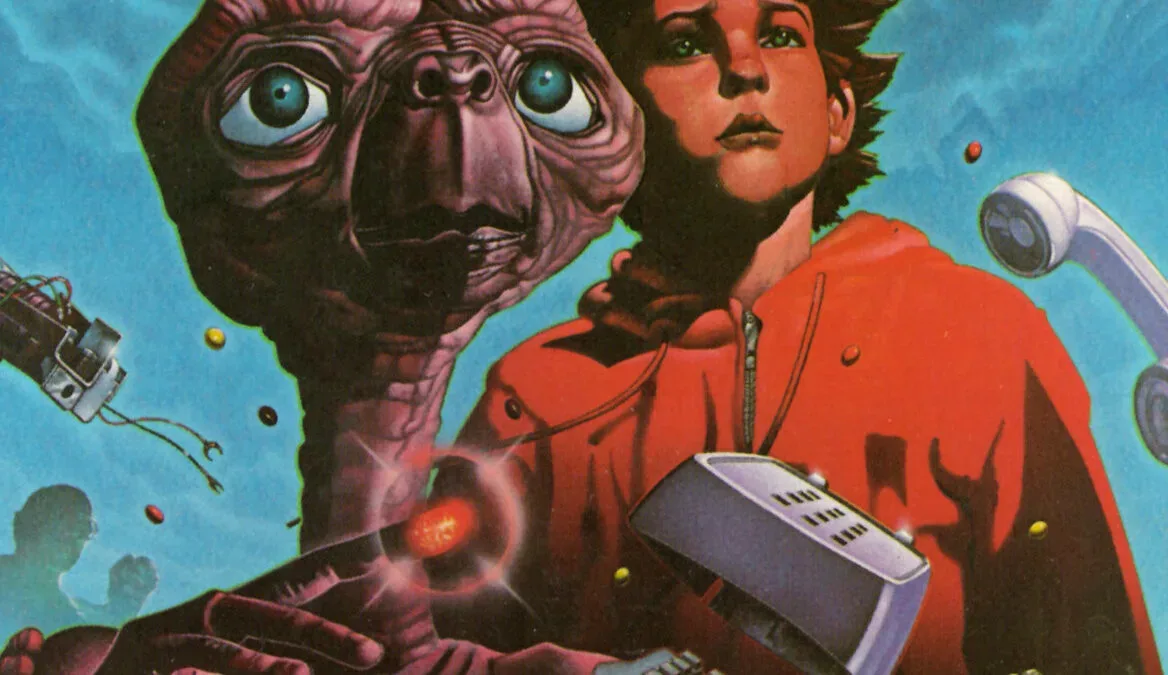
Howard Scott Warshaw, the programmer behind Atari’s E.T. the Extra-Terrestrial adaptation and Yar’s Revenge, has drawn an uncomfortable line between the video game market crash of the early 1980s and the present-day rush to use artificial intelligence in development.
Speaking at DevGAMM in Lisbon, Warshaw argued that AI can make it possible for vastly more people to produce games, but that greater volume can come with a severe cost: a market crowded by rushed, low-quality releases that players struggle to sort from worthwhile work. In his view, the problem is not merely that bad games exist. It is that they can consume the attention, trust and visibility needed by better games to reach an audience.
“AI is going to have the same impact on a larger scale,” Warshaw said, describing how many more people can now realize and create a video game using AI.
It is a warning from someone whose career is inseparable from one of gaming’s most enduring cautionary tales. E.T. has become a shorthand for a disastrous licensed game, and its notorious unsold stock was eventually found buried in New Mexico after years as an industry urban legend. But Warshaw’s point is not that one disappointing game can single-handedly topple a business. The causes of the 1983 crash remain debated. His concern is about a broader market pattern: when a platform becomes easy to fill, buyers can be overwhelmed by products they do not trust.
The 1983 comparison is about oversupply, not one cartridge
The historical comparison needs some care. The early-1980s console business had many home systems, software releases spread across those systems, and consumers who could find the choices confusing. Quality varied sharply. Warshaw recalled that critics in the late 1970s and early 1980s were already ready to dismiss games as a passing fad, while people in the business feared the crash could encourage investors to pull funding away.
E.T. became the emblem of that moment because the circumstances were so extreme. Atari gave Warshaw only a few weeks to build a game tied to a major film that had arrived that same summer, aiming for the holiday season. The compressed schedule mattered. A game’s design, programming, testing and refinement all require time; speeding up one part does not automatically solve the rest.
That is the useful part of Warshaw’s analogy. A weak release can disappoint. A giant accumulation of weak releases can make every unfamiliar title look like a gamble. In a physical retail era, that could mean expensive shelf space and unsold inventory. In today’s digital-first market, the shelf is effectively infinite—but player attention is not.
Digital storefronts do not usually run out of room for another listing. They can, however, become harder to browse. Search results, recommendation feeds, new-release pages and category listings are all finite surfaces competing for a player’s time. A flood of games that few people want to buy may still impose a cost by pushing harder-to-find work further from view.
Related coverage includes Howard Scott Warshaw Warns AI Could Create an ’83-Style Game Market Crisis.
What “discoverability” means in a digital store
Discoverability is the chance that a person can find a game they may actually want amid a huge catalogue. It is more than simple search. It includes whether a title appears in a new-release list, gets surfaced in a recommendation feed, can be located through meaningful tags, or earns space on a storefront’s front page.
For players, weak discoverability means more effort spent separating appealing games from noise. For small teams, it can mean making a distinctive project that never reaches the people most likely to enjoy it. For stores, it creates a quality problem even if they do not directly make the games: shoppers may come to see browsing as frustrating or unreliable.
Warshaw’s proposed priority is therefore not a blanket rejection of AI. He acknowledged that it can accelerate coding substantially. The concern is whether platforms have adequate filters to remove obvious garbage while spotlighting innovative work. His framing places responsibility on the systems that organize and present games, rather than assuming that more creation tools will somehow produce better curation on their own.
“We need better filters to figure out a way to get rid of the garbage games and not waste time with that, and to highlight what are really innovative and exciting things,” Warshaw said.
AI is a tool; the risk is an unchecked publishing pipeline
It is important to distinguish AI-assisted development from the outcome Warshaw fears. AI can refer to tools used for coding, artwork, text, audio or other production tasks. The presence of such a tool does not, by itself, reveal whether a game is playable, original, thoughtfully designed or responsibly made. Nor does it establish that a game is poor.
The risk described here is instead a pipeline problem. If automation reduces the effort needed to create and submit a title, then more submissions may arrive faster than a storefront’s systems can evaluate, categorize or surface them. A release can be technically complete enough to list while still being shallow, broken, derivative or poorly communicated to potential buyers.
That distinction also explains why Warshaw sees room for a constructive outcome. Faster technical work could give creators more time to focus on the parts of game-making that need judgment: design decisions, pacing, player feedback, clarity, balance and a coherent creative purpose. AI does not determine whether those things receive attention. The people making and publishing the game do.
His warning is aimed at the incentive to skip that work. When publishing appears cheap and quick, there is pressure to treat a game listing as a volume business: make more, submit more, and hope one catches attention. That approach may be especially harmful in crowded stores, where each low-effort release adds friction for everyone else.
Steam and itch.io face different versions of the same problem
Warshaw’s comments arrive as digital storefronts are already contending with an influx of hastily made, AI-produced material. Steam has traditionally relied heavily on market behavior to shape what appears prominently to users. That makes storefront presentation especially significant: a page may contain enormous numbers of listings, but the visible feed determines what most players encounter.
itch.io has taken a more direct response in at least one respect, removing more than a terabyte of machine-made material. The scale is notable because it highlights how digital abundance works differently from a stack of physical cartridges. Storage may be relatively easy to add, yet moderation, categorization and useful browsing do not happen automatically just because files can be hosted.
The immediate stakes are not necessarily a repeat of the 1983 crash in the literal sense. The modern industry is vastly established culturally, and major games and console brands are not regarded as a fad in the way games sometimes were decades ago. Warshaw’s warning is better read as an argument about market health: declining confidence in discovery, lower visibility for legitimate releases and an expensive burden placed on players and storefront operators.
There is also a financial dimension. The concern raised is that AI-made releases can have disproportionately little commercial success compared with human-made offerings, while still clogging the routes through which buyers discover games. A store filled with titles that do not sell is not automatically doomed, but it risks creating a marketplace where useful signal is buried under material that generates little value for creators, customers or the platform.
What better filters could actually mean
Warshaw did not prescribe a single rule, and no one tool could solve a discovery problem this broad. Still, “better filters” points to a practical collection of goals rather than an abstract demand for quality.
- Clearer sorting: Players need ways to narrow huge catalogues by genre, features and other meaningful information rather than wade through a single undifferentiated release feed.
- Useful labeling: Storefront information should help a customer understand what a game is and what they are considering before a purchase or download.
- Stronger anti-spam systems: Stores need ways to identify mass-submitted, misleading or otherwise low-value listings without treating every small creator as suspect.
- Better promotion of distinct work: A storefront’s editorial and recommendation systems can make thoughtful, unusual games easier to encounter instead of rewarding only sheer publishing volume.
- Room for human judgment: Automated tools can help manage scale, but they cannot replace deliberate decisions about whether a game is clear, functional and worth showing to players.
These goals should not be confused with a demand that every game meet one narrow creative standard. Games thrive on strange ideas, small experiments and projects made outside major studios. The issue is whether storefronts can preserve that openness while preventing browsing from becoming a slog through misleading or disposable submissions.
The lesson of E.T. is not to stop making games
Warshaw’s own history makes the warning more nuanced than a simple anti-technology argument. He made Yar’s Revenge, a game remembered as a success, and later created the E.T. game under extraordinary time pressure. The contrast illustrates why tool access and production speed are not substitutes for design time, testing or a clear understanding of what players need.
The early-1980s collapse was a painful demonstration that the audience’s patience has limits. Today’s players have a different problem: not too few choices, but too many choices presented without enough help. In that environment, quality control is not just a gatekeeping question. It is a way to respect a player’s time and give serious creators a fairer chance to be seen.
For players navigating both new digital releases and older hardware, making intentional choices about the games and devices they keep using can be part of the answer; here is a practical look at how to turn an old Xbox into a media box, retro machine or PC controller.
Warshaw’s forecast is not inevitable. AI may accelerate certain tasks, while creators continue to make carefully designed games and stores improve how they manage their catalogues. But his central challenge is clear: if the barrier to publishing keeps falling, the work of helping people find the good stuff becomes more urgent—not less.