Itch.io is tightening its response to a surge of uploads that it attributes to the growing availability of generative-AI tools. The independent game marketplace says the number of game pages created each day roughly doubled over a little under three months, climbing from just above 3,000 on August 3 to more than 6,000 on October 30.
The striking part of that graph is what did not rise alongside it. Itch.io said downloads and purchases did not show a comparable increase. In practical terms, that suggests the added listings are making the catalogue larger without demonstrating matching audience demand—a discovery problem for players and a visibility problem for developers trying to publish a game in good faith.
The company has now said it has deleted “a couple terabytes” of what it characterized as AI slop. It is also widening generative-AI disclosure requirements across more product categories and adding filtering controls, including within search results, so users can choose not to see works disclosed as using generative AI.
A catalogue problem, not simply a single spammer problem
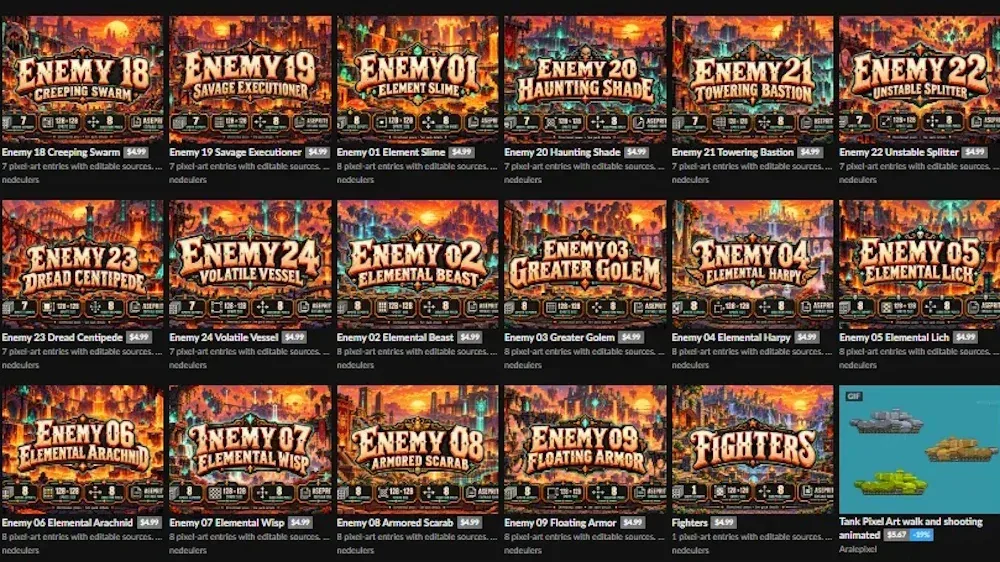
A screenshot circulating around the discussion showed one account dominating nearly an entire page of listings with very similar AI-created games. Itch.io said bulk-upload behavior of that kind violates its existing content guidelines and that the relevant games were actively de-indexed from search.
De-indexing means a page can be removed from the platform’s search discovery system. It is an important moderation tool because a listing that cannot surface in ordinary searches is much less able to crowd out other projects. It is not necessarily the same thing as deleting the uploaded material entirely, however, so it should not be treated as proof that every problematic upload has been erased.
Still, Itch.io has specifically said bulk uploaders are not the principal explanation for the overall rise. Its view is that the increase is being driven by first-time uploaders rather than a small set of accounts flooding the site. That distinction matters: a rule aimed solely at one prolific account can be straightforward to enforce, while a mass of separate accounts each uploading a small number of low-effort projects is substantially harder to address.
That is why the jump from roughly 3,000 to over 6,000 daily game pages is more consequential than an isolated example of repeated uploads. A marketplace can remove obvious batches, but its discovery systems still have to handle the cumulative volume of listings arriving from many people. For independent creators, the damage can be mundane but real: more time spent trying to locate genuine new work, less predictable search visibility, and less confidence that a category page represents a useful editorial or community signal.
What the new disclosures cover
Itch.io already had generative-AI disclosures in place in some areas. Its updated policy extends that requirement to tabletop games, books, comics, and soundtracks. Creators uploading to those categories must state whether generative-AI tools were used and explain how they were used.
Related coverage includes Itch.io Removes Terabytes of AI Content as Daily Game Uploads Double.
The requirement also applies if AI-generated material was subsequently edited or removed. That is a broad standard. It means disclosure is about the work’s creation process, rather than a claim that a finished upload contains visibly machine-generated material at the moment a buyer sees it.
Generative AI, in this context, refers to tools that generate material such as text, images, audio, or code from user prompts or other inputs. The term does not by itself reveal what role the tool played. It could refer to a prominent visual asset, written material, music, or assistance during programming. That is why a disclosure that says how a tool was used can be more helpful than a binary label alone.
The distinction is particularly important across Itch.io’s varied catalogue. A tabletop project, comic, soundtrack, book, and downloadable game are not evaluated by audiences in precisely the same way. Someone looking for a soundtrack may care most about music generation; someone browsing a comic may focus on visual art and writing; someone choosing a game may want to know whether generated assets appear on screen, whether generated code was used behind the scenes, or both. A disclosure framework cannot settle every individual objection, but it gives users information with which to make their own decisions.
Filtering is a user-choice tool, not a blanket ban
Alongside the disclosure expansion, Itch.io is adding generative-AI filtering in areas where it said the feature was critically absent, including search. People who do not want games using disclosed generative AI to appear in results will be able to filter them out.
A filter is a discovery control. It changes what a particular user sees; it does not inherently declare that every filtered item violates platform rules, nor does it remove those pages for everyone. This approach is fundamentally different from a complete prohibition on AI-assisted content.
That difference explains why the update has not satisfied everyone. Some users have argued that Itch.io should ban AI material outright, particularly because the service is associated with solo developers and hobbyist creators. Under that view, a filter still leaves AI-associated projects available and puts the burden on users to opt out.
But a ban would create its own difficult questions. The reported upload growth is said to come chiefly from first-time uploaders, not solely from conspicuous bulk spam. Enforcing a universal ban would therefore require the platform to identify prohibited use accurately across a high volume of submissions. It would also need to determine what counts as use when a creator employed a tool during development but did not retain its output in the final project.
Those issues are not merely semantic. Itch.io’s own disclosure rule reaches works where AI-generated elements were later edited away or removed, showing that the company is treating prior use as relevant information. A removal policy would need an equally clear definition, reliable evidence, and a process for handling disputes. The source material does not establish what automated detection, manual review, or appeal process Itch.io uses, so it would be premature to assume that any one moderation model is simple to operate at this scale.
The hard line between art, assets, and code
The AI debate is often discussed as though every use were identical. The available facts point to a more complicated reality. Some people working in programming consider AI use in coding acceptable even when they object to AI-generated on-screen artwork. Others may want a stricter separation. Either way, a one-word “AI” label can conceal meaningful differences.
For players, the most useful disclosure is likely one that establishes scope. Was generative AI used for art visible in the game? Was it used for text, voice, music, or promotional images? Was it used for code assistance? Was generated material retained, revised, or removed? Those are different questions with different practical implications, and they are the reason a policy asking creators to explain the manner of use has more value than a simple yes-or-no field.
There is also an enforcement tension here. The broader a policy becomes, the more content and workflow details a platform may have to judge. The narrower it becomes, the easier it can be for borderline behavior to pass without meaningful context. Itch.io’s combined approach—removing prohibited bulk behavior, requiring disclosures in more categories, deleting substantial volumes of unwanted material, and allowing search filtering—appears designed to address several parts of that problem without presenting a total ban as an easy technical fix.
It is a moderation challenge with no evidence of an instant cure. The platform’s removal of multiple terabytes signals that it is acting on the issue, while the graph shows why removals alone may not restore discoverability if new pages continue arriving at the higher rate. The search filter can reduce the clutter for users who choose it, but its usefulness depends on creators accurately disclosing their use and on the platform enforcing those disclosure rules.
Why the upload graph matters to ordinary users
For someone who uses Itch.io to browse experimental, personal, or niche projects, the immediate concern is not necessarily the total storage footprint of removed files. It is whether search and category browsing still help them find interesting work. If pages are created in far greater numbers without similar growth in downloads or purchases, then each browse page has more entries competing for limited attention.
That can change the experience even if users never knowingly download an AI-made game. Search results become harder to scan, newly released legitimate projects may have less time in view, and the relationship between “recently added” and “worth investigating” grows weaker. Filtering disclosed AI content could make browsing more manageable for users who want that choice, while disclosure gives other users an opportunity to assess projects on their own terms.
For developers, clear labels also matter beyond the immediate argument over generative tools. A project that openly explains its production choices is easier for an audience to evaluate than one that leaves buyers guessing. And in a catalogue growing at this pace, transparent metadata is part of discoverability infrastructure: it helps people narrow an enormous list to the work they are actually looking for.
The broader games business is grappling with related questions around AI use and rising submission volume. A recent dispute over platform responsibilities toward creators also illustrates how policy details can shape trust; creator safeguards have become an increasingly visible industry concern. In Itch.io’s case, the present policy response is concrete but limited: disclose generative-AI use more widely, hide disclosed work from searches for users who opt out, de-index uploads that violate bulk-upload rules, and remove material the platform considers abusive.
Whether that balance is sufficient will depend on implementation rather than rhetoric. The key measures to watch are whether the elevated pace of new pages persists, whether disclosure and filtering work reliably in the places users browse most, and whether legitimate independent work remains findable amid the additional volume. For now, Itch.io is not treating the issue as a theoretical future risk. It is responding to a visible increase in listings, while acknowledging that the difficult part is distinguishing unwanted clutter from the much broader question of how, and whether, creators may use AI tools.