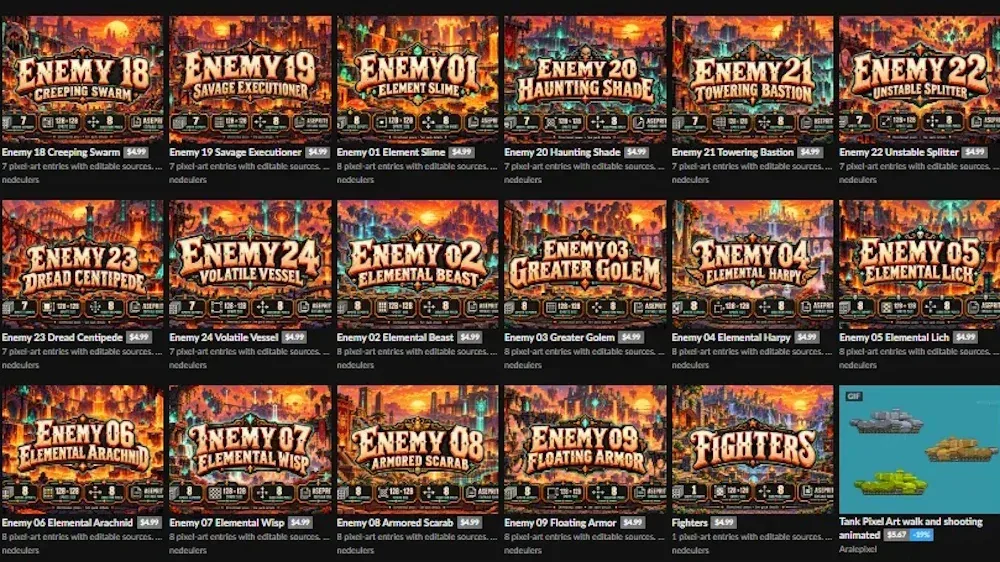
Itch.io is taking a more forceful stance on mass-uploaded generative-AI material, saying it has deleted “a couple terabytes of AI slop” from its marketplace while expanding the disclosure tools that let customers decide what they want to see.
The size of that deletion makes for a striking headline, but the more consequential change for people browsing the store may be the new search control. Itch.io has added generative-AI disclosure filtering to more parts of the site, including search results, where users can apply a No AI genre/tag filter when looking for games, assets, and other uploads.
That combination matters. Removing material that violates a platform’s existing rules deals with a backlog; a visible search filter gives users an ongoing way to narrow the catalogue themselves. In an era when digital stores can be filled quickly with near-duplicate listings, the distinction between moderation and discovery tools is important. One handles content that should not be there under the rules. The other gives people control over otherwise permitted material.
What Itch.io’s AI-spam rule actually covers
The removal appears to be tied to Itch.io’s quality guidelines, which have included an AI-spam clause for more than two years. The policy does not state that every use of an algorithm or generative tool is automatically banned. Instead, it says automatically generated or AI-generated work can sometimes be useful or interesting, while drawing a line at using those systems to mass-produce product pages.
Its examples of spam are especially revealing because they focus on scale, curation, and repetition rather than on a single technical label. The guidelines can cover:
- excessive quantities of automatically generated or AI-generated uploads;
- projects made predominantly by algorithms or AI with little human involvement;
- randomly generated content with no or minimal curated design; and
- multiple, substantially similar iterations made through AI or algorithmic generation.
In plain terms, a platform can distinguish between a creator using a tool within a designed project and an account treating the storefront like an unlimited-output bin. The latter model can produce enormous numbers of pages, files, models, or variations with little meaningful difference between them. Even when individual uploads are small, that volume can make it harder for players to find projects made with deliberate design choices.
Itch.io’s own description also took aim at poorly optimized AI-generated models. Optimization refers to preparing digital files so they use storage, memory, and processing resources efficiently. An oversized model or asset may be awkward for a customer to download and use; at platform scale, huge uploads can also consume substantial infrastructure capacity. The company’s point was not merely that generated content exists, but that bulk uploads of inefficient files do not become a good marketplace contribution simply because uploading them is technically possible.
Disclosure has expanded beyond games
Itch.io already required generative-AI tags for games and game assets. That disclosure requirement now reaches tabletop games, soundtracks, books, and comics as well. Creators must complete an AI disclosure when they create a new page or edit an existing one.
Related coverage includes Itch.io Removes Terabytes of AI Spam and Expands Its No-AI Search Filters.
This is a significant detail because Itch.io is broader than a conventional game store. A visitor might be seeking a downloadable role-playing-game supplement, a piece of music, a comic, development assets, or a small experimental game. A disclosure system that only applies to video games would leave gaps in the store’s wider catalogue. Extending it across these categories makes the information more consistent for people browsing different kinds of creative work.
A disclosure is not the same thing as a quality judgement. It is a label that communicates the reported use of generative AI. The practical value comes from making that label usable in browsing decisions. Someone comfortable with generative elements can continue looking through disclosed work. Someone who wants to avoid it can use the No AI option rather than manually opening a long succession of product pages.
That is why search placement is meaningful. Filters hidden on a detail page arrive too late: the shopper has already encountered the listing and spent time evaluating it. A search-results filter affects the catalogue at the point where users are sorting, comparing, and deciding what is worth their attention.
Why storefront clutter is a player problem
“AI slop” is an intentionally blunt phrase, but the underlying problem is familiar even outside debates over generative technology: a storefront is only as useful as its ability to surface relevant work. When low-effort, repetitive, or mass-produced listings multiply, search results can become less trustworthy. Users may have to sift through more pages to find a game, tool, or creator they were actually looking for.
This can be particularly difficult for small creators. A modest project does not have a giant advertising campaign to overpower cluttered search rankings. If discovery is diluted by scores of nearly identical listings, the cost is paid in attention. Players lose time filtering the catalogue; developers and artists lose a cleaner route to audiences interested in their work.
The policy’s emphasis on “minimal curated design” gets to the heart of that issue. Curation, in this context, means conscious human selection and arrangement: deciding what belongs, what does not, how a project is presented, and why its final form has value. A system can generate endless possible results, but abundance alone does not provide that judgement.
It is also worth separating the platform’s reported deletion from broader claims about every AI-assisted project. Itch.io has not framed its quality rule as a declaration that all generative-AI use is spam. Its approach instead pairs disclosure with a rule against excessive, algorithmically mass-produced, and minimally curated uploads. That leaves room for different customer preferences without treating the marketplace as a free-for-all for bulk publishing.
How the No AI filter changes browsing
The new option is described as a “Genre/Tag” selection in search. For users, the immediate practical takeaway is simple: start a search as normal, then look for the No AI filter if avoiding disclosed generative-AI material is part of the criteria.
It is a small interface decision with a clear effect. Before a dedicated exclusion filter, a customer could potentially use individual disclosure information only after reaching particular listings. With filtering built into search results, a preference can shape the list from the outset.
There are limits to what any disclosure-based control can guarantee. The filter works from the information attached to listings, and users should understand it as a way to exclude content identified through the site’s disclosure process—not as a magical technical test of every file on the internet. Still, consistent disclosure requirements and a clear filter provide a more actionable system than expecting customers to investigate every item unaided.
For creators, the expanded requirement adds an administrative step whenever they make or revise a page. But it also gives audiences a clearer signal about how a project is presented. Transparency can prevent some mismatch between customer expectation and product description, especially in categories where people care strongly about the origins of art, writing, audio, assets, or rules material.
A different answer to the marketplace AI debate
The dispute over AI on game storefronts is often flattened into a binary argument: embrace it all or prohibit it all. Itch.io’s documented approach is more specific. It calls for disclosure, targets spam-like mass production through existing quality guidelines, and gives users an exclusion tool in search.
That does not settle every question around authorship, rights, labour, or the quality of AI-assisted work. Nor does it identify every item removed in the reported multi-terabyte deletion. The exact contents of the deleted material have not been detailed. What is clear is that the platform has connected moderation to concrete user controls instead of leaving disclosure as passive text on a listing.
That focus on useful controls is particularly relevant while game storefronts wrestle with cloned and algorithmically produced listings. The challenge is not only whether a file can be uploaded; it is whether a catalogue remains navigable and whether customers can express a preference without turning every search into a research task.
PC gaming already asks users to navigate all manner of platform and hardware quirks, from storefront discovery to unexpected peripheral behaviour; one recent example involved a USB issue that looked like a motherboard problem. Storefront tools cannot remove every complication, but a clear content filter is at least a direct answer to one avoidable kind of friction.
For Itch.io users, the practical result is straightforward: the company says it has removed a substantial amount of content it considers AI spam, expanded AI disclosures to more product types, and introduced a way to search for work marked No AI. Whether that becomes a wider model for digital marketplaces will depend on enforcement, accurate disclosures, and whether the filter remains easy to find and use. For now, it gives customers a more explicit say in what their search results contain.