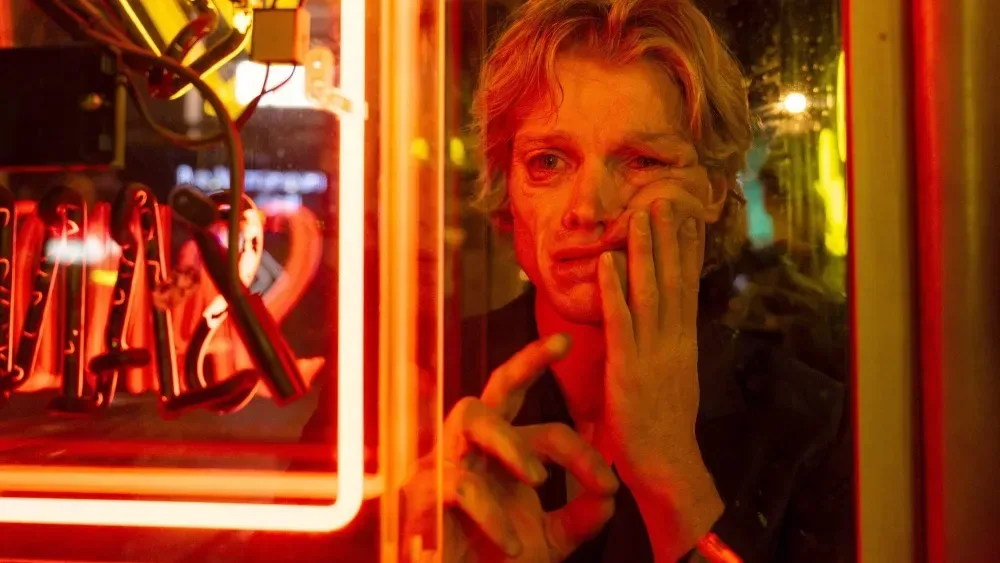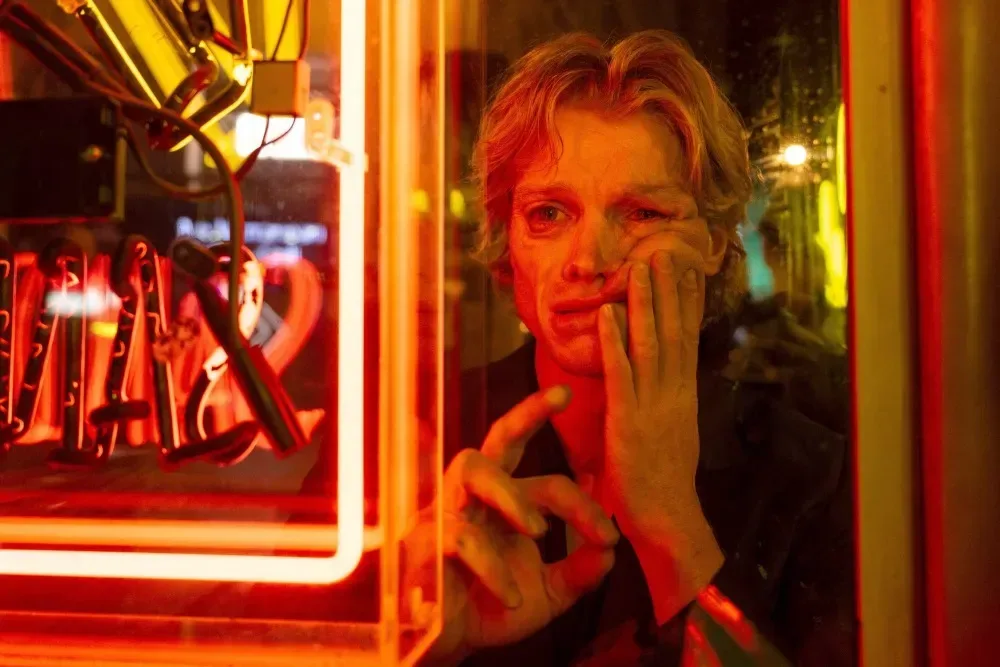
Clayface is not treating its comic-book premise as an excuse to stack familiar capes, logos and sequel bait into every available corner of the frame. Director James Watkins’ account of the film points toward a more focused ambition: turn one of Batman’s most mutable enemies into the center of an R-rated tragedy, then build a Gotham oppressive enough to make that tragedy feel inevitable.
That approach is notable because the movie occupies a potentially awkward intersection. Clayface is a long-running Batman villain, Gotham is among the most recognizable fictional cities in superhero storytelling, and the film is the live-action introduction for its version of the character within the rebooted DC Universe. Yet Watkins says he was drawn to the project as a standalone narrative rather than as a delivery system for overt Batman references or promises about a future matchup.
Tom Rhys Harries plays Matt Hagen, an A-list actor whose career and face are destroyed after a gangster brutally disfigures him. He seeks help from Dr. Caitlyn Corr, played by Naomi Ackie, whose experimental procedure restores him while changing him into something monstrous. His blood cells acquire the ability to reshape his body and make him resemble other people, including Corr, the gangster who injured him and his own father. The power becomes inseparable from a spiral in which Matt loses control of both his body and his sanity.
That is a body-horror premise rather than a conventional power fantasy. Body horror is horror rooted in unsettling changes to the human form: the fear is not simply that a monster is nearby, but that a person’s own flesh, identity or physical boundaries have become unstable. In Clayface, shapeshifting is therefore not presented as a clean superhero ability. It is tied to injury, grief, revenge and a man becoming increasingly unable to recognize himself.
Why Matt Hagen became the foundation
The Clayface name has been used by multiple characters in the comics, including Basil Karlo and Matt Hagen. Watkins says the script’s choice of Hagen gave the film a more relatable route into a contemporary setting. He later explored the other versions and notes that the movie draws selected elements from across the character’s history, but the emotional journey remained Hagen’s.
That distinction matters for the adaptation’s tone. Watkins felt a Basil Karlo-centered version risked pushing the material toward a more overtly gothic mode, while Matt Hagen could exist more naturally in a modern idiom. The film’s Gotham is not simply modern, however. It is intentionally difficult to place in one exact era.
Watkins describes the city as slightly timeless and deliberately “muddy” in its period signals. Production designer James Price and Watkins aimed to make its environment function like a character: imposing, cramped and heavy. Their visual touchstones included 1930s German expressionist cinema, particularly its dominating structures, stark angles and noir-like shadows, alongside street photography of New York in the 1970s, 1980s and 1990s.
German expressionism refers here to a filmmaking style known for visually exaggerated architecture, distorted perspectives and dramatic shadow. It can make the external environment feel like an extension of a character’s mental state. That is a fitting grammar for a story about a performer whose face, career and sense of self are being forcibly remade. Gotham’s looming buildings do more than establish a recognizable DC location; they reinforce the feeling that Matt is dwarfed by forces he cannot master.
Related coverage includes Clayface Builds DC Universe Gotham Through Body Horror and Practical Effects.
The city’s neon, practical street lighting, dirt and eccentricity are meant to contrast with Coast City. Where Coast City offers bright sunlight, visible sky, sea and greens, Gotham is designed to reveal very little sky at all. It is a visual opposition with a clear storytelling purpose: one place has openness and color, while the other presses down on its inhabitants.
A monster designed around pain, not only clay
Clayface has been interpreted in many forms on the page and in animation, creating an unavoidable challenge for live action. A design needs to recall the character’s history without becoming an inert translation of a drawing. Watkins says the team considered around 19 iterations before arriving at the final monster appearance.
The stated priority was the person within the creature. Watkins focused especially on Clayface’s left eye, looking for pain and heartbreak inside it, as well as on the quality of the character’s scream and voice. This is an important creative choice for a story that ends with Matt having killed those who wronged him, along with several innocent people, and living alone in the sewers as a mud monster. The endpoint is horrific, but the intended effect is tragic rather than merely monstrous.
Small changes mattered. Watkins describes tiny adjustments to folds of flesh as capable of radically altering whether the design felt persuasive. That is the peculiar craft problem of a creature like Clayface: a face that can melt and shift still has to communicate recognizably human emotion. The design has to suggest instability without becoming so abstract that the viewer loses Matt altogether.
Practical effects give the transformation weight
Watkins’ overall rule was simple: if a moment could be achieved practically, he wanted to attempt it practically. That does not mean the movie rejects visual effects. Instead, it describes a hybrid method in which practical makeup, rigs, camera techniques and physical performers establish a tangible base, with visual-effects work used to augment what cannot literally be done.
Practical effects are physical elements captured during filming, such as prosthetic makeup, mechanical rigs, props and stunt work. VFX, or visual effects, refers to digital work added or altered after photography. The distinction is not a contest with one universal winner. For a film built around deforming flesh, though, the presence of a physical surface, a real cavity in a costume or an actor working against an actual appliance can give the camera texture and performers something immediate to react to.
The nightclub sequence demonstrates that philosophy beyond makeup. Watkins used in-camera wipes to make Matt’s transformations seem to happen within a shot. A pillar, for example, could obscure an actor briefly; the scene could then be replayed with a different performer emerging from the same obstruction. The device turns ordinary blocking and editing logic into a shapeshifting scare.
There is also a contortionist in the sequence after a stunt fall down the stairs, helping sell bodies bent in unnerving ways. Using a contortionist is not simply an old-school flourish. It preserves the unsettling specificity of an actual human body moving beyond everyday limits, which suits a character whose transformations should feel wrong even before they look impossible.
The murder of Corey, played by Josh James, involved a physical rig on Harries with a large chest cavity, allowing the actor to be pulled into Clayface’s body. Watkins describes the effect as practical with augmentation. The airplane sequence likewise relied heavily on physical components: Harries wore contact lenses and prosthetic makeup, while the bathroom set sat on a gimbal so it could move and simulate jolts in real time.
A gimbal in this context is a rig that lets a set move in controlled directions. Instead of asking performers to imagine the turbulence and then adding all motion later, the physical bathroom could lurch while the scene was shot. Multiple scissors were prepared for different needs, including sharp, blunt, rubber and green-screen-tipped versions. For close-ups, the production also used an oversized eyeball and giant scissors.
Those details underline how much safety and illusion planning can sit behind a brief, stomach-turning image. Harries found a controlled way to position the scissors just above his eye so the camera angle could imply a far more dangerous action. The goal was not to place an actor at risk; it was to choreograph the apparent risk precisely enough that an audience reads the intended horror.
The team created an extensive progression of facial stages for Harries, with roughly 65 stages at one point when bandages and other transition elements were included. Some were built for subtle differences in melting and drooping; some could be moved via a pulley. Digital enhancements could push those physical elements further, but the makeup gave the transformations an underlying heft.
Aaron Paul’s brief role has a thematic use
Aaron Paul appears in a quick cameo as Matt’s father during one of Matt’s transformations. Watkins had wanted Paul for the part and says the actor, who was living in Paris, agreed to participate in the small role. It functions as more than a celebrity pop-in: Matt can wear his father’s face, but he is not his father. The moment adds another layer to a film concerned with the gulf between appearance and identity.
That restraint also seems to define the film’s relationship with its larger superhero setting. The graphics department included posters and other background details that may serve as Easter eggs, but Watkins did not want to force references that the narrative had not earned. He says there was no pressure to include them.
For viewers, that means Clayface may be best understood as a DC story with a deliberately narrow lens. It gives the rebooted universe its first live-action Gotham after Superman established Metropolis, and this version of Clayface had technically appeared earlier in the animated Creature Commandos. But its central business is Matt Hagen’s collapse, not a scavenger hunt for franchise signals. Fans following comic-book culture more broadly can also see how superhero properties continue to move across formats in a Marvel-focused comic-shop sales roundup.
What the ending does—and does not—promise
By the end, Matt has taken revenge against the mobsters who ruined his life, but his violence has extended to innocent people as well. He is left alive but isolated, a reclusive monster in the sewers. It is an ending that can place a recognizable villain on the board while still closing the emotional arc that the film set out to tell.
Watkins does not offer a plan for Clayface’s next appearance or suggest that the movie is specifically preparing a confrontation with Robert Pattinson’s Batman or another hero. He places those questions with James Gunn, while emphasizing that his own objective was for the movie to feel complete by itself.
That is an unusually useful boundary in an interconnected-universe conversation. A character’s survival is not the same thing as a confirmed sequel, crossover or opponent. Clayface creates a live-action origin and a distinctive Gotham, but its stated creative aim is a full tragedy about one man—not an unfinished prologue waiting for Batman to arrive.