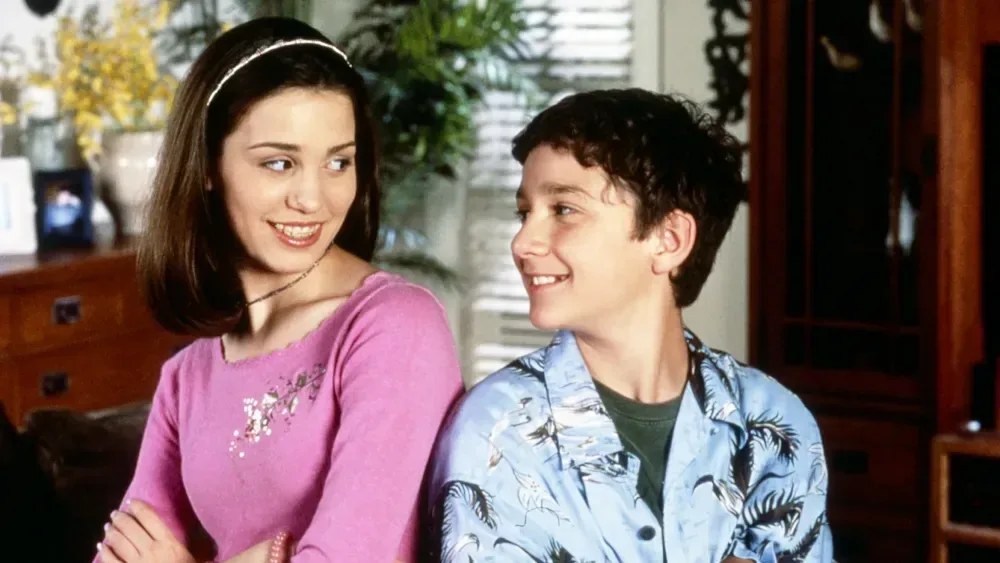
Christy Carlson Romano has revisited the difficult working relationship she shared with Shia LaBeouf while they played siblings on Even Stevens, describing two young performers whose lives and expectations were moving in very different directions.
In a recent podcast appearance, Romano said she and LaBeouf were “like oil and water” during the Disney Channel comedy’s run. Romano was 14 and LaBeouf was 12 when the pair worked together. Their characters, Ren and Louis Stevens, were built around an intentionally combative sibling dynamic, but Romano’s comments concern the performers’ off-camera incompatibility rather than a revelation that their on-screen disagreements were fabricated.
Her explanation centered on upbringing. Romano described being raised with a highly structured, performance-focused outlook: preparation, punctuality, knowing lines and hitting marks. She said her family viewed the many components of her training as “cross-training,” and she was pursuing pre-college studies at Juilliard.
LaBeouf’s childhood, as Romano described it, was far less stable. LaBeouf has previously spoken publicly about a tumultuous upbringing and about his father being a recovering addict who could be abusive. Romano characterized the contrast between their backgrounds as a major reason the two did not connect.
Two child actors, very different pressures
It is important to separate what Romano is doing here from a simple behind-the-scenes feud story. Her account does not reduce the tension to personality labels. Instead, she presents it as a collision between children carrying different burdens into the same workplace.
Romano’s description of herself maps closely onto Ren Stevens, the achievement-oriented older sister she played. On the show, Ren’s desire for control and recognition repeatedly ran into the schemes and unruliness of Louis, played by LaBeouf. That basic contrast was the engine of the siblings’ comic conflict. But Romano’s new comments make clear that the resemblance between the actors and the roles had limits—and that real-life strain is not the same thing as a scripted sitcom premise.
The distinction matters. A child performer can be expected to meet adult professional standards while still being a child dealing with family circumstances, school, public attention and an unfamiliar work environment. Romano’s reflection suggests that the pressure to function professionally did not erase either actor’s vulnerabilities. In her view, it left little room for them to understand or support one another.
She also gave LaBeouf credit for pursuing his career with determination, noting that he secured a manager at age eight and made a path for himself. That acknowledgement adds nuance to a conversation that could otherwise be read purely as condemnation. Romano is not presenting him simply as the disruptive opposite of her disciplined image; she is describing a gifted, ambitious young person navigating instability.
What “hit your marks” means on a TV set
Romano used a piece of production shorthand when she described her approach: “hit your marks.” In film and television, a mark is a planned physical position an actor reaches during a scene. Landing in the intended spot helps the camera, focus, lighting and blocking work as designed.
Blocking is the planned movement and placement of performers in a scene. It can be as simple as crossing to a doorway at a specific line or sitting down before another actor enters. For a multi-camera sitcom, where scenes may be staged with several cameras covering action from different angles, consistency can be especially useful. An actor knowing dialogue, timing movement and repeating the action reliably is part of the practical discipline Romano says she was taught.
That vocabulary helps explain why her self-description is more specific than “Type A.” She was identifying with a work style rooted in rehearsal, precision and predictability. Her point is that such habits were not just personal preferences; they were part of how she had been trained and parented.
At the same time, the supplied details do not establish every day-to-day cause of friction on the set, nor do they provide LaBeouf’s response to Romano’s recent comments. Romano is recounting her own experience and interpreting their differences many years later. Readers should treat it as her perspective on a shared period of work, rather than a complete record of every interaction between the two actors.
The context of ‘Even Stevens’
Even Stevens aired from 2000 through 2003. The series followed the Stevens family, with Ren and Louis as the younger siblings whose opposing temperaments regularly put them at odds. Romano’s Ren was presented as conscientious and ambitious; LaBeouf’s Louis was the disruptive, impulsive counterweight. Their clashes were central to the show’s family-comedy format.
That enduring character contrast may explain why Romano’s remarks draw attention long after the show ended. The series is remembered through the interaction between Ren and Louis, and its stars became associated with those sharply drawn roles. But Romano’s recollection is a reminder that nostalgia for a program can flatten the reality of the people who made it—particularly when they were minors.
Disney Channel nostalgia also continues to spill into other entertainment conversations, including discussions of how Disney-style cultural landmarks are echoed or avoided in games. For example, recent discussion around GTA 6’s apparent Disney World parody choices shows how broadly those associations remain embedded in pop culture. Romano’s comments, however, are personal rather than a commentary on the Disney brand or the show’s legacy as a corporate property.
A prior social-media dispute adds context
Romano had already signaled that her feelings about LaBeouf’s place in Disney Channel history were complicated. Earlier in the year, after Raven-Symoné named LaBeouf as one of her choices for a hypothetical Disney “Mount Rushmore,” Romano posted and later deleted a message saying he did not deserve a place there. She said she would explain her reasoning in a Substack post.
The “Mount Rushmore” framing is, of course, a shorthand for a tiny group of defining figures, not a literal ranking system. It asks people to choose who represents an era or institution most strongly. Romano’s response indicates that she sees that kind of celebratory retrospective as incomplete without considering the experience behind the public image.
Her latest comments give some shape to that reaction, though they do not turn it into a point-by-point case about LaBeouf’s career. Romano instead returned to the emotional reality of being children working in close proximity while both faced personal difficulties. The emphasis is not on an argument over who was more famous, more talented or more essential to Disney Channel’s history. It is on what she believes neither of them had the capacity to offer the other at the time.
A photo and a more reflective message
On the same day as the podcast discussion, Romano posted an old set photo showing herself with LaBeouf and his father. Her caption was notably more reflective than the earlier social-media post. Romano wrote that she and LaBeouf spent three years in adjoining trailers while both were enduring painful childhoods, and expressed regret that they could not be there for one another.
That does not erase the “oil and water” assessment. Instead, it reframes it. Romano’s account holds two ideas together: the relationship was hard, and both children were struggling in ways that made connection difficult. It is a more compassionate formulation than simply treating the pair as incompatible co-stars.
It also avoids romanticizing adversity. The notion that hardship automatically creates mutual understanding is common in retrospective stories, but Romano’s message points in the opposite direction. People under intense stress may lack the emotional resources to recognize someone else’s pain, even when they are physically close and experiencing parallel pressures. In this case, the adjoining trailers became a symbol of proximity without support.
Romano says more is coming in her memoir
Romano said she plans to share more in her forthcoming memoir, Once Upon a Trainwreck: The Fall and Rise of a Child Star, which is set to be available October 6. The book’s title signals that her account will address the wider arc of her experience as a young performer, though no additional claims about its contents can be drawn from the information currently available.
For now, her public comments offer a limited but meaningful window into how she understands the Even Stevens years. They are not a production exposé, a legal allegation or a claim that one difficult relationship explains everything that happened to either actor afterward. They are a retrospective from someone who was a teenager at the center of a popular series and now sees the period through the context of childhood trauma, professional pressure and distance between two people who spent years working side by side.
That context may be the most consequential part of Romano’s reflection. Ren and Louis Stevens were written to clash. Romano and LaBeouf, in her telling, were children attempting to get through very different realities while performing that conflict for television.