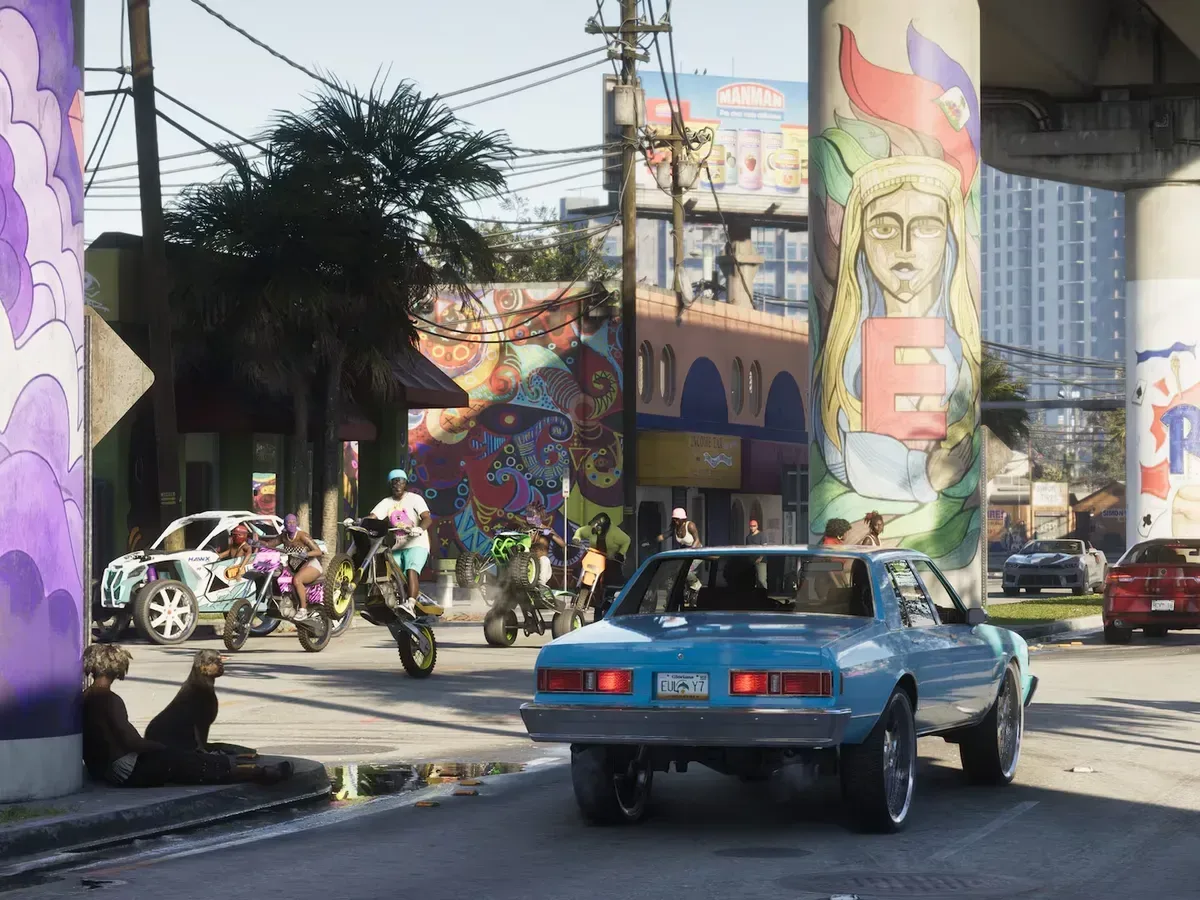
Grand Theft Auto VI appears unlikely to offer players a full-scale spoof of Disney World or a one-to-one fictional Orlando to tear through when it arrives on November 19 for PS5 and Xbox. That is the clearest reading of a new comment from Rockstar Games senior vice president of environment art Paul MacPherson, though it is not quite the same as saying central Florida has been cut from the map.
The distinction matters. GTA worlds have long been built around reinterpretation rather than strict replication: recognizable regional character, compressed geography, fictional names, and satirical businesses can all coexist without an exact counterpart for every major real-world attraction. MacPherson’s remarks indicate that Rockstar is making those choices deliberately, prioritizing the needs of the game over a sightseeing checklist.
What Rockstar actually appears to be ruling out
MacPherson was asked about whether prominent central Florida destinations such as Orlando and Disney World would appear, alongside eastern Florida sites including NASA’s Space Center and the Space Force base at Cape Canaveral. None of those locations has been plainly identified in the game’s official trailers, screenshots, gameplay material, or reported leaked material.
“We have to constantly evaluate the diversity of landscapes, towns, structures, landmarks, vistas, plant species, rock formations, and everything else before we work with design and narrative to distill a list down that best works with and serves the game’s needs,” MacPherson said. “So, while we may not have those exact locations, everything we have is geared to getting that full Florida experience!”
The pivotal phrase is “those exact locations.” It strongly lowers expectations for a destination designed as an obvious Disney World-sized analogue, or for a virtual Orlando recreated as a discrete city players can visit. It also makes a named, unmistakable stand-in for Cape Canaveral’s real-world space facilities seem less likely.
That is not a map confirmation in the broader sense. Rockstar has not, in this comment, published a full location list or said there will be no amusement park, no launch-related facility, no central-Florida town, or no Disney-flavored satire whatsoever. It is instead a useful boundary on speculation: a specific real-world landmark may be absent even if the mood, architecture, industries, or visual language associated with that part of Florida informs the world.
“Full Florida experience” is a design goal, not a promise of every landmark
MacPherson’s explanation describes an environment-art selection process. In plain terms, an open-world map cannot simply absorb every notable place in a state. Developers have to decide which landscapes, buildings, plant life, roads, towns, views, and geographic contrasts create a setting that is both recognizable and useful for missions and exploration.
That last part is especially important. A landmark can be culturally famous yet still be a poor fit for the game’s design or narrative. Conversely, a less globally famous location can be more valuable if it gives the map a fresh visual identity, supports activities, or creates an interesting route between larger population centers. MacPherson specifically frames environment work as something coordinated with design and narrative, rather than as a separate exercise in copying a region.
Related coverage includes GTA 6's Florida Map May Skip a Full Disney World-Style Destination.
For players, “full Florida experience” should therefore be understood as an atmosphere-and-variety promise, not an exhaustive tourism promise. The reported criteria include landscape diversity, towns, structures, landmarks, vistas, plant species, and rock formations. That is a broad recipe for evoking a place. It does not require every famous place to receive a fictional facade and a giant parking lot.
There is also a practical benefit to that approach. A game world that selects and recombines regional features can create better pacing than one that chases literal distances and exact municipal borders. Players may move from dense urban space to wetlands, roadside attractions, small towns, or distinctive recreational areas in ways that feel true to a region while still serving the game’s missions. That is analysis based on Rockstar’s stated priorities, rather than confirmation of any particular map layout.
An alligator attraction suggests central Florida influence remains
Official marketing has already pointed toward a large alligator-themed park in GTA VI. The attraction appears inspired by Gatorland, the long-running gator-focused amusement park and zoo south of Orlando. Its presence is meaningful because it suggests Rockstar is not treating central Florida as a blank space simply because an exact Disney World or Orlando equivalent may not be present.
Instead, the game may be drawing from selected pieces of the area. An alligator park is the type of regional attraction that can communicate Florida immediately: wildlife, tourism, spectacle, roadside strangeness, and plenty of room for Rockstar’s exaggerated fictional treatment. It can also do so without forcing the game to reproduce a massive theme-park complex or a particular city.
That makes the park a more concrete clue than broad fan assumptions about what “Florida-inspired” must contain. The confirmed implication is modest but valuable: central Florida’s identity can show up through curated attractions and regional details. The unconfirmed leap would be treating that one attraction as evidence for a complete Orlando region, a Disney-scale park, or neighboring space facilities.
Disney-style satire may still surface in another form
The absence of an exact theme-park destination would not necessarily mean the absence of Disney parody. A Minnie Mouse-like character seen in the gameplay reveal appears connected to Fred’s Pictures, an in-universe Disney-like company referenced previously in Grand Theft Auto V. That detail leaves open the possibility that Disney-adjacent corporate or character satire exists within GTA VI’s world without being attached to a vast, explorable resort.
This is worth separating into two questions that can easily get conflated. First: will the game include a gigantic theme-park area that clearly functions as a Disney World spoof? MacPherson’s comments make that look doubtful. Second: will the game make jokes about Disney-like branding, characters, entertainment companies, or Florida tourism? The Fred’s Pictures connection gives that possibility some support, but it does not establish the scale of the reference or what role it will play.
Rockstar’s fictional-brand approach also gives it flexibility. A reference can be a visual gag, a background business, an advertisement, a costume character, or something with a larger story function. Players should avoid assuming that one Minnie-like figure automatically confirms a park, a mission chain, or a specific location.
Why fans were looking toward Orlando and Cape Canaveral
The interest is easy to understand. Central Florida’s major tourist attractions and the east coast’s space infrastructure are among the state’s most recognizable images. In an open-world game promising a large Florida-inspired setting, they are obvious candidates for fictionalized versions—and obvious targets for the series’ brand of satire.
But recognizability alone does not determine inclusion. MacPherson’s comment directly explains that landmarks compete with other terrain, settlement, visual, and storytelling needs. A developer may choose elements that convey the same regional flavor more efficiently, or may focus on locations that offer stronger gameplay opportunities without mapping every famous destination.
The available information also gives no basis for declaring the map’s full eastern reach. The answer says the exact space-related locations may not be included, not that the game has no east-coast-inspired content of any kind. Likewise, it does not define which portions of central Florida are represented, or how closely any fictional areas will correspond to real geography.
What this means before launch
The sensible expectation is a Florida-inspired game world built from selected, remixed ingredients, not a promise that every famous Florida destination receives a Grand Theft Auto counterpart. The alligator-themed park is the strongest currently described sign that influences beyond the most obvious coastal-city imagery are making their way into the game. Disney-like satire remains plausible through Fred’s Pictures, but a full resort-scale parody appears far less certain.
That is a more useful lens for every remaining map theory. Officially shown or named elements deserve attention; interpretive clues can suggest themes; and missing landmarks should not be silently upgraded into confirmed destinations. The same caution applies across game news generally, where clear official details carry more weight than enthusiastic pattern-matching—whether the subject is GTA VI’s setting or a defined update such as 007 First Light’s announced free DLC.
For GTA VI specifically, Rockstar’s message is not that Florida’s interior and east coast do not matter. It is that the studio is choosing what best serves its own world. On November 19, players will be able to see which Florida details survived that selection process—and whether a gator-filled attraction proves more memorable than the giant theme park many were expecting.