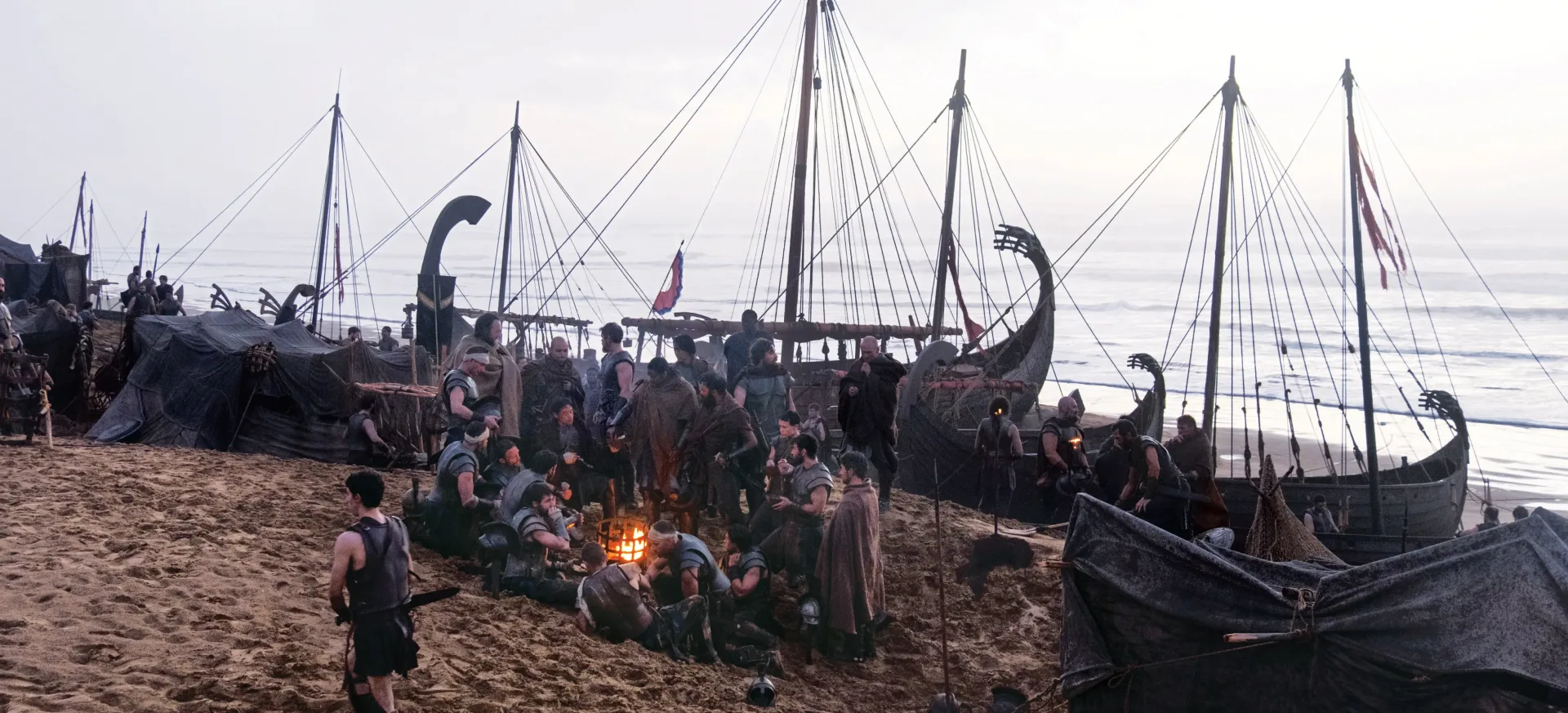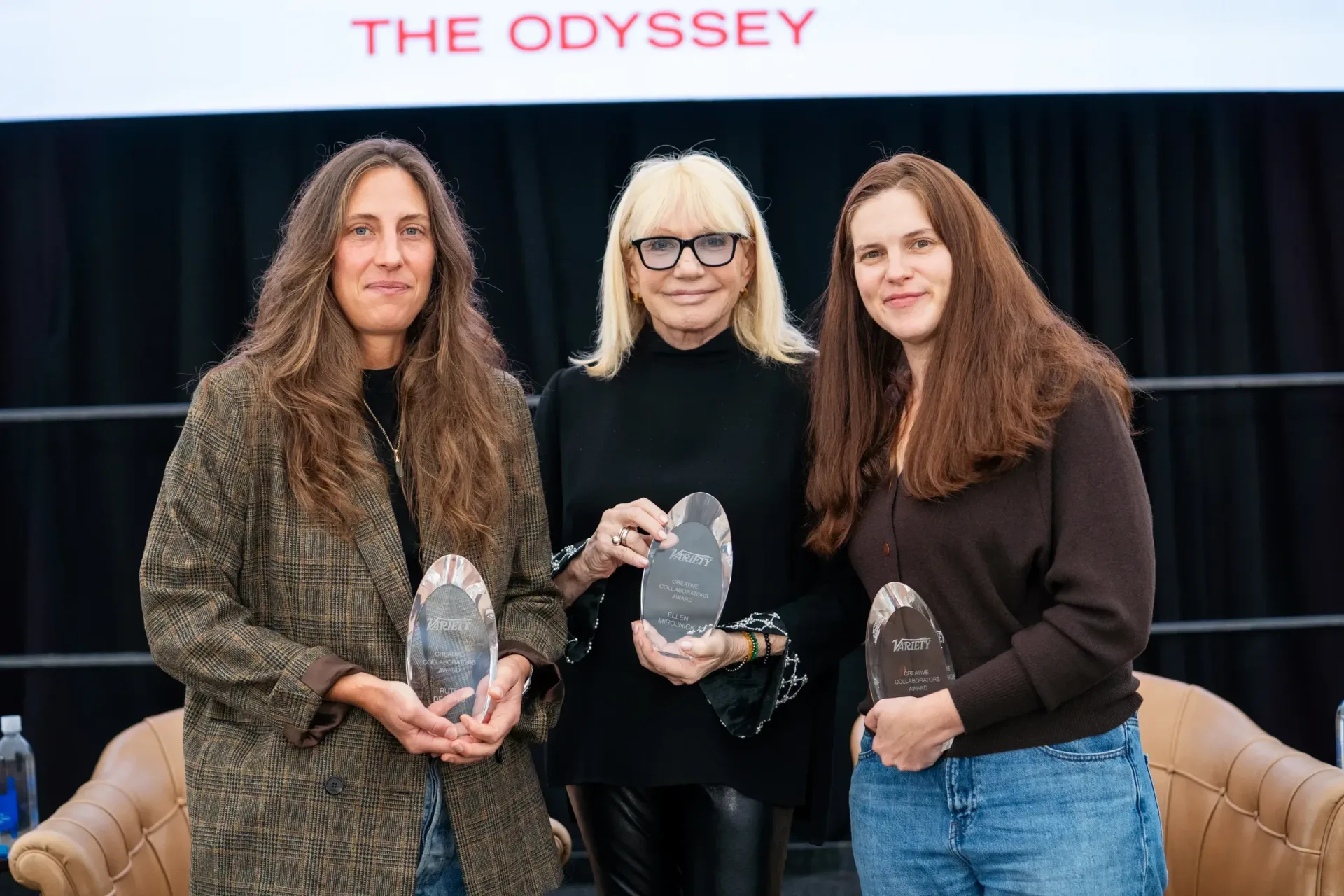
Christopher Nolan’s The Odyssey is taking Homer’s journey into unusually physical territory. Production designer Ruth De Jong, costume designer Ellen Mirojnick and editor Jennifer Lame have outlined a sprawling approach centered on real locations, built environments, large-scale props and extensive practical work—not simply as a stylistic flourish, but as the connective tissue between performance, camera work and post-production.
The scale is striking. De Jong’s work stretched across Morocco, Greece, Italy, Iceland, Scotland and the United States. Mirojnick’s department made more than 5,300 costumes. Lame cut 2.1 million feet of 70mm IMAX film. And the production’s Trojan Horse was built in versions roughly 35 feet tall, large enough for actors, Nolan, cinematographer Hoyte van Hoytema and an IMAX camera to occupy its interior.
Those figures are impressive on their own, but the more interesting part is what they say about the film’s method. The goal was not a generic ancient-world spectacle. Mirojnick said Nolan was adamant that the movie not resemble a familiar “sword-and-sandal” picture. The departments instead had to solve a linked series of practical problems: how to give a mythic story tactile weight, how to create a Trojan city on a huge scale, how to make a Cyclops emotionally legible, and how to make costumes survive the punishing elements built into the shoot.
A production built around physical decisions
De Jong had previously worked with Nolan on Oppenheimer. For The Odyssey, she read the screenplay in person and was told there were effectively no creative limits placed on the production design. That freedom was paired with a demanding expectation: find a way to achieve the ideas practically.
Practical effects is a broad filmmaking term, but here it has a very literal meaning. It includes constructing full-scale sets and props, shooting at usable locations, and placing performers in environments that exist during filming. It does not mean visual effects disappear. Rather, digital work can extend, refine or alter footage that starts with real actors, objects and spaces.
That hybrid was especially important to the Cyclops sequence. The story follows the familiar Polyphemus episode: Odysseus and his men enter a cave with sheep and cheese, discover they have intruded into the home of Polyphemus, and attempt an escape after Odysseus identifies himself as “Nobody.” After blinding the Cyclops, Odysseus reveals his real name while fleeing, giving Polyphemus the information he needs to ask Poseidon to punish him.
The sequence has an inherent production challenge. A giant monster can become an abstract effects problem, yet the episode depends on a personal mistake by Odysseus and a direct emotional response from Polyphemus. Nolan’s team wanted the Cyclops to be physically present in the cave. Bill Irwin played the character during the shoot, while visual effects supervisor Andrew Jackson’s team supplied temporary eye work so collaborators could see how the single eye would read during the process.
The temporary work, often called temp VFX, is not necessarily the final image. It is a working version used to communicate timing, eyelines, framing and intended emotion before the final visual-effects shots are completed. In this case, it gave the editorial and performance teams something concrete to assess while assembling the scene. Lame emphasized that the eye was central to the character’s emotional expression, making that early reference especially useful.
The finished sequence is relatively brief, but it began as something much longer. Lame described having a wealth of material and making choices between footage involving Irwin and a puppet. That is a useful reminder that a “practical” scene is not automatically simple or fixed. It can generate more usable material, more approaches to performance and more editorial options. The hard work moves into deciding what version of a moment best serves the final story.
The cave was a location problem before it was an effects problem
For De Jong, the Cyclops scene began with a search for the right cave rather than a rush to build one. The team examined numerous locations, including sites in Greece. Constructing a cave was considered, but it was costly, and the preference remained to find a location that could accomplish the scene physically.
Eventually, they found a site where boats could be placed at the base of the mountain. That detail matters because geography is part of storytelling. If viewers can understand the relationship between cave, shore, boat and escape route in a single physical space, the scene does not need to manufacture every connection later. The setting supplies its own spatial logic.
Analysis: this is arguably the strongest case for location-based design in a story like The Odyssey. Homeric myth includes gods, monsters and impossible journeys, but its drama still depends on movement through dangerous places. A cave that feels like it has a real entrance, slope and route to the sea can make the audience intuit the stakes before any supernatural enhancement is added.
That does not turn location work into a rejection of technology. The Cyclops combines an actor, a puppet, temporary eye imagery, final visual-effects work and editorial refinement. It is a collaboration across disciplines rather than an either/or contest between practical filmmaking and computer-generated imagery.
Troy at 2.5 acres
The fall of Troy called for a different form of physical scale. De Jong’s Troy set covered 2.5 acres, or more than 110,000 square feet. After an initial search in Turkey failed to produce a suitable environment, the production landed at Aït Benhaddou in Morocco. De Jong saw an opportunity to build from the ground up across the surrounding acreage while using the existing town as a real-world extension of the built set.
That phrase—“set extension”—is commonly associated with digital imagery, where artists enlarge a built environment beyond what was physically constructed. In this case, the location itself performed much of that visual function. The existing landscape and town offered depth and scale around new construction, reducing the sense that the city stopped at the edge of a soundstage wall.
The achievement was also logistical, not merely visual. De Jong said sets were being built simultaneously across the six countries involved in the production. That means the production-design department had to maintain a common visual language across environments as different as Troy, Circe’s remote home and Odysseus’ boat, even while local terrain and weather conditions changed dramatically.
The attack on Troy also included a major Athena statue moment that had been written into the screenplay. Lame indicated that the footage arrived early in the process and that the intended cut was important to the story’s relationship between Athena, Odysseus and the revelation at stake. It is an example of a sequence where design, photography and editing were aligned from the script onward, rather than being discovered only after filming.
Directorial tone can make that kind of alignment matter as much as spectacle. A recent look at another game-adjacent adaptation noted how deliberately embracing a movie’s chosen flavor can shape the whole project; the discussion around Street Fighter’s intentionally gonzo tone is a useful contrast. Nolan’s stated target for The Odyssey, as described by his collaborators, is not familiarity or pastiche. The physical design choices are part of distinguishing its tone.
5,300 costumes and the usefulness of linen
Mirojnick’s team created more than 5,300 costumes, beginning with armor for the armies. The challenge was not just volume. The departments had to establish distinctions among Trojans, Spartans and individual characters while ensuring that clothing could function during a demanding location shoot.
For Odysseus, research pointed the team toward linen as one of the fabrics available in the period represented. Linen became valuable both aesthetically and practically because it could be aged and distressed. Distressing is the costume process of intentionally altering material so it carries believable signs of use, exposure and wear. Rather than giving every performer a clean, newly made garment, costumers can use fading, abrasion, dirt, salt effects and other treatments to tell a character’s story visually.
The environments themselves influenced those garments. Mirojnick specifically referenced sand, salt, wind, rain and black sand. In a long sea voyage, clothing cannot stay pristine without creating an obvious disconnect between character and setting. The material’s response to weather becomes part of the costume design, particularly for a hero whose journey is defined by endurance.
There is a practical implication beyond screen realism: costumes must remain legible on camera while accommodating action, armor and repeated filming. With large groups representing opposing armies, consistency and variation must coexist. A crowd has to read as a unified force, but it cannot look like a row of identical outfits freshly pulled from storage.
A Trojan Horse designed like a ship
The Trojan Horse was one of the earliest concepts Nolan wanted the team to crack, alongside the Cyclops. De Jong rejected a simplistic hammered-wood look and instead developed the idea that the horse would be made from ship components and shiplap. The concept treats the object as the work of highly capable craftspeople, not a crude symbol assembled without structural thought.
Shiplap refers to overlapping boards designed to fit together. Used here as a design concept, it gave the Horse a relationship to marine construction and helped imagine a credible material logic for a huge wooden structure. The head and legs could be carved, while the body had to contain people and substantial camera equipment.
Prototypes and models were made in Los Angeles with construction coordinator Jonas Kirk. Since multiple horses were needed, Kirk proposed creating a mold. The need for duplicate builds reflects the demands of filmmaking: a prop used for exterior movement, interior photography and other specific staging may require more than one physical version, even if the audience experiences it as a single object.
Perhaps the most evocative detail is how one Horse shot was achieved. When it was dragged along a Troy beach toward the temple, stunt coordinator George Cottle’s team assembled 300 men, tied ropes and had the performers physically pull it. No machinery moved the Horse in that moment.
Analysis: the value of that decision is not merely that it sounds impressive. A real pull creates a shared physical task for the people on screen: rope tension, body position, uneven pace and the visible effort of moving a massive object. Those details can be designed or augmented in other ways, but the production’s approach placed the actors inside the action’s basic mechanics.
Across the cave, Troy and the Trojan Horse, the throughline is clear. The Odyssey was approached as a film where artisans could build the circumstances performers respond to, then use visual effects and editing to shape that material rather than replace its foundation. Whether that approach produces a definitive screen version of Homer’s epic remains a question for the completed film. What is already evident is the scale and specificity of the craft challenge: translating a myth packed with giant beings, hostile gods and legendary objects into spaces, fabrics and structures people could actually inhabit.